- Title
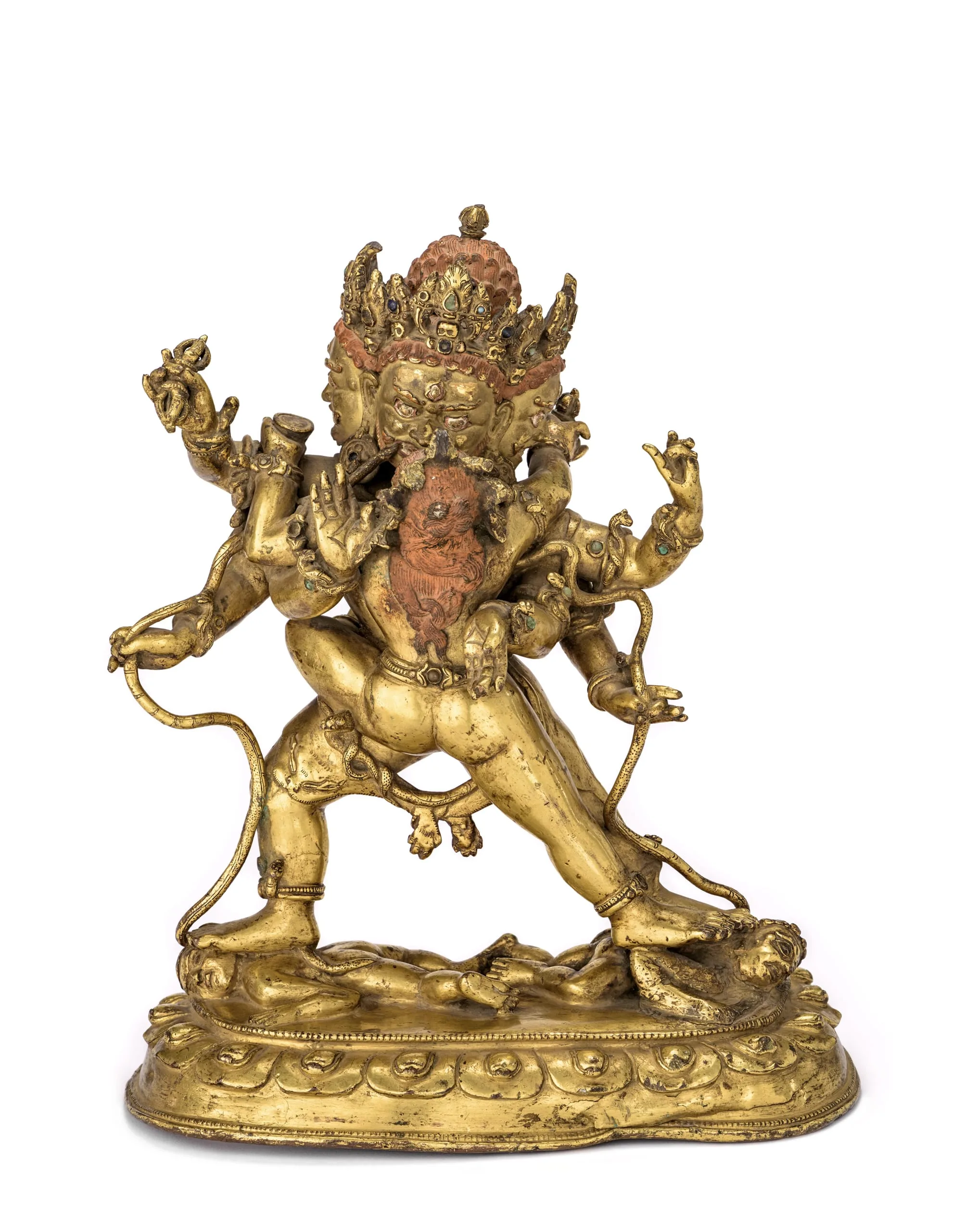
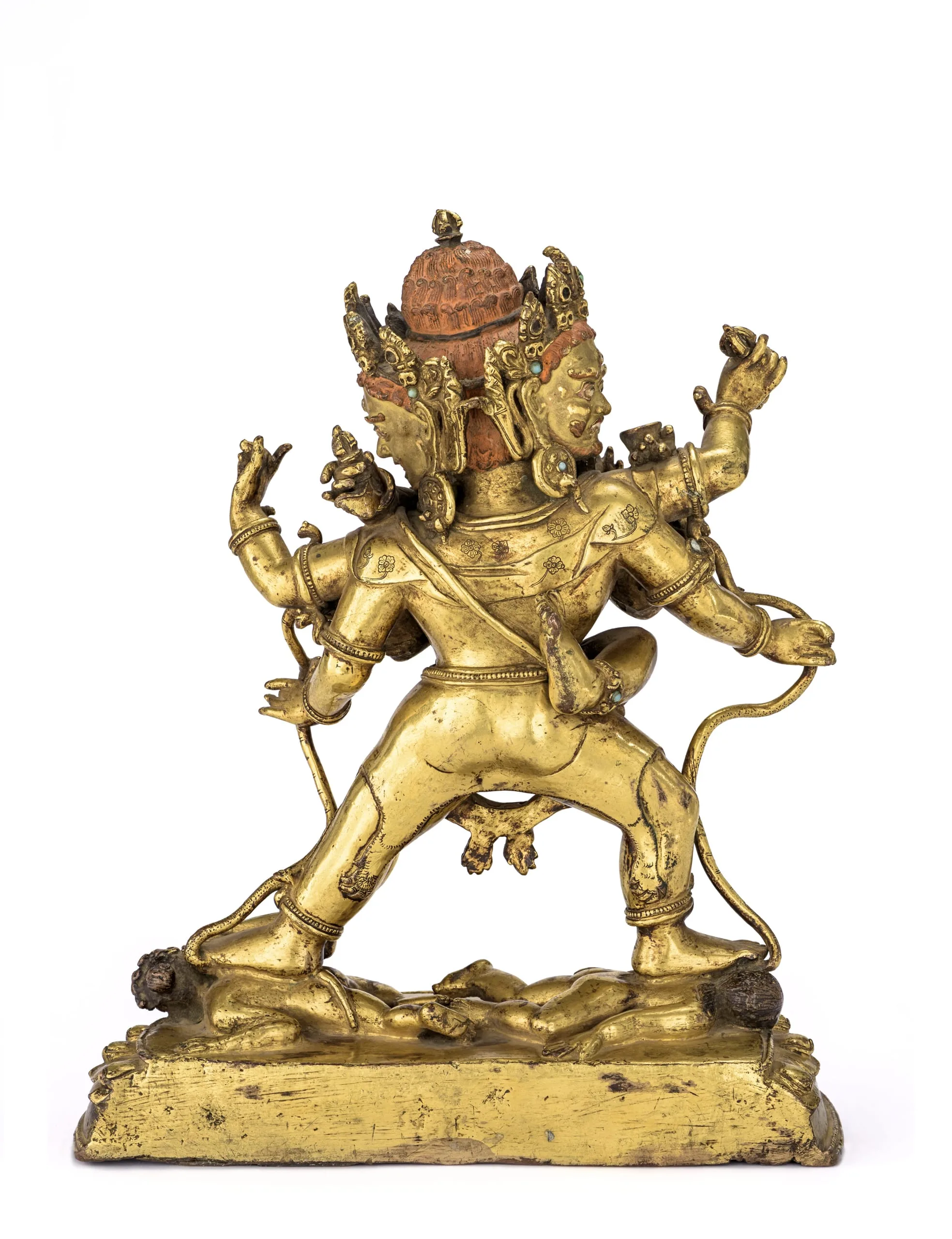
- Mahachakra Vajrapani and His Consort Mamaki
- Date Made
- 15th century
- Medium
- Gilt unalloyed copper inlaid with turquoise and other gemstones; cold gold paste and paint
- Dimensions
- Height: 11 in. (27.94 cm)
- Accession Number
- M.82.42.6
- Curatorial Notes
Mahachakra Vajrapani (The Great Wheel Vajra Holder) is a Tantric emanation of the Bodhisattva Vajrapani appearing as a meditational deity (yidam). He has three faces on a single head with red hair and crowned with the prongs of a thunderbolt (vajra). He has six arms. His two lower hands hold serpents relating to his primary function of subduing the Nagas (subterranean and suboceanic serpentine dragons), who are personified by the prostrate figures representing evil that are being trampled by Vajrapani. He is biting the serpents, which is a distinctive iconographic element. His remaining hands hold the thunderbolt and display the gestures of reassurance (abhaya mudra), admonition (tarjani mudra), and charity (varada mudra). He wears a leonine skin around his waist and a scarf with floral motifs around his shoulders. His consort Mamaki (Greedy) embraces Vajrapani in the “father-mother” (yab-yum) sexual posture. She has one head and two arms holding a flaying knife (kartrika) in her right hand and a skullcup in her left hand.
For a closely related contemporaneous Tibetan image of Mahachakra Vajrapani, see Marylin M. Rhie and Robert A.F. Thurman, Wisdom and Compassion: The Sacred Art of Tibet, expanded edition (Tibet House New York in association with New York: Harry N. Abrams, Inc., 1996), p. 191, no. 56. A comparable Nepalese image of Mahachakra Vajrapani is in the Virginia Museum of Fine Arts, Richmond (91.556).
- Selected Bibliography
- Pal, Pratapaditya. Art of Tibet. Expanded edition. Los Angeles: Los Angeles County Museum of Art, 1990.
- McArthur, Meher. Reading Buddhist Art: An Illustrated Guide to Buddhist Signs and Symbols. London: Thames & Hudson, 2002.
- Reedy, Chandra L. Himalayan Bronzes: Technology, Style and Choices. Newark: University of Delaware Press, 1997.
- Pal, Pratapaditya. The Art of Tibet. New York: The Asia Society, Inc., 1969.
- Pal, Pratapaditya. Art of Tibet. Los Angeles; Berkeley, CA: Los Angeles County Museum of Art; University of California Press, 1983.
- Little, Stephen, Tushara Bindu Gude, Karina Romero Blanco, Silvia Seligson, Marco Antonio Karam. Las Huellas de Buda. Ciudad de México : Instituto Nacional de Antropología e Historia, 2018.
- Little, Stephen, and Tushara Bindu Gude. Realms of the Dharma: Buddhist Art across Asia. Los Angeles: Los Angeles County Museum of Art, 2025.