LACMA

ShopMembershipMyLACMATickets
LACMA
Los Angeles County Museum of Art
5905 Wilshire Blvd.
Los Angeles, CA 90036
info@lacma.org
(323) 857-6000
Sign up to receive emails
Subscribe
© Museum Associates 2025

Museum Hours

Monday

11 am–6 pm

Tuesday

11 am–6 pm

Wednesday

Closed

Thursday

11 am–6 pm

Friday

11 am–8 pm

Saturday

10 am–7 pm

Sunday

10 am–7 pm


  • About LACMA
  • Jobs
  • Building LACMA
  • Host An Event
  • Unframed
  • Press
  • FAQs
  • Log in to MyLACMA
  • Privacy Policy
© Museum Associates 2025
Collections

Unknown
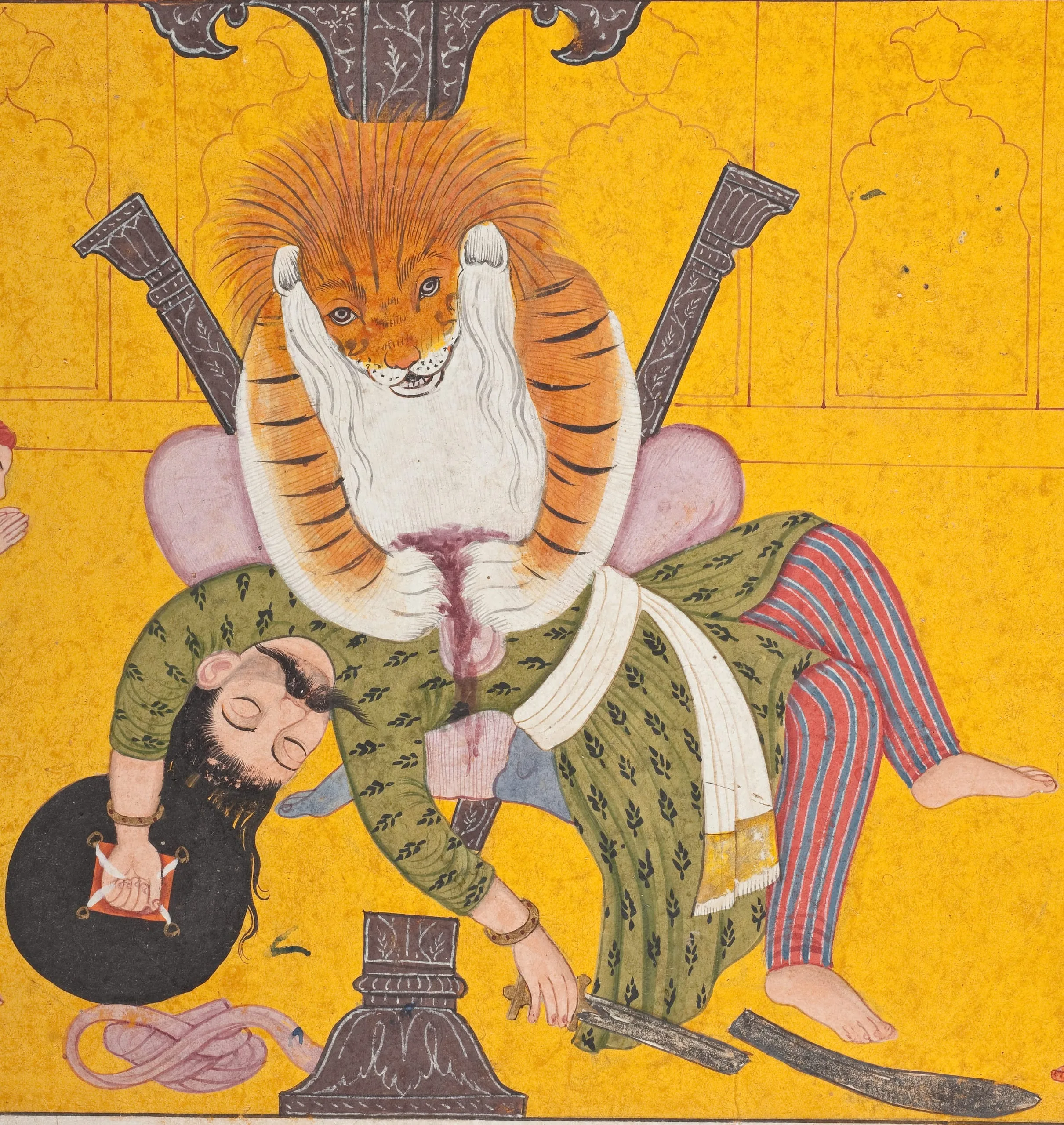
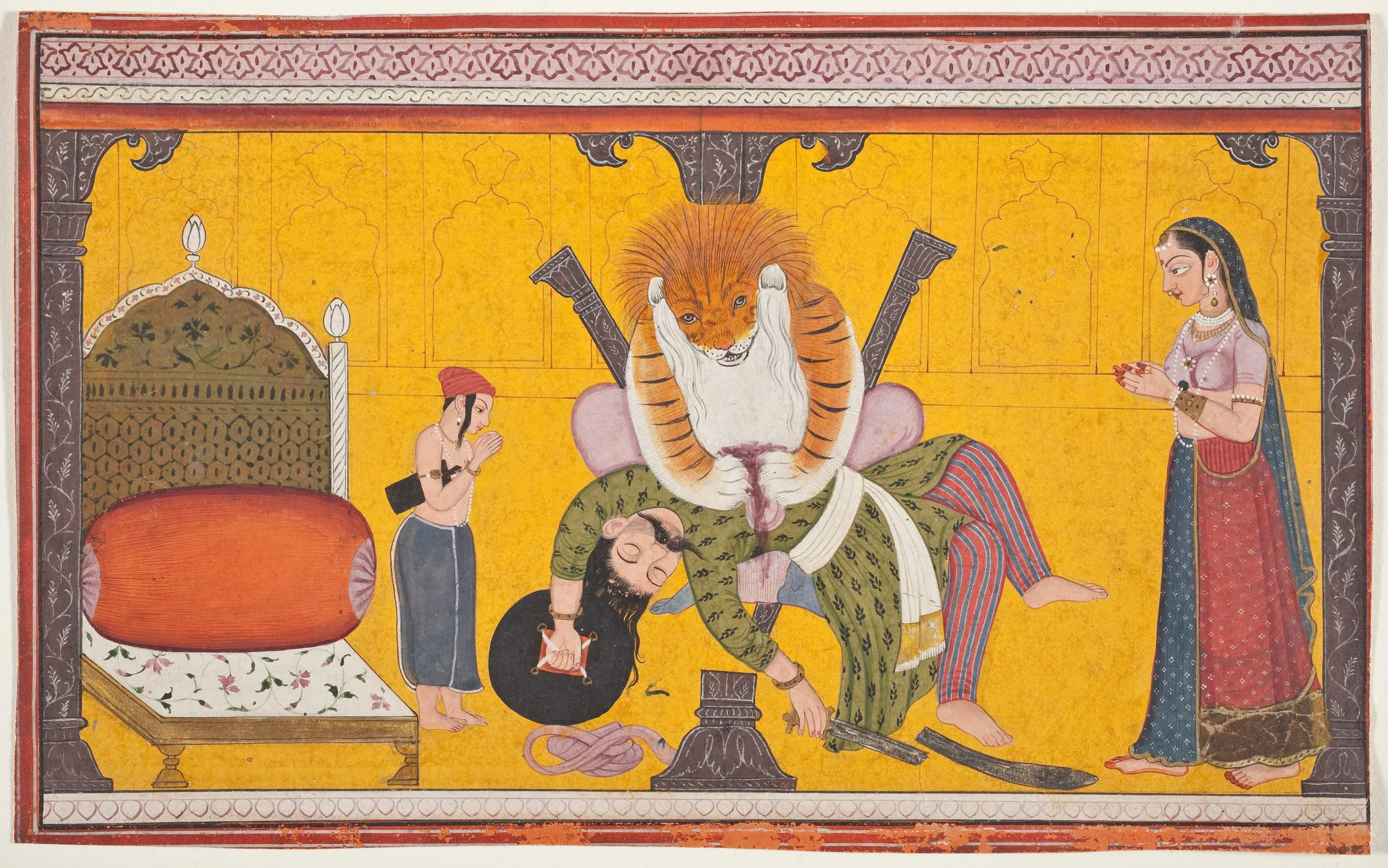
Narasimha Disemboweling Hiranyakashipu, Folio from a Bhagavata Purana (Ancient Stories of the Lord)circa 1760-1770

Not on view
Indian miniature painting, narrative scene with a lion-headed deity wrestling a human figure on a golden yellow background, with attendant figures to either side
Opaque watercolor painting on a vivid yellow ground depicting a lion-headed deity with striped orange and white body overpowering a bearded male figure in green patterned robe and red striped trousers. The figure is bent backward with a sword fallen nearby and a severed head held in hand. Two dark pillar-like architectural elements frame the scene above.
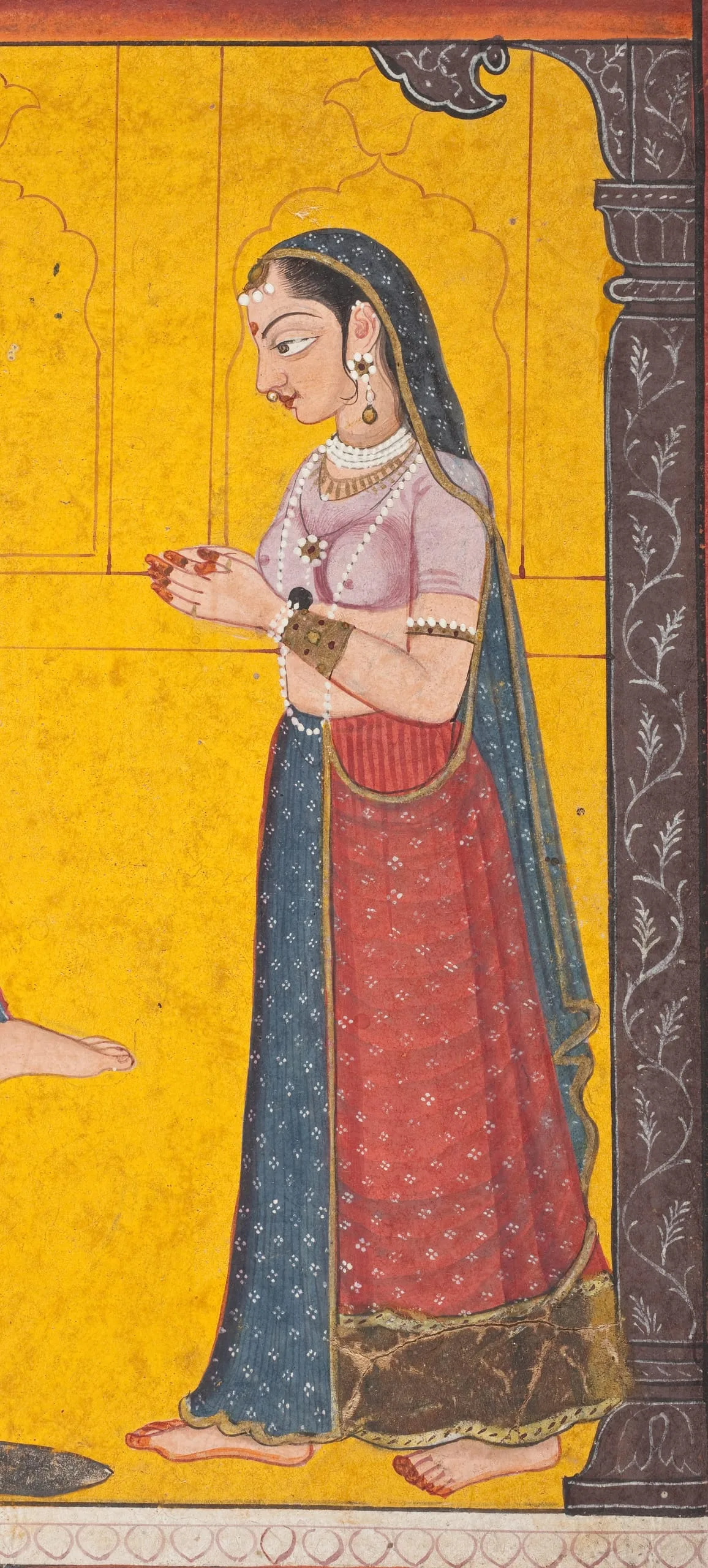
Opaque watercolor miniature painting on a golden yellow ground; a standing woman in profile wearing a red patterned skirt, blue dupatta, pearl necklaces, and jeweled ornaments, hands raised in an anjali gesture beside a dark carved column with floral inlay.
Artist or Maker
Unknown
Title
Narasimha Disemboweling Hiranyakashipu, Folio from a Bhagavata Purana (Ancient Stories of the Lord)
Place Made
India, Himachal Pradesh, Nurpur
Date Made
circa 1760-1770
Medium
Opaque watercolor and gold on paper
Dimensions
Sheet: 5 7/8 x 9 1/2 in. (14.92 x 24.13 cm); Image: 4 3/4 x 9 1/4 in. (12.07 x 23.5 cm)
Credit Line
From the Nasli and Alice Heeramaneck Collection, Museum Associates Purchase
Accession Number
M.82.42.8
Classification
Drawings
Collecting Area
South and Southeast Asian Art
Curatorial Notes

The Bhagavata Purana (Ancient Stories of the Lord) is traditionally ascribed to the legendary poet-sage Vyasa in the 8th-10th century CE. It stresses the path of devotion (bhakti) to Krishna, the eighth incarnation of Vishnu, the Hindu God of Preservation. To fulfill his role as the guardian of the world and savior of humanity, Vishnu appears as a succession of heroic animals and semi-mortal saviors, called avatars, through which he intervenes in times of crisis or unrighteousness.

The tale of Narasimha, the fourth avatar, embodies the sectarian rivalry present in Hinduism from its earliest times and eventually expressed primarily through Vaishnavism and Shaivism. Vishnu manifested as Narasimha (literally, "man-lion") to save the pious Prahlada from his bigoted father, King Hiranyakashipu, to whom Brahma had given a boon making him invulnerable to man or beast, unable to be killed indoors or outdoors, and unconquerable in day or night. To subvert the boon, Vishnu ingeniously assumed a form that was half-man and half-lion (neither man nor beast), and he attacked while his foe was standing on a porch (neither indoors nor outdoors) during the twilight hour (neither day nor night) (Bhagavata Purana 7:8:12-29).

Here, Narasimha emerges from the porch pillar and disembowels the dethroned Hiranyakashipu. Prahlada and Hiranyakashipu’s wife Kayadhu observe the divine act with gestures of devotion.

Another Nurpur rendition is in the Vicoria and Albert Museum, London (IS.104-1954).
Selected Bibliography
  • Meller, Susan. Labels of Empire: Textile Trademarks: Windows into India in the Time of the Raj. Novato, CA: Goff Books, 2023.