LACMA

ShopMembershipMyLACMATickets
LACMA
Los Angeles County Museum of Art
5905 Wilshire Blvd.
Los Angeles, CA 90036
info@lacma.org
(323) 857-6000
Sign up to receive emails
Subscribe
© Museum Associates 2026
  • About LACMA
  • Jobs
  • Host An Event
  • Unframed
  • Press
  • FAQs
  • Log in to MyLACMA
  • Privacy Policy
© Museum Associates 2026
Collections

Unknown
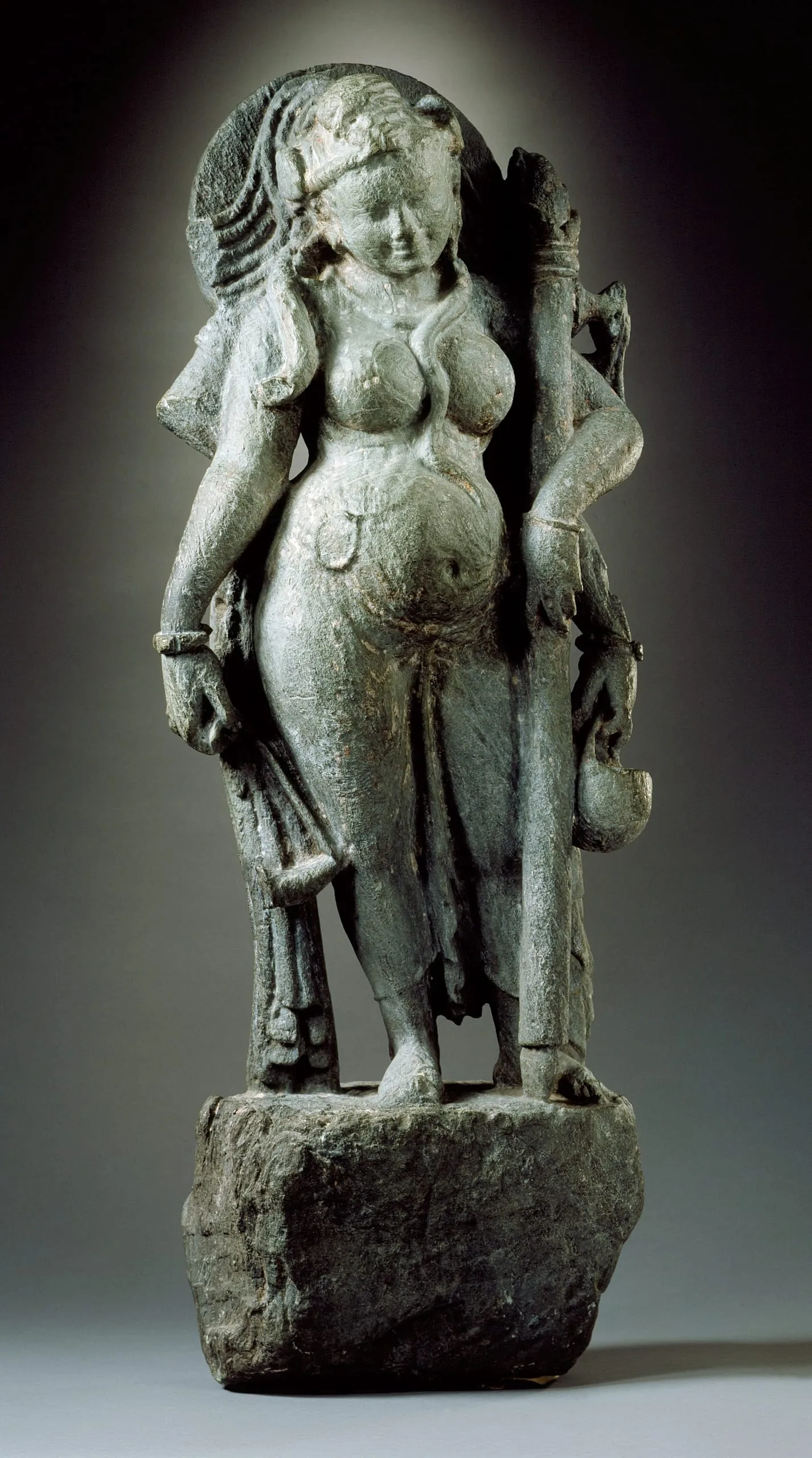
A Tantric Goddesscirca 500-550

Not on view
Gray stone sculpture of a standing female figure with a circular halo, rounded abdomen, jewelry, and a staff to one side, on a rough rectangular base
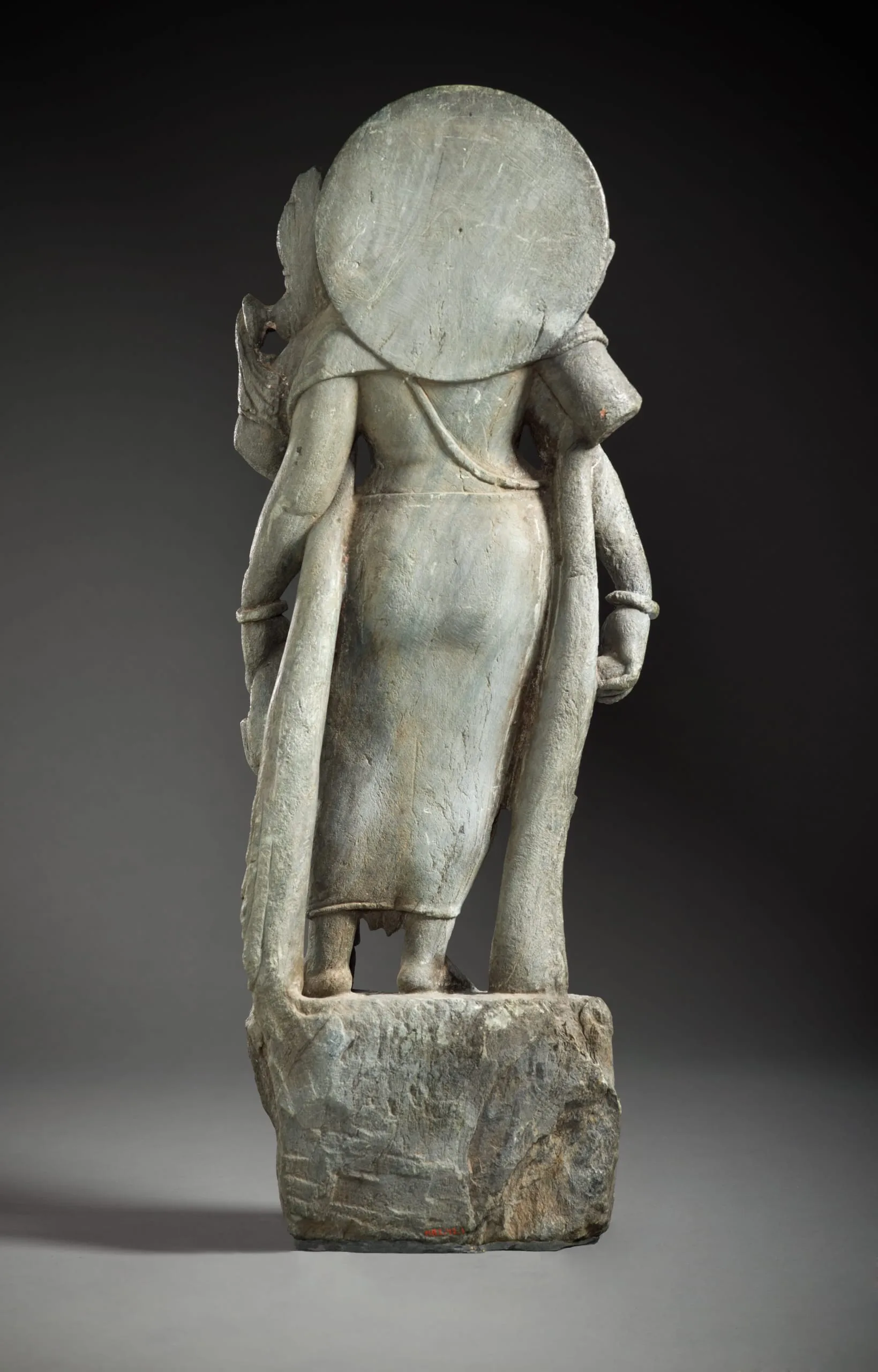
Stone sculpture viewed from the rear, a standing figure in draped garments with a large circular halo or disc behind the head, mounted on a rough rectangular base; pale gray stone with weathered surface texture.
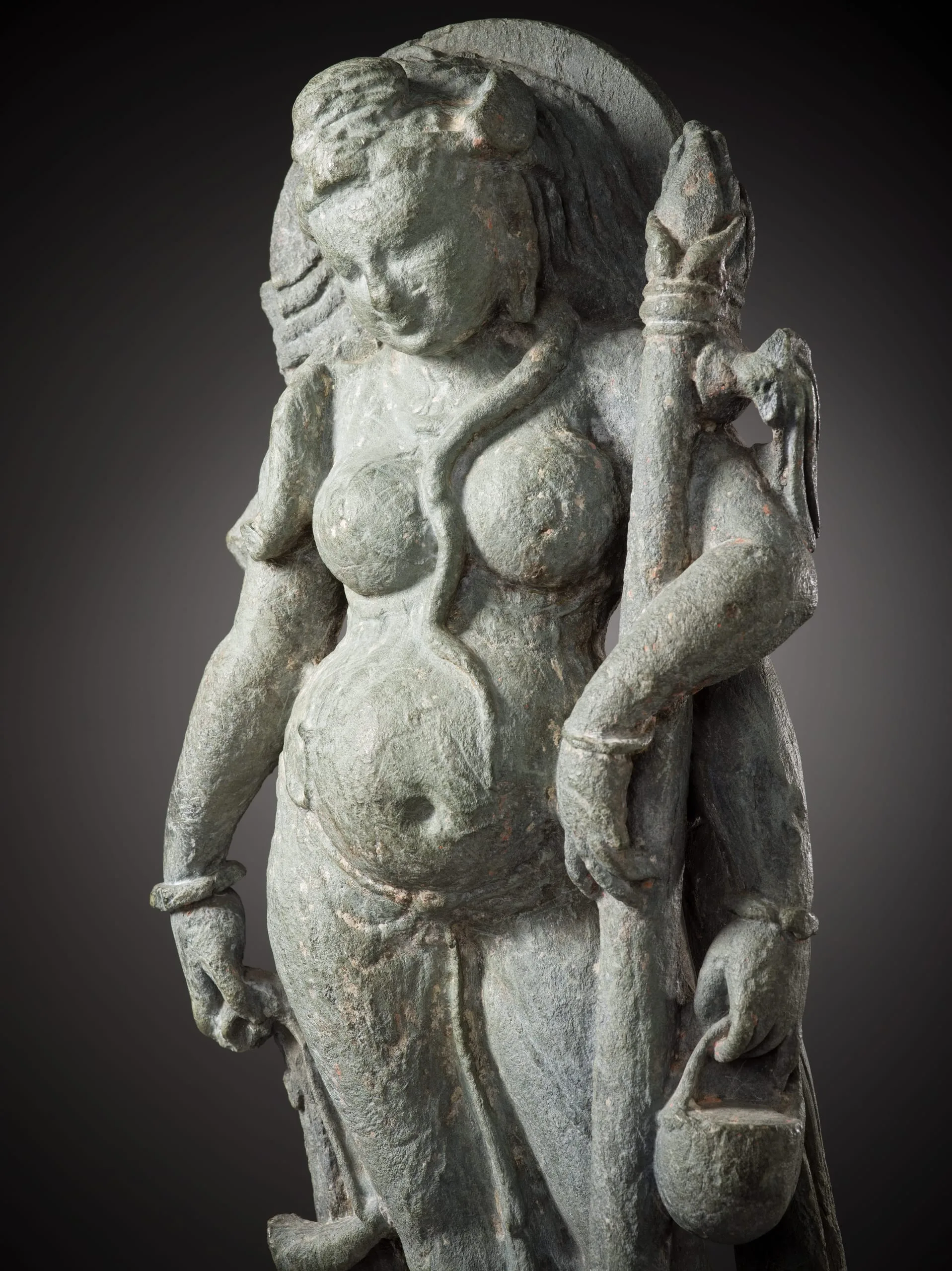
Stone sculpture of a standing female figure in tribhanga posture, wearing ornamental jewelry and draped garments, with a circular halo behind the head and a staff or tree at right; weathered gray stone with visible surface erosion.
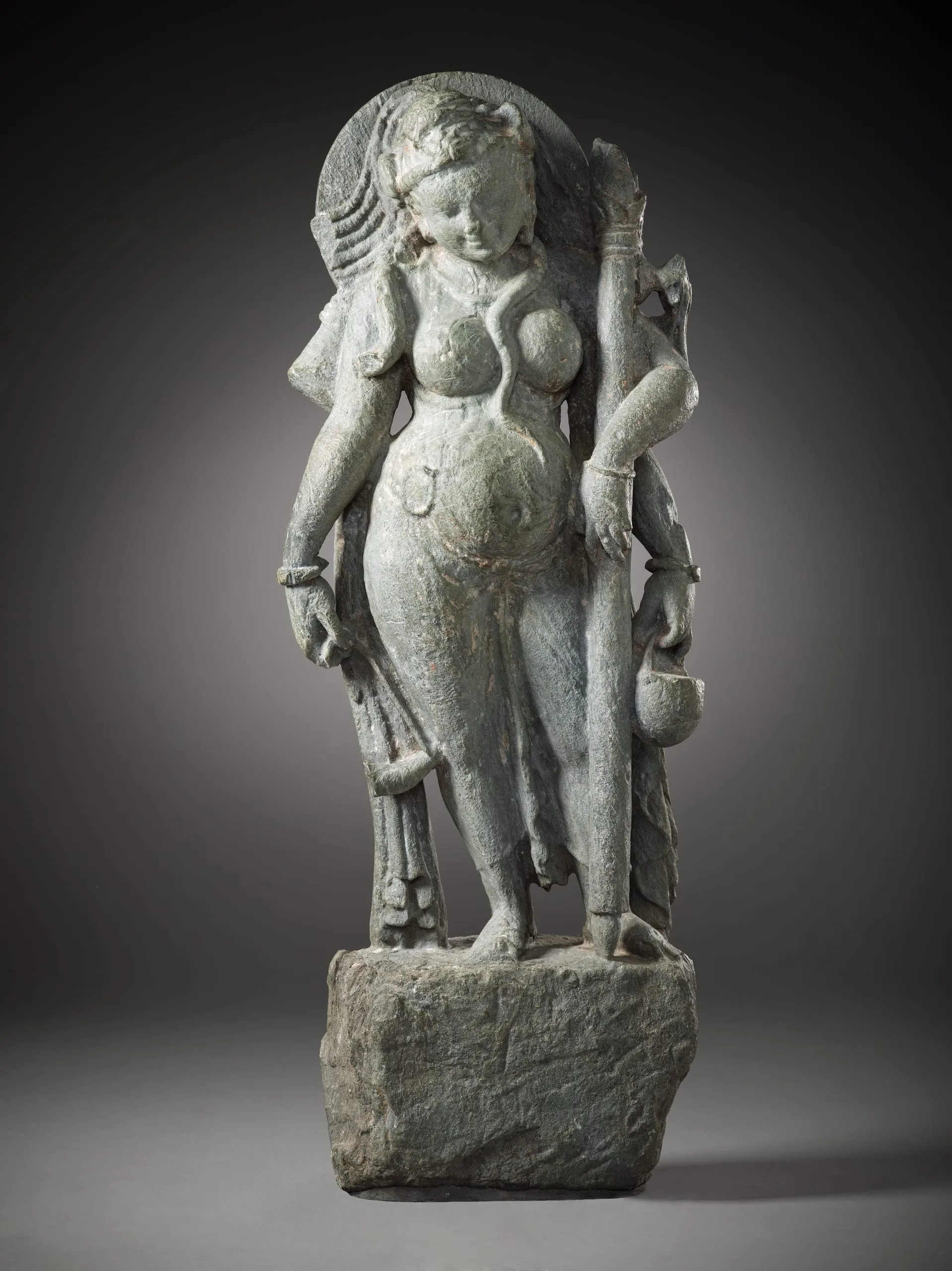
Stone sculpture of a standing female figure with a circular halo, holding a staff in one hand and a small vessel in the other, wearing jewelry and a draped lower garment; weathered gray stone surface with rounded, sensuous carving typical of South Asian temple sculpture.

Unknown, A Tantric Goddess, circa 500-550, Los Angeles County Museum of Art, From the Nasli and Alice Heeramaneck Collection, Museum Associates Purchase, photo © Museum Associates/LACMA

Artist or Maker
Unknown
Title
A Tantric Goddess
Place Made
India, Rajasthan, Tanesar-Mahadeva
Date Made
circa 500-550
Medium
Foliated dark green schist
Dimensions
30 x 12 x 5 1/2 in. (76.2 x 30.48 x 13.97 cm)
Credit Line
From the Nasli and Alice Heeramaneck Collection, Museum Associates Purchase
Accession Number
M.82.42.1
Classification
Sculpture
Collecting Area
South and Southeast Asian Art
Curatorial Notes

This elegant representation of a tantric goddess, its possible set mate M.82.42.2, and a now-dispersed group of more than a dozen additional mother goddesses, as well as images of Ganesha, Karttikeya, and possibly Shiva, were reportedly discovered around 1957 by R. C. Agrawala (b. 1926) near the modern Tanesar (Thaneshvara) Mahadeva Temple near Udaipur, Rajasthan. The goddesses were from more than one set originally and some may represent the mythological mothers of Skanda (Skandamatas or Krittikas). The dispersed sculptures are now located in the National Museum, New Delhi; City Palace Museum, Udaipur (147); Allen Memorial Art Museum, Oberlin College (69.62); British Museum, London (1963,1112.1); Cleveland Museum of Art (1970.12); and formerly the Metropolitan Museum of Art, New York.

The tantric goddess is nimbate. Her hair is worn in a topknot with long braids streaming out behind her (kaparda). She wears a serpent as a necklace and a stylized form of the Brahmanical sacred thread (valayopavita) that has a prominent ring-like loop or fastener (valaya) attached at waist level. The goddess has full breasts and is pot-bellied. Her protuberance is not an indication of obesity or pregnancy, but rather a representation of the cosmic breath of life (prana) and the physical swelling of maternal, generative earth energy. She is four-armed. Her upper left arm cradles and carries a three-pointed spear or Shiva’s trident (trishula) with an hourglass-shaped ritual drum (damaru) mounted onto the shaft below the spearhead. The instrument is played during tantric dances or rituals to symbolize the primal sound of creation (nada or Om) alongside the destructive/protective power of the trident and its mastery over time (the three blades symbolize the past, present, and future). Her lower left hand carries an ascetic’s waterpot in the form of a bucket (udanchana). It was used during public offerings and sacrifices (shrauta rituals) to scoop a ritual invigorating juice (soma) out of a larger storage trough (dronakalasa) for the purpose of making oblations and libations. Her lower left hand carries a ritual bull horn (gaumukhi shringi) suspended by two decorative cords that was used during ceremonial bathing (abhisheka). Her upper left arm is missing. The back of the sculpture is fully finished, unlike M.82.42.2, which may suggest that the two works are from different sets.
Selected Bibliography
  • Rosenfield, John. The Arts of India and Nepal: The Nasli and Alice Heeramaneck Collection. Boston: Museum of Fine Arts, Boston, 1966.
  • Yaldiz, M.; Lobo, W., eds. Investigating Indian Art. Berlin: Museum fur Indische Kunst, 1987.
  • Pal, Pratapaditya, ed. Aspects of Indian Art: Papers Presented in a Symposium at the Los Angeles County Museum of Art. Leiden, The Netherlands: E.J. Brill, 1972.
  • Pal, Pratapaditya. Indian Sculpture, vol.1. Los Angeles: Los Angeles County Museum of Art; University of California Press, 1986.
  • Newman, Richard. The Stone Sculpture of India: a Study of the Materials Used by Indian Sculptors from ca. 2nd Century B.C. to the 16th Century. Cambridge, MA: Center for Conservation and Technical Studies, Harvard University Art Museums, 1984.
  • El Universo de la India: Obras Maestras del Museo de Arte del Condado de Los Angeles. Santiago: Centro Cultural Palacio La Moneda, 2012.