- Title
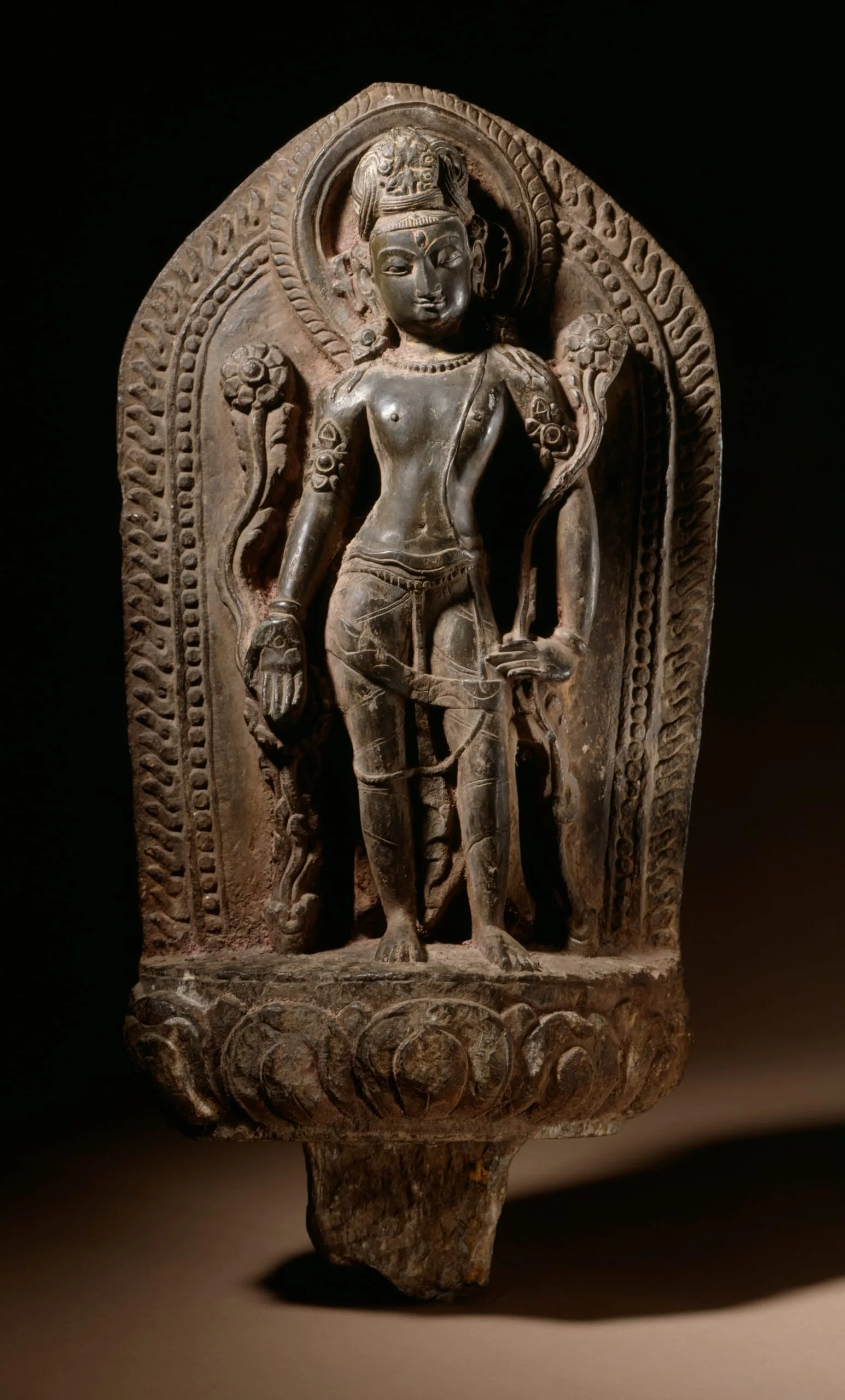
- The Bodhisattva Avalokiteshvara
- Date Made
- 15th century
- Medium
- Stone with traces of red devotional paint
- Dimensions
- 15 1/2 x 7 3/4 x 3 in. (39.37 x 19.68 x 7.62 cm)
- Accession Number
- M.82.40
- Curatorial Notes
Avalokiteshvara, the Bodhisattva of Compassion, stands gracefully on a lotus base in the Triple-bend Posture (tribhanga sthanaka) with his head slightly inclined, the hips jutting to one side, and the shoulders leaning in the opposite direction, conveying dynamic movement and compassion. He has a third eye of wisdom (jñana netra), the piled hair of a yogi (jata mukuta) to emphasize his ascetic nature, is nimbate, and has a flaming aureola (prabhavali) with a pearl border. He is bare chested, barefooted, and wears a striped dhoti, a sash tied diagonally across his thighs, and princely ornaments (bodhisattva abharana), including the Brahmanical sacred thread (yajñopavita) over his left shoulder. His left hand rests on his hip and holds the long stalk of a blossoming lotus growing out of the lotus base. Accordingly, standing sculptures of Avalokiteshvara with two arms are commonly called Padmapani (lotus-bearer). His right hand is extended in the gesture of charity (varada mudra) and has a jewel or sacred marking (lakshana) in the palm. A second lotus on a long stalk is behind his right hand. A large support tang protrudes from beneath the lotus base. See also M.80.222 and M.81.8.1.
- Selected Bibliography
- Pal, Pratapaditya. Art of Nepal. Los Angeles: Los Angeles County Museum of Art; University of California Press, 1985.
- Matilsky, Barbara C. Buddist Art and Ritual from Nepal and Tibet. Chapel Hill: Auckland Art Museum, University of North Carolina, 2001.