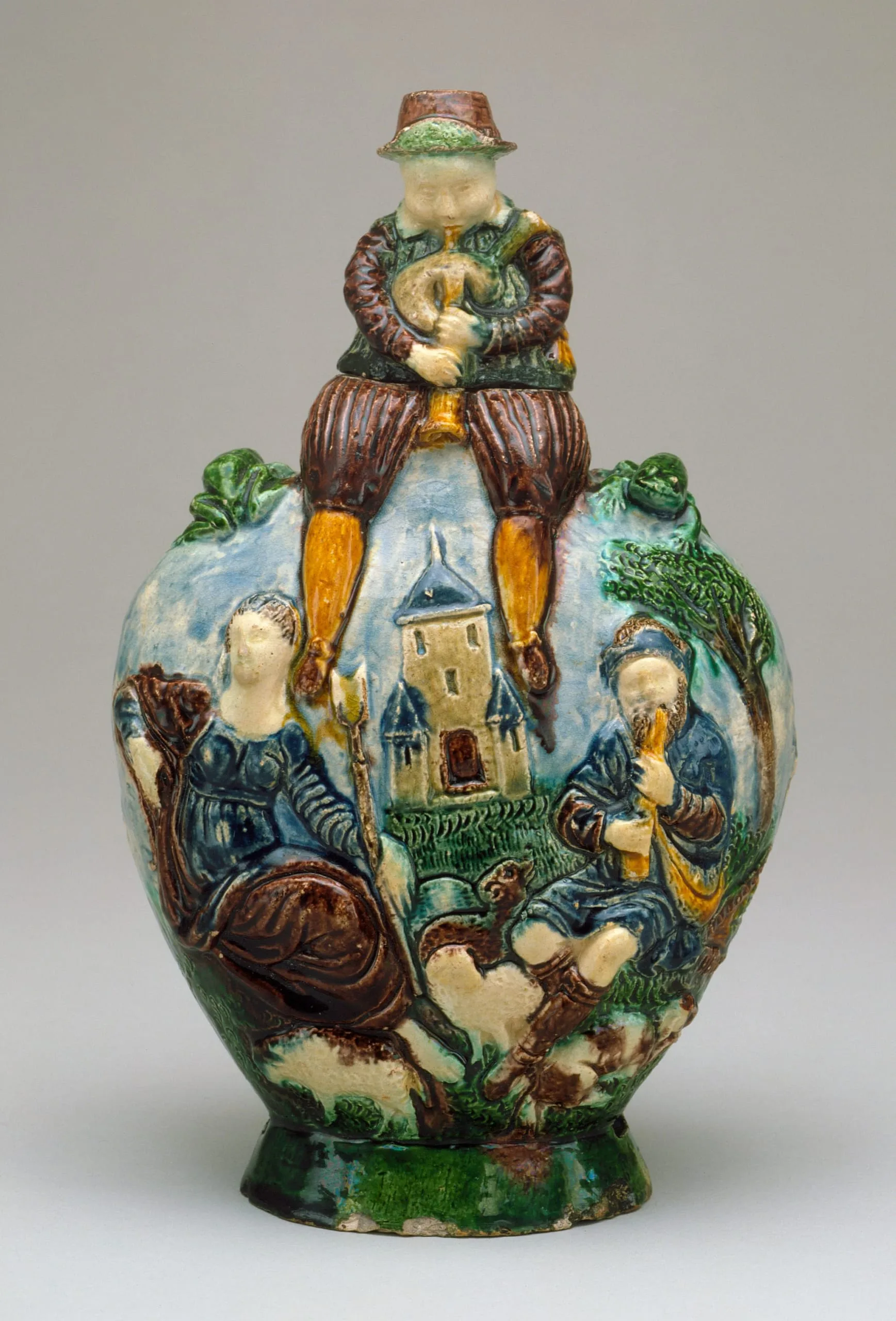
The form of this bottle is that of a pilgrim flask, characterized by a flattened round body tapering into a narrow neck. Such flasks were based on an Islamic form and fashioned after bottles, initially made from dried gourds, that pilgrims and travelers used to carry water. The stopper is disguised as a young boy sitting atop the bottle and playing a bagpipe, accompanied by another bagpipe player and a shepherdess surrounded by her flock. In the background is a grand estate; on the obverse is an allegorical figure, possibly representing peace, holding a palm. In lieu of loops that would have allowed the bottle to be suspended and carried (as in a true pilgrim flask), two frogs sit on the shoulders of the bottle. The earth-toned palette, inclusion of aquatic animals, and pastoral nature of this scene represent a rustic style of polychrome lead-glazed earthenware popularized in sixteenth-century France.
While unlikely to be the maker of this specific flask, Bernard Palissy developed this style of “rusticware.” Palissy was a sixteenth-century French Huguenot ceramist and engineer. His particular style of pottery grew out of an interest in understanding the principles of geology and the generation of life, as well as his mastery of earthenware ceramics as he attempted to re-create Chinese porcelain. Among Palissy’s patrons were the duc de Montmorency, who commissioned him to decorate the Château d’Écouen, and Catherine des Medicis, who brought him to work in Paris and supported his pottery works near the Louvre. A number of other makers produced ceramics in Palissy’s style in the sixteenth century, and interest in his ceramics was revived in the nineteenth century.
Cynthia Kok
2025