LACMA

ShopMembershipMyLACMATickets
LACMA
Los Angeles County Museum of Art
5905 Wilshire Blvd.
Los Angeles, CA 90036
info@lacma.org
(323) 857-6000
Sign up to receive emails
Subscribe
© Museum Associates 2025

Museum Hours

Monday

11 am–6 pm

Tuesday

11 am–6 pm

Wednesday

Closed

Thursday

11 am–6 pm

Friday

11 am–8 pm

Saturday

10 am–7 pm

Sunday

10 am–7 pm


  • About LACMA
  • Jobs
  • Building LACMA
  • Host An Event
  • Unframed
  • Press
  • FAQs
  • Log in to MyLACMA
  • Privacy Policy
© Museum Associates 2025
Collections

Guy Pène du Bois
An American Oriental1921

Not on view
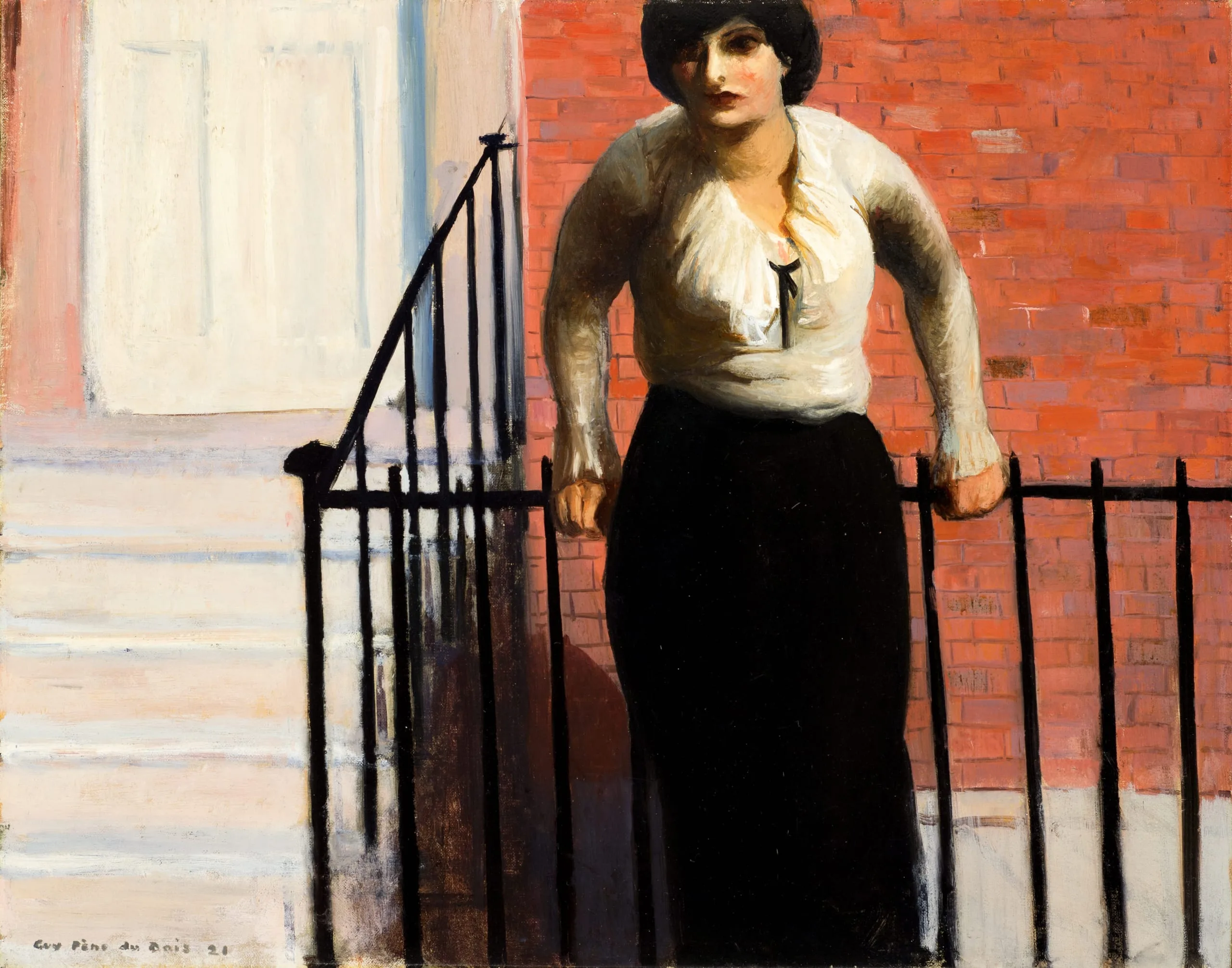
Oil painting portrait of a dark-haired woman in a white blouse and black skirt, leaning on an iron fence in front of a red brick wall
Artist or Maker
Guy Pène du Bois
United States, New York, Brooklyn, 1884-1958
Title
An American Oriental
Place Made
United States
Date Made
1921
Medium
Oil on canvas
Dimensions
Canvas: 20 1/16 × 25 1/8 in. (50.96 × 63.82 cm) Frame: 26 1/2 × 31 1/2 × 3 in. (67.31 × 80.01 × 7.62 cm)
Credit Line
Mr. and Mrs. William Preston Harrison Collection
Accession Number
39.9.7
Classification
Paintings
Collecting Area
American Art
Curatorial Notes
An American Oriental dates from the first years of du Bois’s mature period and consequently is not completely characteristic of his later work. It was originally exhibited as New York Oriental, the term Oriental referring to a dark, exotic woman. The woman in this painting is not one of the fashionably dressed ladies du Bois usually depicted in his typical mature paintings but is a common, urban gypsy. In contrast to the two flappers depicted in Shops, 1922 (LACMA; q.v.), who also stand before a black, wrought-iron fence on a city street, this Oriental brazenly confronts the viewer with her direct gaze and open, frontal pose.
Du Bois was a master of modern design. He conceived the Oriental as dark, shadowy, and fully modeled in contrast to the flat, brilliant orange brick wall she stands before and the gleaming white steps nearby. The scene is a slightly asymmetrical arrangement of three simplified areas of color held together by the iron fence. The woman’s head is slightly cropped by the top of the canvas. In the late nineteenth century this compositional device became synonymous with contemporaneity; it does not, however, appear in du Bois’s other paintings. The brick wall and adjoining door are painted in the highly saturated hues that became the hallmark of his paintings from the 1920s.
Selected Bibliography
  • LACMA: Obras Maestras 1750-1950: Pintura Estadounidense Del Museo De Arte Del Condado De Los Angeles. Mexico, D.F.: Museo Nacional de Arte, 2006.