- Title
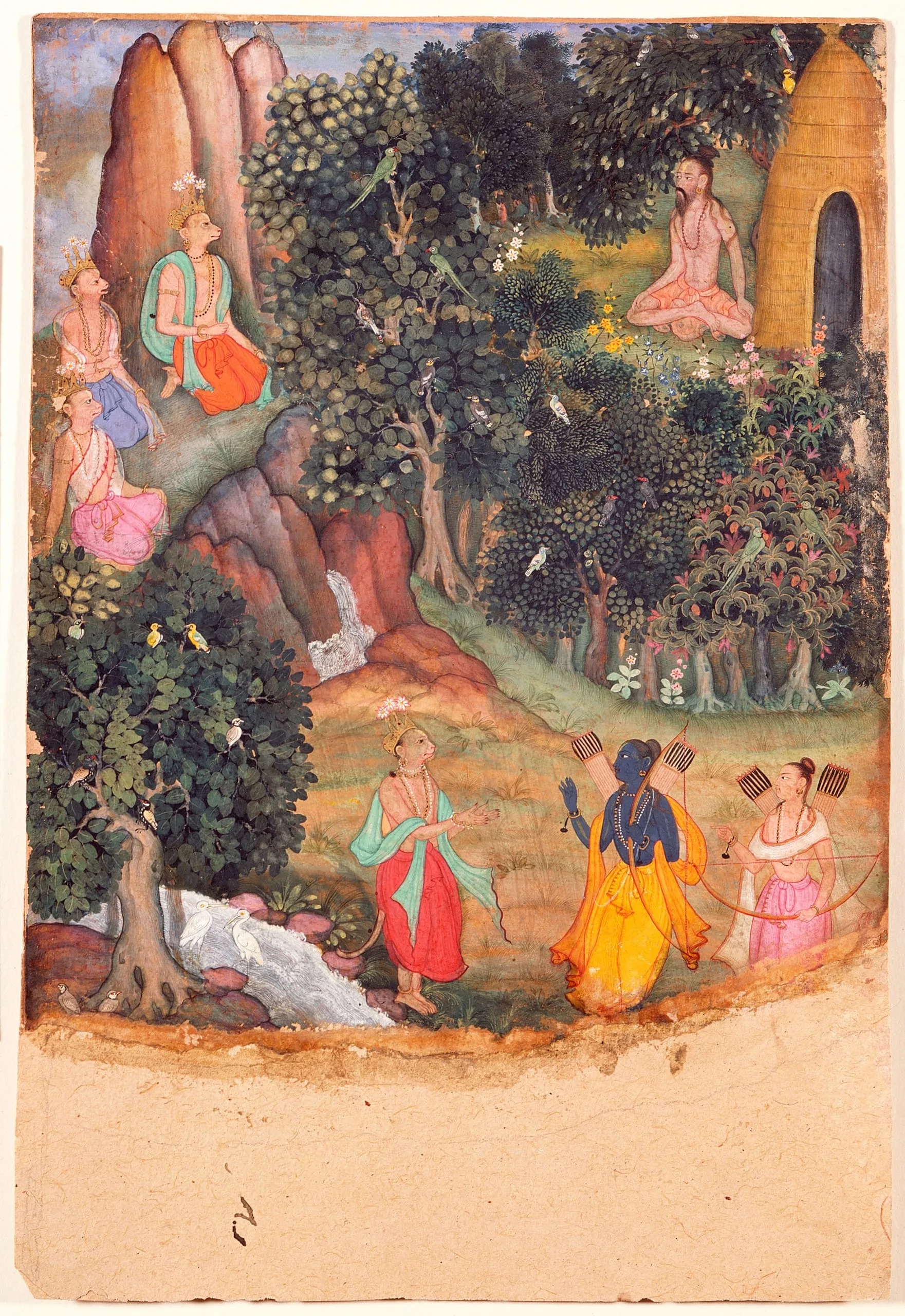
- Rama and Lakshmana Meet Sugriva at Matanga's Hermitage, Folio from a Ramayana (Adventures of Rama)
- Date Made
- circa 1595-1600
- Medium
- Opaque watercolor, gold, and ink on paper
- Dimensions
- Image: 9 3/8 x 7 1/2 in. (23.81 x 19.05 cm); Sheet: 11 1/8 x 7 3/8 in. (28.26 x 18.73 cm)
- Accession Number
- M.82.6.6
- Curatorial Notes
The Ramayana narrates the epic saga of the valiant Prince Rama and his dutiful wife, Princess Sita, who was abducted by Ravana, the arrogant ten-headed King of Lanka (probably modern Sri Lanka), during Rama's unjust fourteen-year forest exile from his capital of Ayodhya (near Faizabad in Uttar Pradesh). To rescue Sita, Rama and his faithful brother Lakshmana assembled a great army of monkeys and bears led by the Monkey-King Sugriva and his Monkey-General Hanuman. After several magical battles, the princess was freed, and the happy couple triumphantly returned home to rule Ayodhya. Rama and Sita epitomize the ideal ruler and the paragon of fidelity in traditional Hindu culture.
This partially damaged folio and its set mate M.82.6.5 are from a dispersed subimperial Mughal manuscript of the Ramayana painted in circa 1595-1600. It was likely created for a high-ranking Hindu affiliated with the Mughal court, which can be deduced by the Ramayana passages on reverse being inscribed in Sanskrit rather than Persian. Both folios depict episodes set in the Kishkindha Forest with the same protagonists, but they express a vastly dissimilar emotional intent and were likely done by different artists (compare the variances in garb and physiognomy between the two figures of Rama). Here, the pictorial emphasis is on the lush flora and fauna used to create an atmosphere of spiritual vitality and timeless serenity at the hermitage of the sage Matanga on the Rishyamuka Mountain.
- Selected Bibliography
- Pal, Pratapaditya. Indian Painting, vol.1. Los Angeles: Los Angeles County Museum of Art, 1993.
- Heeramaneck, Alice N. Masterpieces of Indian Painting : From the Former Collections of Nasli M. Heeramaneck. New York: A.N. Heeramaneck, 1984.
- Rosenfield, John. The Arts of India and Nepal: The Nasli and Alice Heeramaneck Collection. Boston: Museum of Fine Arts, Boston, 1966.