LACMA

ShopMembershipMyLACMATickets
LACMA
Los Angeles County Museum of Art
5905 Wilshire Blvd.
Los Angeles, CA 90036
info@lacma.org
(323) 857-6000
Sign up to receive emails
Subscribe
© Museum Associates 2025

Museum Hours

Monday

11 am–6 pm

Tuesday

11 am–6 pm

Wednesday

Closed

Thursday

11 am–6 pm

Friday

11 am–8 pm

Saturday

10 am–7 pm

Sunday

10 am–7 pm


  • About LACMA
  • Jobs
  • Building LACMA
  • Host An Event
  • Unframed
  • Press
  • FAQs
  • Log in to MyLACMA
  • Privacy Policy
© Museum Associates 2025
Collections

Unknown
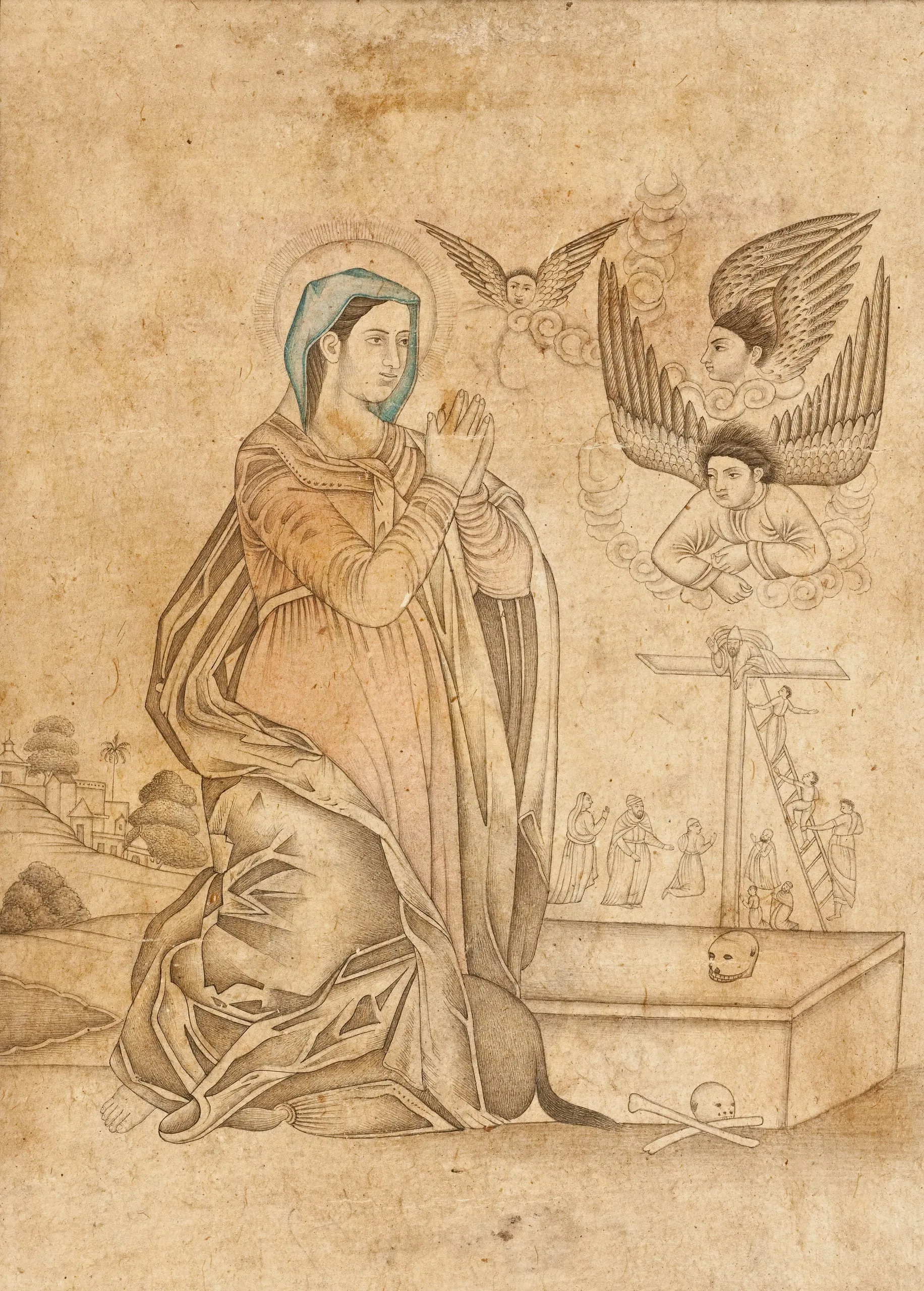
Composition with the Virgin Marycirca 1675

Not on view
Drawing in brown ink and blue-gray wash on aged tan paper, kneeling woman in prayer with halo, winged figures above, and a crucifix scene with skull and crossbones at lower right
Artist or Maker
Unknown
Title
Composition with the Virgin Mary
Place Made
India, Karnataka, Bijapur (?)
Date Made
circa 1675
Medium
Ink and opaque watercolor on paper
Dimensions
Sheet: 11 7/8 x 7 3/4 in. (30.16 x 19.69 cm); Image: 7 5/8 x 5 3/8 in. (19.37 x 13.65 cm)
Credit Line
Purchased with funds provided by Julian C. Wright Bequest, Christian Humann Fund, Felix and Helen Juda Foundation, Paul F. Walter, Valley M. Knudsen Estate, the de Anda-Fast family, and Dr. Ronald M. Lawrence
Accession Number
M.82.289
Classification
Drawings
Collecting Area
South and Southeast Asian Art
Curatorial Notes

This nim qalam (half-pen) lightly tinted drawing is likely an Indianized pastiche based on unidentified European engravings. The central figure probably represents the Virgin Mary praying at the site of the crucifixion of Jesus, known as Calvary or Golgotha. This is indicated by the cross with the ladder used to lower the body of Christ and the symbolic skulls and crossbones on the rectangular tomb. The cross has been misinterpreted as a plank on a post. The small figures adjacent to the cross are wearing Indo-Islamic garb, including the bust of the apex of the cross, which resembles a cap-wearing Muslim mullah rather than a crowned God the Father. Three winged angels, presumably cherubim, hover in the clouds. In the distance on the left is a European-style town, probably Jerusalem.

The identification of Virgin Mary is suggested by her halo and her blue veil, symbolic of her purity. Alternatively, as the Virgin Mary is commonly portrayed beside the cross with her arms crossed over her chest, the genuflecting figure may be intended as the penitent Mary Magdalene. She is similarly depicted in Baroque iconography as praying to angels beside the empty tomb. (For example, see an etching of circa 1640-1655 by the Venetian artist Giulio Carpioni (1613-1678) in the Metropolitan Museum of Art, New York, 2012.136.333.) Omitted, however, is her primary attribute, the jar of ointment she used to anoint Christ’s feet. Curiously, the hindquarters of an ass protrude from under her robe.
Selected Bibliography
  • Pal, Pratapaditya. Indian Painting, vol.1. Los Angeles: Los Angeles County Museum of Art, 1993.
  • Phil Freshman. Los Angeles County Museum of Art Report, July 1, 1981-June 30, 1983. Los Angeles: Los Angeles County Museum of Art, 1984.