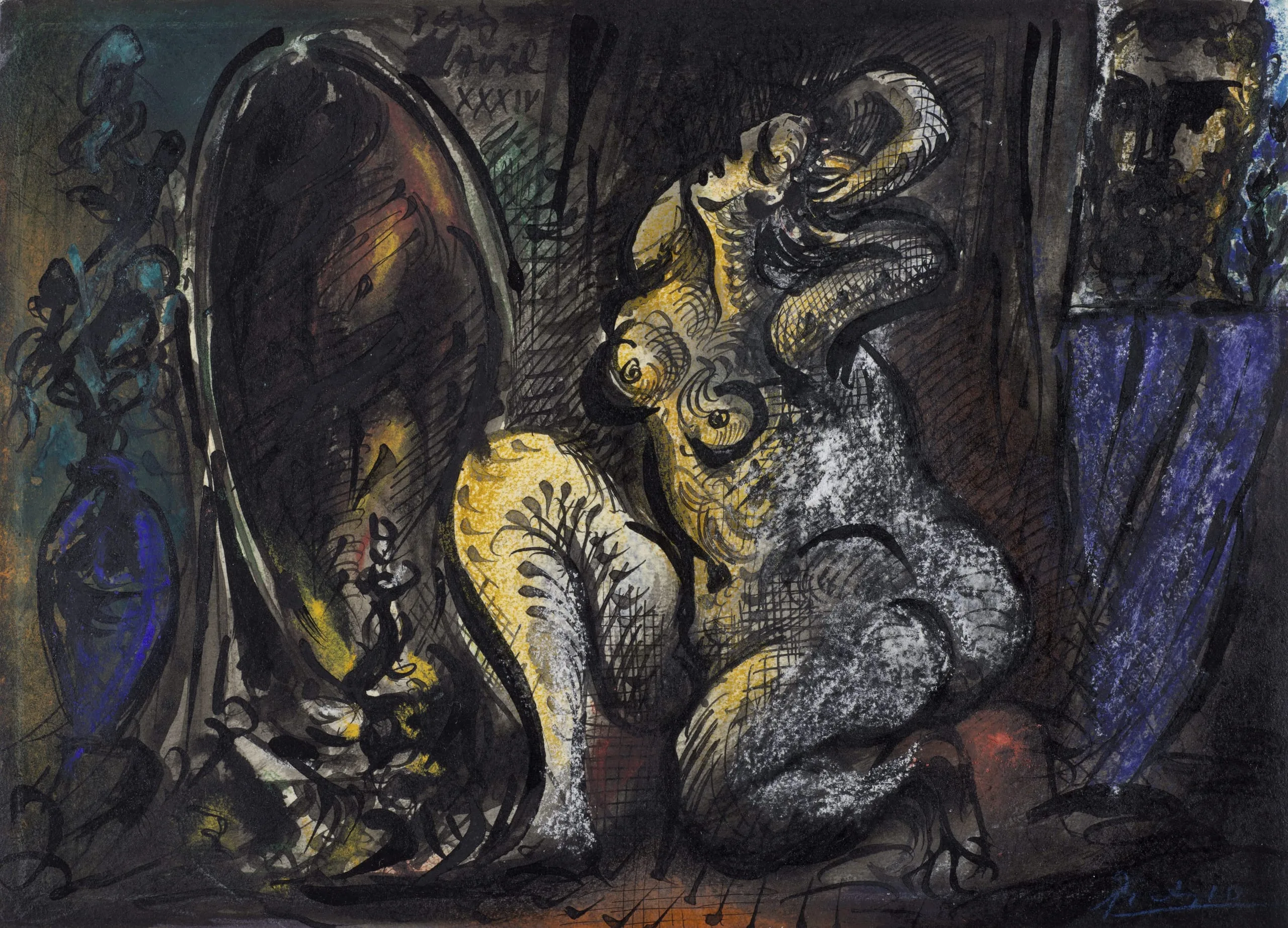
The subject of the artist and his model preoccupied Pablo Picasso at least from the late 1920s. Female Nude Kneeling before a Mirror dates from a period of intense graphic activity, during which Picasso was working on his famous series of one hundred etchings, the Vollard Suite, forty-six of which were devoted to the theme of the sculptor in his studio.
In these images, Picasso mingled the Neoclassicism that characterized much of his work of the 1920s with 1930s Surrealism. Elements of both styles are evident in Female Nude Kneeling before a Mirror, a drawing characterized by sensuous calligraphic lines and rich washes of color. The voluptuous modeling of the female form, with its cross-hatching and decorative patterning of tear-shaped pen strokes, gives the drawing a particular vibrancy.
The kneeling nude — her head thrown back, her arms raised, her mouth slightly open — seems autoerotically absorbed by her own reflection in the mirror. At the same time, a bearded man (a frequent surrogate for Picasso) peers at her voyeuristically through an open window. The act of observing, both passive (the mirror) and active (the model/muse, the voyeur, the artist, the external viewer), thus becomes the drawing's central theme. Its mystery and sexual tension are further enhanced by the candle, which provides the chamber's only light and casts a yellow glow across the model's naked form.