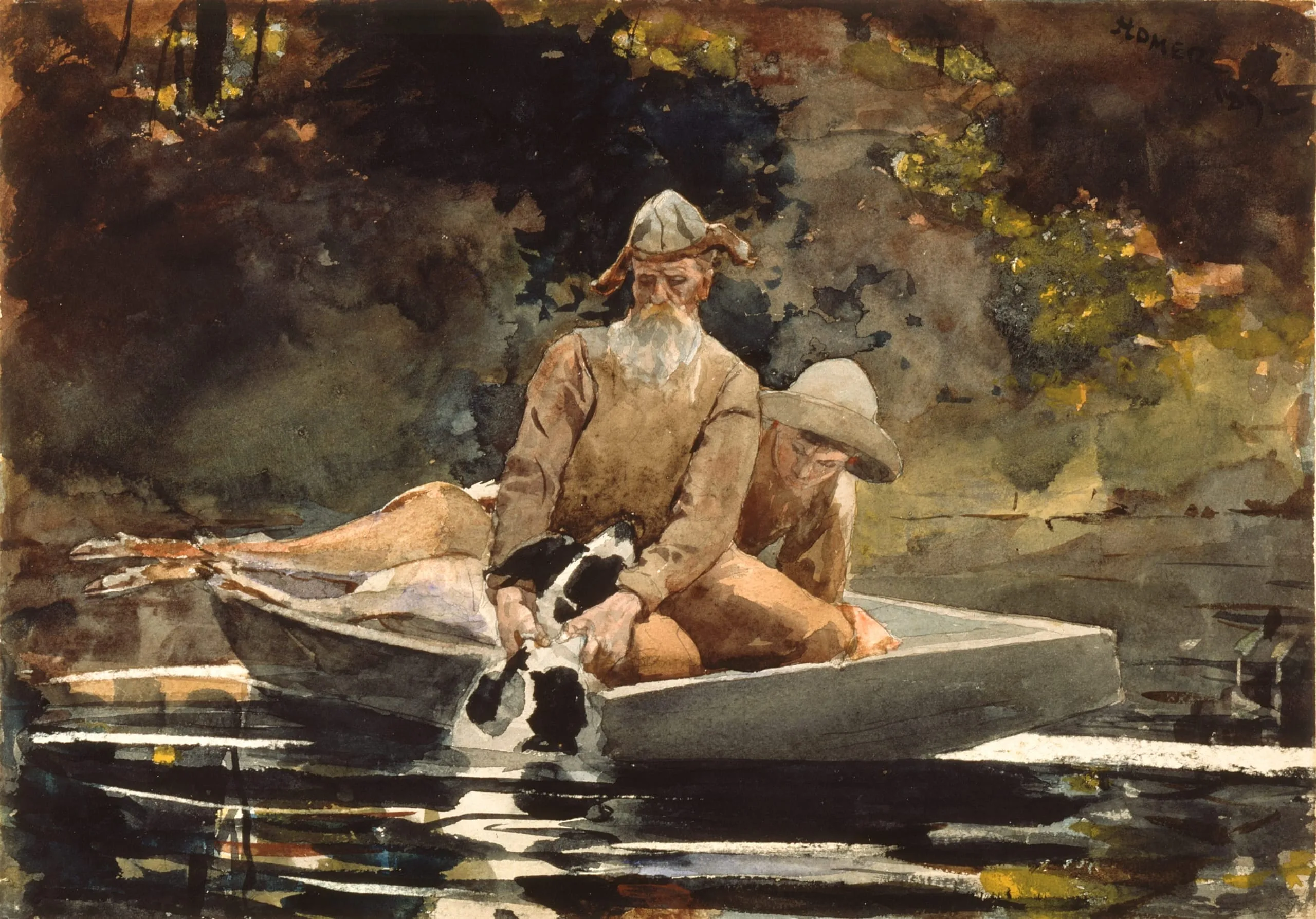
After the Hunt is one of twenty-six watercolors made by Winslow Homer in the early autumn of 1892 while he was vacationing in the Adirondacks. Homer first visited this wilderness area near Minerva in upstate New York in 1870 and returned there often to fish with his brother Charles, eventually becoming a charter member of the sportsmen’s North Woods Club.
Along with his watercolors of the tropics, Homer’s images of the Adirondacks constitute his most outstanding work in the medium. In theme and composition After the Hunt is a classic example of his Adirondack scenes. Homer’s love of nature and respect for the rugged life of the hunters and fishermen are here clearly conveyed.
Adirondack hunters often pursued their quarry into a lake, where a deer would drown or be cornered by the hounds. In After the Hunt the pursuit is over, the deer has been hauled into the boat, and the old hunter is taking care of his dog. The bearded man appears in many Homer images and was first identified by art historian Ashton Sanborn as the guide Henry Holt. Another Homer scholar, Philip C. Beam, suggests that Homer used models of similar appearance and that John Gatchell and his son Wiley, residents of Scarboro, Maine, may have posed for some of the Adirondack scenes, especially those completed after Holt’s death in 1893 or those finished in Homer’s studio in Prout’s Neck. Although Homer painted some watercolors outdoors, many were completed or executed entirely in the studio. After the Hunt was probably a studio production.
Homer was one of many late nineteenth-century artists to consider watercolor painting an independent art form worthy of exhibition rather than merely a preparatory medium. With his watercolors of the 1890s Homer matured and found his true medium. Indeed, Homer believed that he would be most remembered for his watercolors. Moving away from the soft, tinted drawings of the British watercolor tradition, Homer became a master of rich colors and textures, creating direct, sensuous paintings. The Adirondack images have the deepest color schemes of his watercolors; the purples, greens, dark blues, russets, and yellowgreens of the foliage and water convey a full range of autumnal hues. The clarity of the mountain air is fully described by the bold handling of the reflections on the water, which Homer created by lightly scraping the paper with a knife while it was still wet with pigment. Homer boldly brushed on one transparent layer of color over another so that the water shimmers with multiple reflections and colors. In the thicket behind the figures Homer applied the pigment very broadly, bleeding one wash into another. The bushes do not distract from the figures but instead form a soft screen behind them.
In the more panoramic watercolor The End of the Hunt, 1892 (Bowdoin College Museum of Art, Brunswick, Maine; see illustration), Homer depicted the same subject with identical hunters. In the Los Angeles painting he made a much more powerful statement by moving closer into the scene and creating with the figures and boat a monumental triangle in which verticals and horizontals are counterpoised.