- Title
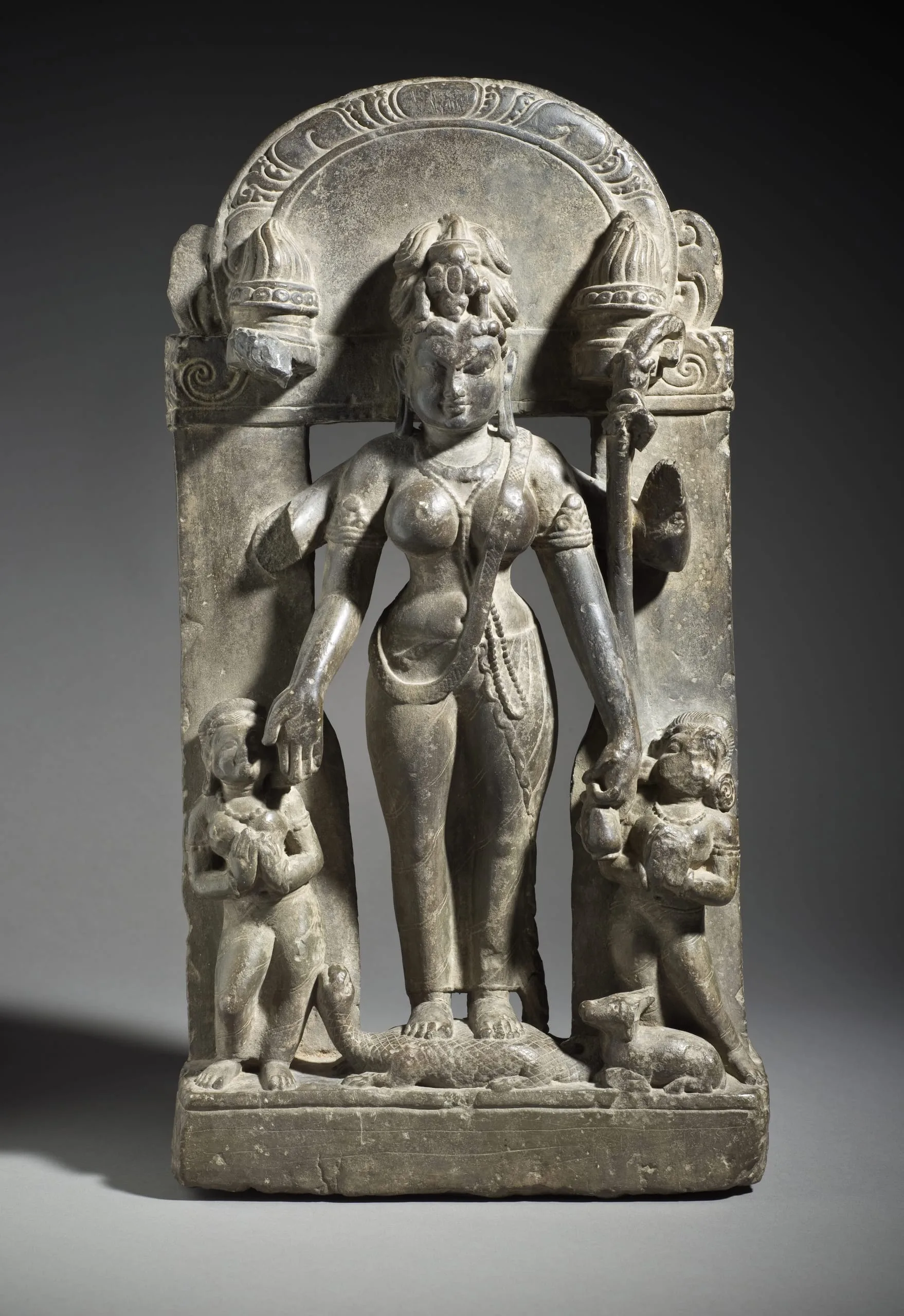
- The Hindu Goddess Gauri
- Date Made
- 9th century
- Medium
- Chlorite schist
- Dimensions
- 16 1/2 x 8 1/2 x 2 1/2 in. (41.91 x 21.59 x 6.35 cm)
- Accession Number
- M.82.226
- Curatorial Notes
The Hindu Goddess Gauri, an epithet of Parvati, is identified by the iguana (godha) upon which she stands. Her ascetic nature is expressed by her piled hair (jata mukuta) and distended earlobes. She wears an ascetic’s sash (yoga patta) across her left shoulder, a long pearl necklace, and armlets. She has four arms. Her lower right hand is held in the gesture of charity (varada mudra). Her lower left hand holds an ascetic’s waterpot (kamandalu). Her upper left hand holds what appears to be a shepherd’s crook, while her upper right hand is now missing. The goddess is flanked by two worshiping attendants. On either side of her head are two flaming torches (agni kunda). Their presence refers to when the Goddess Uma undertook severe austerities, including meditating while surrounded by five fires (pancha agni or pancha tapas), to lighten her dark complexion. Thereafter, she was known as Gauri (Fair One). See also AC1992.209.1.
- Selected Bibliography
- Pal, Pratapaditya. Indian Sculpture, vol.2. Los Angeles: Los Angeles County Museum of Art; University of California Press, 1988.