- Title
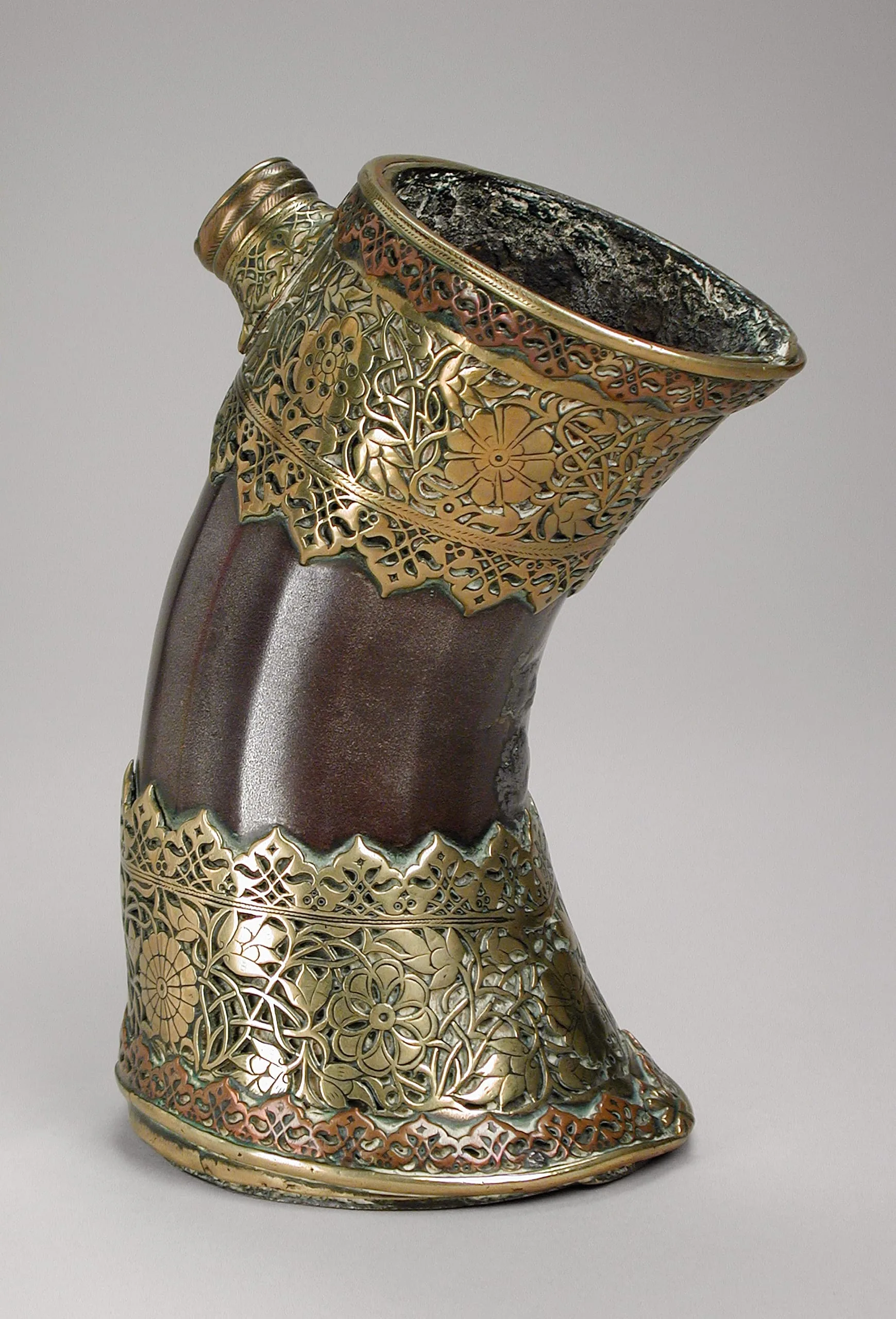
- Hookah Base in the Form of a Yak’s Horn
- Date Made
- circa 1775-1800
- Medium
- Iron with openwork brass and copper mounts
- Dimensions
- 7 11/16 x 6 x 4 1/8 in. (19.53 x 15.24 x 10.48 cm)
- Accession Number
- M.82.225.1
- Curatorial Notes
This sturdy hookah base was likely inspired in form by a yak’s horn, out of which earlier examples may have been crafted. Renditions in cedar wood are also recorded. The LACMA waterpipe base is fashioned from a curved and fluted iron cylinder. It has ornamental brass and copper openwork mounts with central design bands of an exuberant flowering vine bearing diverse blossoms. The mounts’ trefoil rim borders have pierced geometric and floral patterns that recall the decoration of Iranian and Kashmiri metalware. Protruding from the apex of the vessel body is a round brass fitting with a trefoil rim and herringbone collar that once connected to an intermediary tube and mouthpiece. Similar hookah bases have been attributed to the neighboring regions of present-day Pakistan, Gilgit-Baltistan, Skardu and India, Jammu and Kashmir, Ladakh. See examples in the Victoria and Albert Museum, London (IS.23-1966) and the British Museum, London (2017,3038.69).