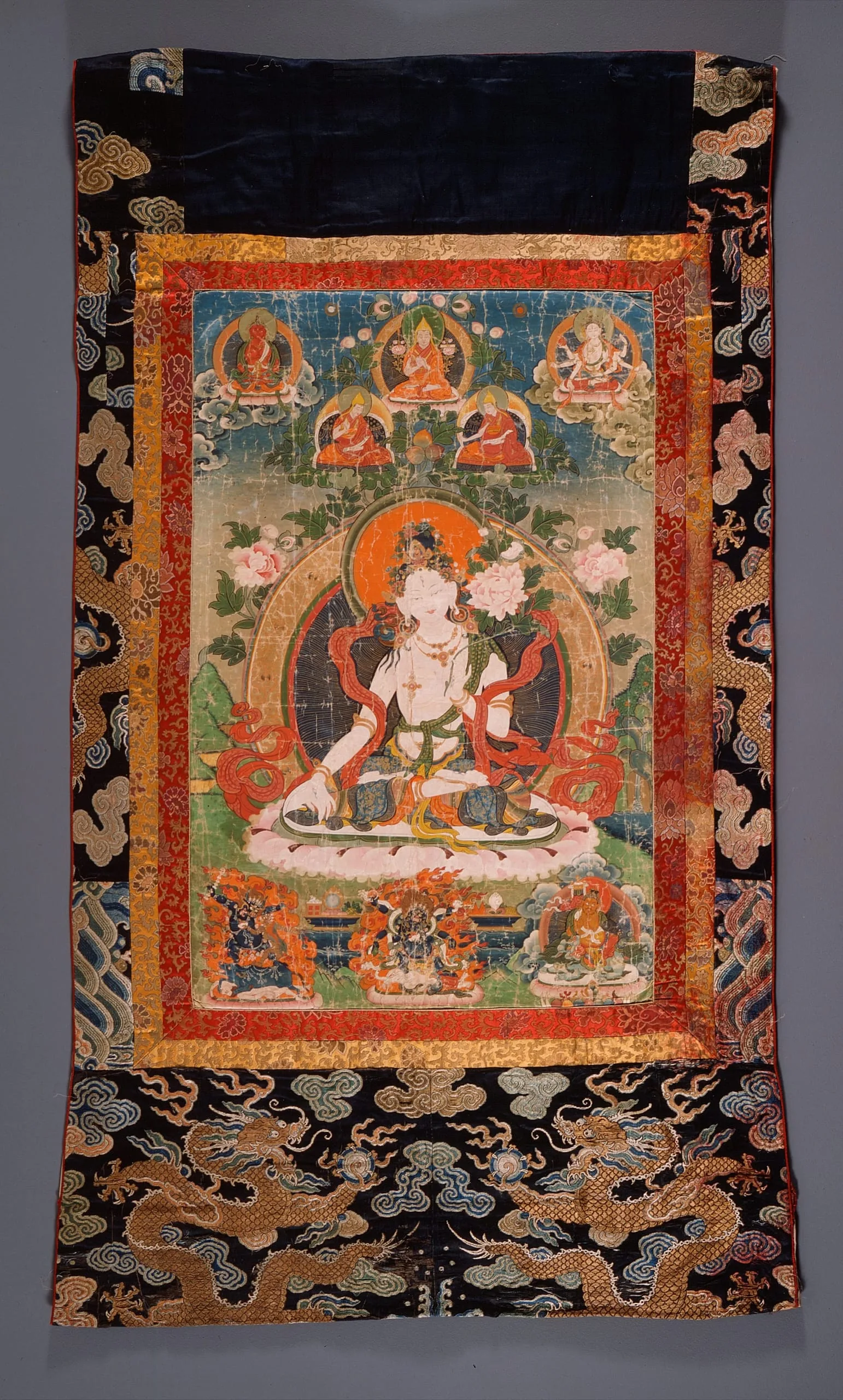
There are many forms of Tara, all of whom help practitioners overcome hindrances and difficulties on the path to Enlightenment. Each Tara has a different symbolic character and associated color. Represented here is White (Sita) Tara, who is a benevolent form of Tara believed to have been born from the Bodhisattva Avalokiteshvara’s tears of compassion. She is associated with healing, longevity, and purification. Sita Tara is regarded as the incarnation of a Chinese princess married to the important early Tibetan King Songtsen Gampo (r. 614-648) who founded the Tibetan Empire (618–842). See also M.77.19.3 and M.84.32.1a-d.
The goddess is appropriately white-skinned and has lush flowers in her hair tied in a bun. She has a third eye and a small forehead image (bimba) of the Jina Buddha Amoghasiddhi. She has a white lotus in her left hand, and her right hand is extended in the gesture of charity (varada mudra). The palms of both hands are graced with an eye symbolic of her omniscience. She is seated in the meditation posture (padma asana) on a lotus base. Behind her is an elaborate aureole (prabhavali) and nimbus. She wears rich jewelry and exquisite textiles. Above her is a triad of Buddhist monks, Tsongkhapa (circa 1357-1419) and his two principal disciples, of the Gelug school wearing their renowned yellow hats. In the upper left corner is the red-skinned Amitayus, while the multiarmed goddess Ushnishavijaya is in the upper right corner. Below Sita Tara are the protective deities from left to right, Yama (see M.71.78), Mahakala (see M.81.90.4 and M.85.293.2), and Kubera or Vaishravana (see M.69.13.8 and AC1992.204.1a-b). The painting is mounted in embroidered silk brocades with imperial five-clawed dragons (see M.2010.81.3).