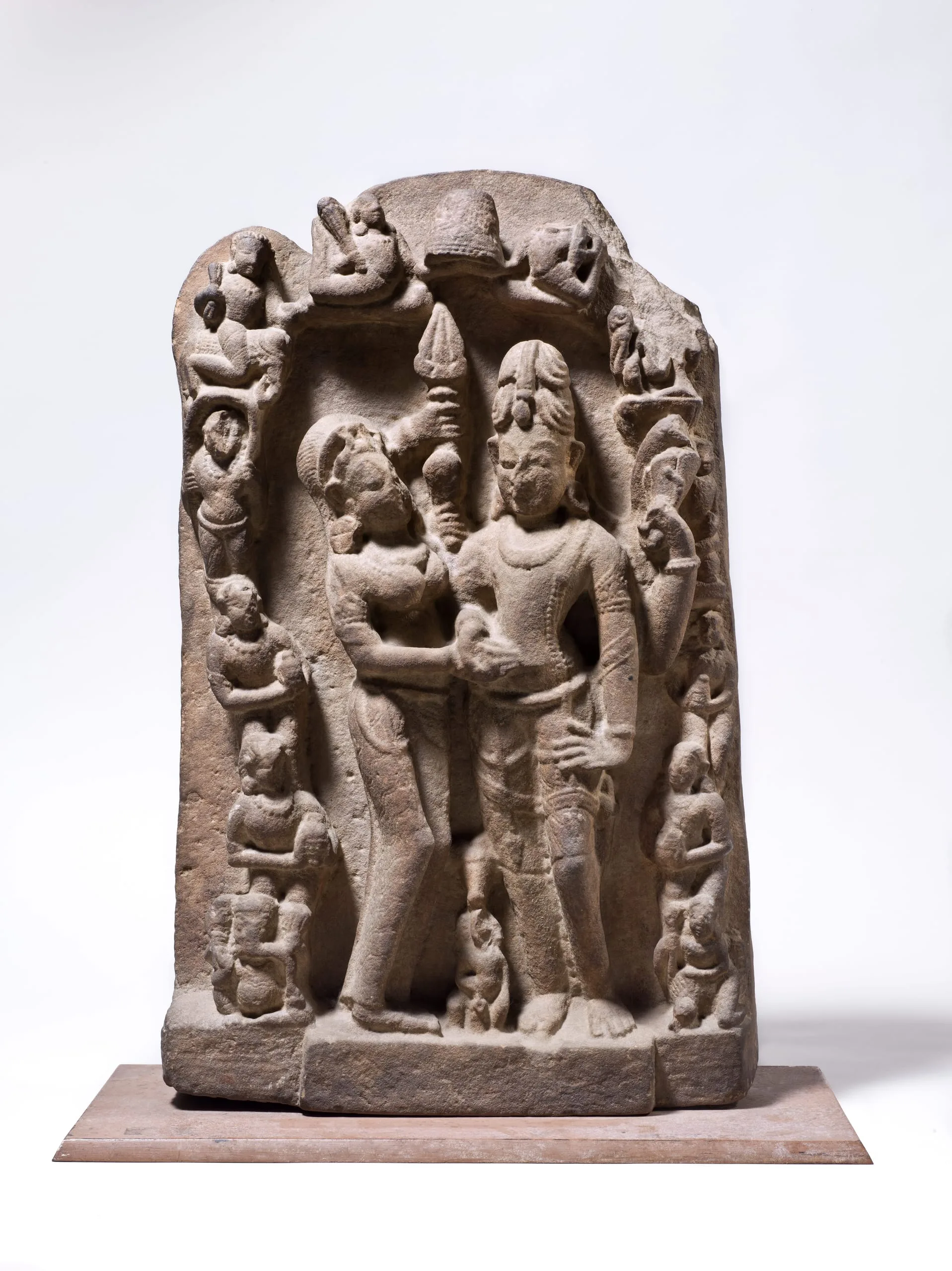
The ‘beautiful’ marriage of Shiva and Parvati (kalyana sundara) was a joyous affair attended by celestial wedding guests. When Shiva became withdrawn and practiced severe austerities after the death of his first wife Sati, he was courted by Parvati, the daughter of King Himavan, the personification of the Himalayan mountains, and Queen Mena (or Mainavati or Menavati). She performed austere penances for 3,000 years to win his heart. When Shiva arrived for the auspicious occasion, he was in his wild ascetic form. In order to appear more suitably for the service, he transformed himself into the embodiment of supreme masculine beauty and radiance (sundaramurti).
In this representation, Shiva has assumed the handsome form of Sundara. He has the piled hair of a yogi (jata mukuta) to emphasize his ascetic nature but is also adorned with jewelry appropriate for a wedding. He is four-armed. With his principal left hand, he takes the right hand of Parvati in the ‘accepting the hand’ ceremony (panigrahana). His principal left hand rests on his hip. In his upper right hand, he holds his trident (trishula). His upper left hand may carry a spray of flowers. Parvati wears an elegant coiffure and is two-armed. She holds her mirror attribute in her left hand. Although they are temporally incongruous in the marriage scene, Shiva and Parvati’s sons, the elephant-headed Ganesh on their right and the youthful God of War Karttikeya on their left, flank the holy couple at the base of the sculpture. Between their legs is a diminutive figure of the god Brahma serving as the officiating priest. Two flying celestial "Bearers of Wisdom" (vidyadharas) hover over the divine bride and groom conveying a crown. Along the sides of the stele are divinities bearing tribute. They likely represent the Eight Guardians of the Directions (ashta dikpala), as the top left two figures are Indra, the Chief of the Gods and Regent of the East, riding his elephant mount Airavata, and Vayu, the God of Wind and Regent of the Northwest, holding a billowing scarf over his head.
A comparable representation attributed to Madhya Pradesh, 11th century, is in the Art Institute of Chicago (2022.4).