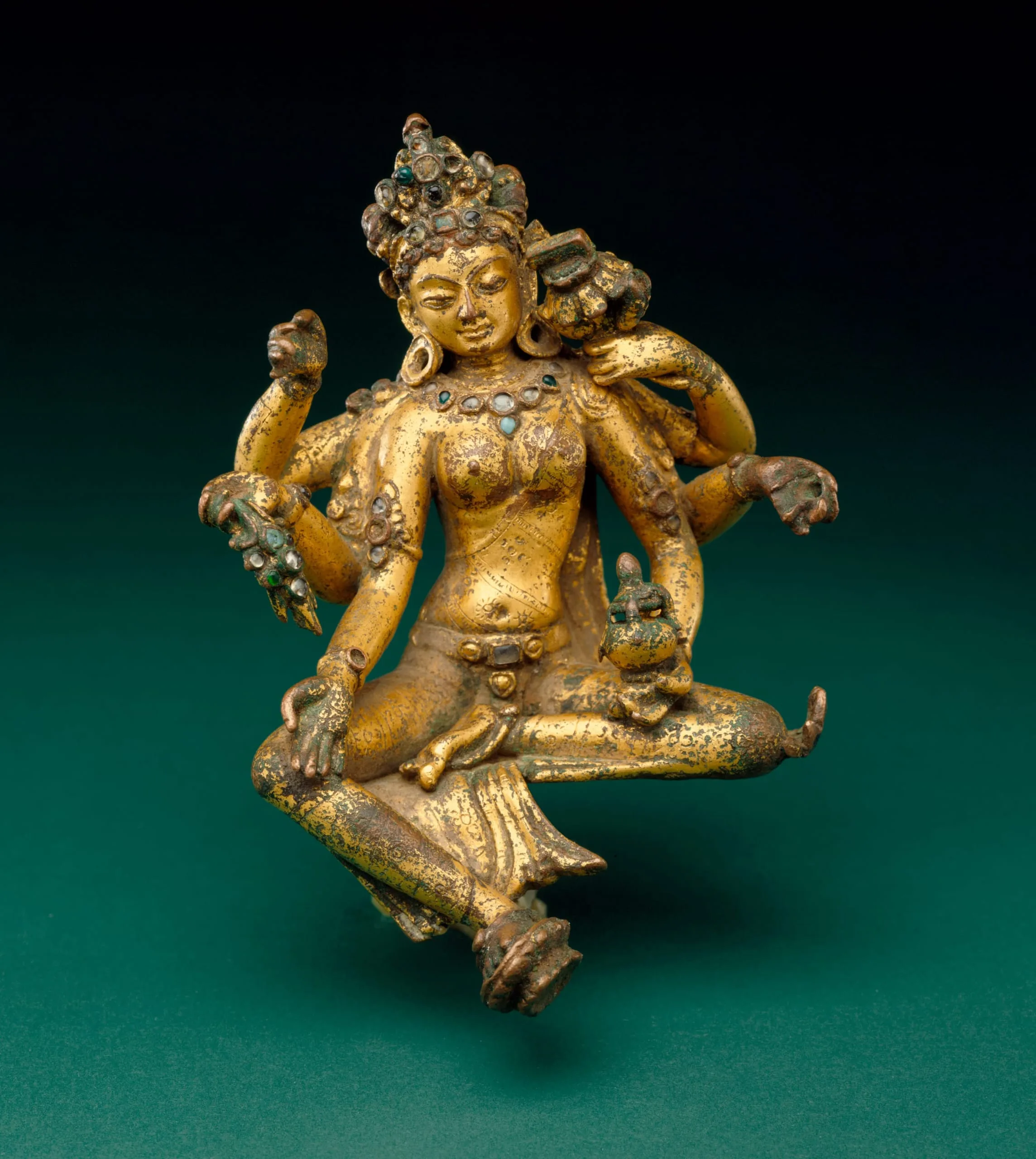
Vasundhara (Bearer of Treasure) is the Newari Buddhist epithet of Vasudhara (Stream of Treasure), the Bodhisattva of wealth, prosperity, and abundance. Vasundhara is the bountiful goddess, the giver of wealth, abundance, and prosperity. As a Buddhist counterpart of Lakshmi, the Hindu goddess of wealth, Vasundhara’s attributes in her six arms symbolize her dual role as provider of abundance and wealth as well as the embodiment of the enlightened state. Vasundhara also has an alternate function in the Newar community. Since the secret "inner" shrines of the transcendental Buddhist deities Chakrasamvara and Vajravarahi are only open to those who have received tantric initiation, Vasundhara serves as the exoteric "double," or public face, of Vajravarahi, the esoteric goddess (yogini) housed in the restricted shrine. Thus, her aspects of the bountiful giver of wealth and transcendent wisdom are accessible to all who worship Vasundhara.
Vasundhara is crowned and wears elegant gem-encrusted jewelry. She sits in a relaxed posture (lalita asana) with her right leg pendant and supported by the pericarp of a lotus flower (karnika). Her lower right hand is held in the gesture of charity (varada mudra). Her middle right hand holds a sheath of jewels (ratna manjari). Her upper right hand is raised in a gesture with curved fingers that pays homage to the Buddha (tathagata vandana mudra). Her lower left hand holds an auspicious Vase of Immortality (tshe bum). Her middle left hand originally held a now-missing sheaf of grain (dhanya manjari). Her upper left hand carries a lotus bearing a manuscript of the Prajnaparamita (Perfection of Wisdom). The sacred text and Buddha-adoring gesture demonstrate Vasundhara’s identification with Prajnaparamita, as the "mother of all Buddhas."
See also M.77.19.7, M.81.8.2, M.91.239, and Himalayan Buddhist Art, https://himalayanbuddhistart.wordpress.com/category/all/nepal/female-characters/vasudhara/page/3/