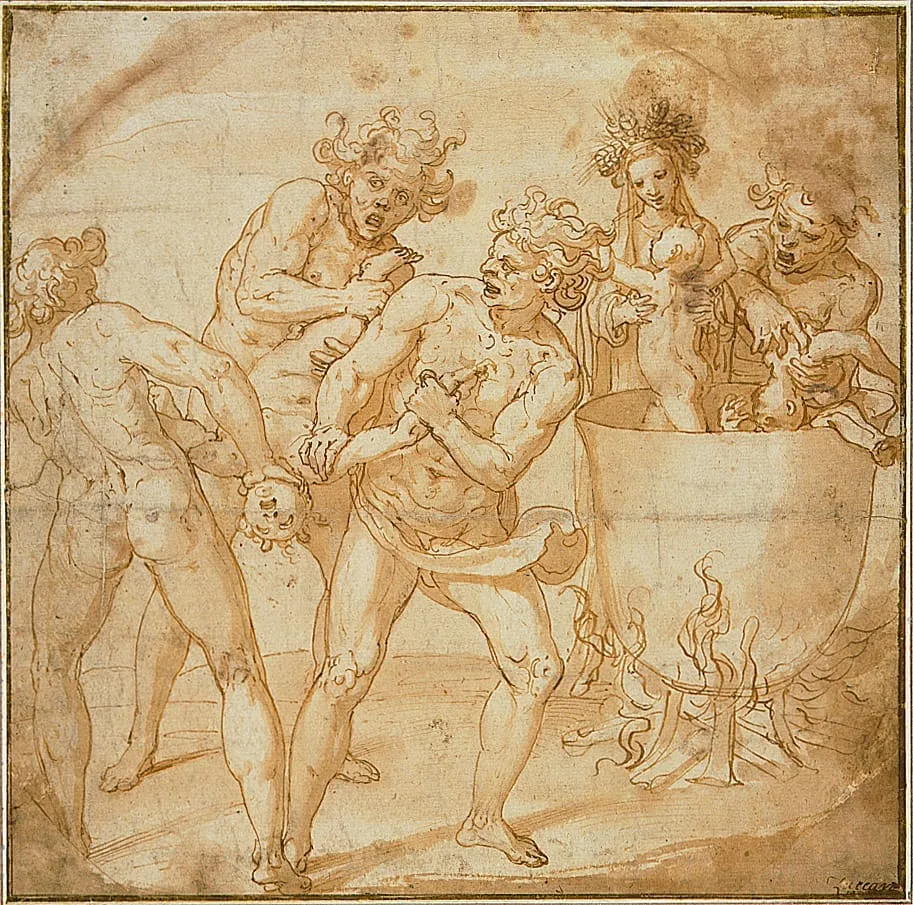
Excerpted from Davis, Bruce. Master Drawings in the Los Angeles County Museum of Art. Los Angeles: Los Angeles County Museum of Art, 1997, 33.
According to Giorgio Vasari, Zuccaro arrived in Rome at the age of fourteen. He was essentially self-taught, guided particularly by the examples of Polidoro da Caravaggio and Perino del Vaga, and was perhaps the most original and talented late mannerist painter in Rome. He executed several commissions for Pope Julius III and Pope Pius IV and for the Farnese family in the Palazzo Farnese in Rome and the Villa Farnese in Caprarola. He died tragically young at the age of thirty-six.
This drawing is a rather complete and detailed study for one of the medallion frescoes in the Camera dell’Autunno on the ground floor of the Villa Farnese. The frescoes, probably begun in 1561 and continued Zuccaro’s death by his brother Federico and others, are considered one of the landmarks in Italian Renaissance decoration. The drawing’s degree of finish and exact correspondence to the painted composition may be related to its probable use as a guide for one of Zuccaro’s assistants. The subject, rather rare in the history of art, is an appropriate one for the country house of a landed aristocrat because of its theme of cyclical renewal, in which the Titans, under orders from the goddess Juno, captured the infant Bacchus, tore him to pieces, and placed him in a boiling cauldron. He was then rescued by his grandmother Rhea and restored to life.