LACMA

ShopMembershipMyLACMATickets
LACMA
Los Angeles County Museum of Art
5905 Wilshire Blvd.
Los Angeles, CA 90036
info@lacma.org
(323) 857-6000
Sign up to receive emails
Subscribe
© Museum Associates 2025

Museum Hours

Monday

11 am–6 pm

Tuesday

11 am–6 pm

Wednesday

Closed

Thursday

11 am–6 pm

Friday

11 am–8 pm

Saturday

10 am–7 pm

Sunday

10 am–7 pm


  • About LACMA
  • Jobs
  • Building LACMA
  • Host An Event
  • Unframed
  • Press
  • FAQs
  • Log in to MyLACMA
  • Privacy Policy
© Museum Associates 2025
Collections

Bagta
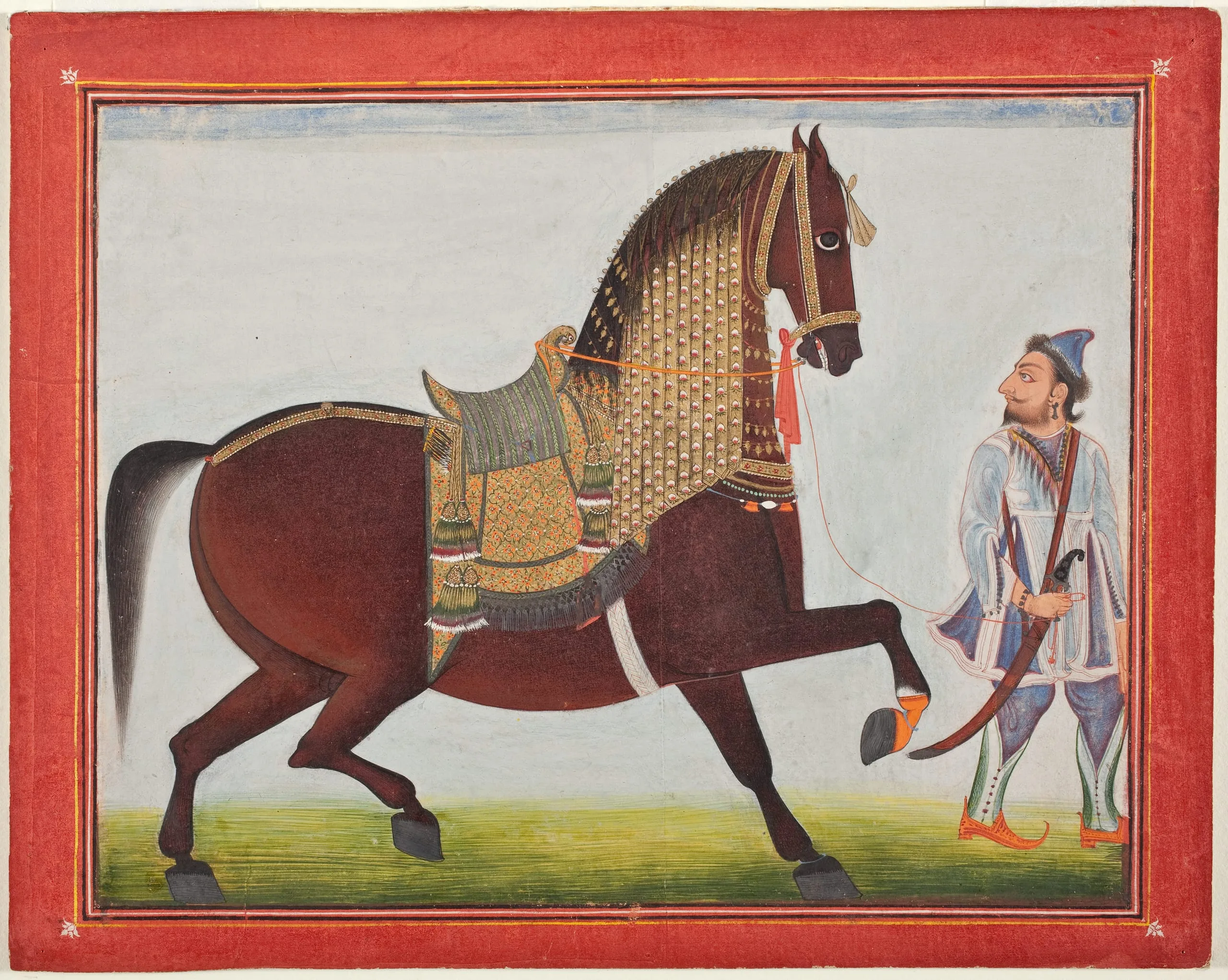
A Horse and his Tradercirca 1800

Not on view
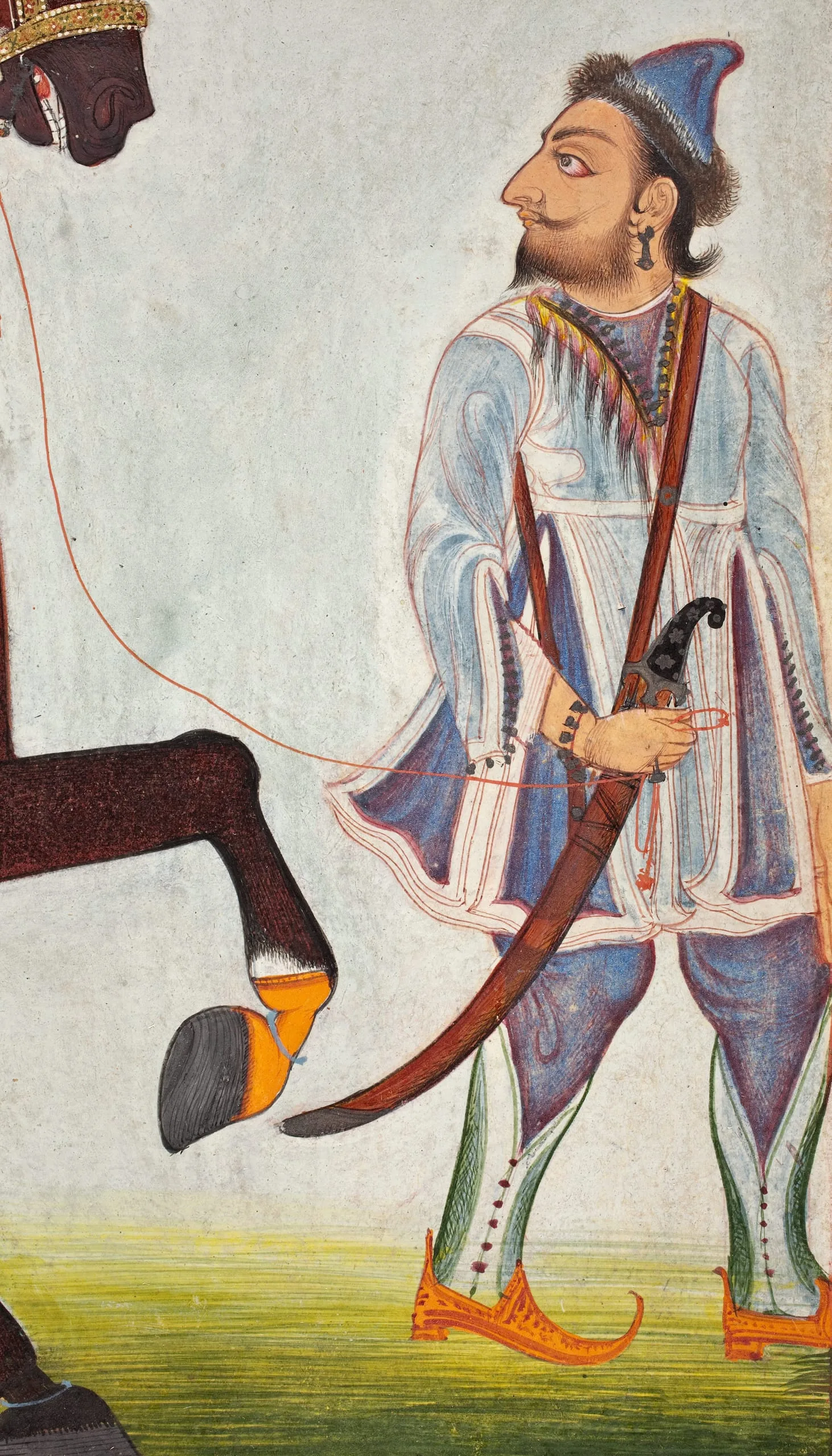
Indian miniature painting of a caparisoned dark brown horse in profile lifting one hoof, led by a man in a blue tunic and tall hat holding a curved sword
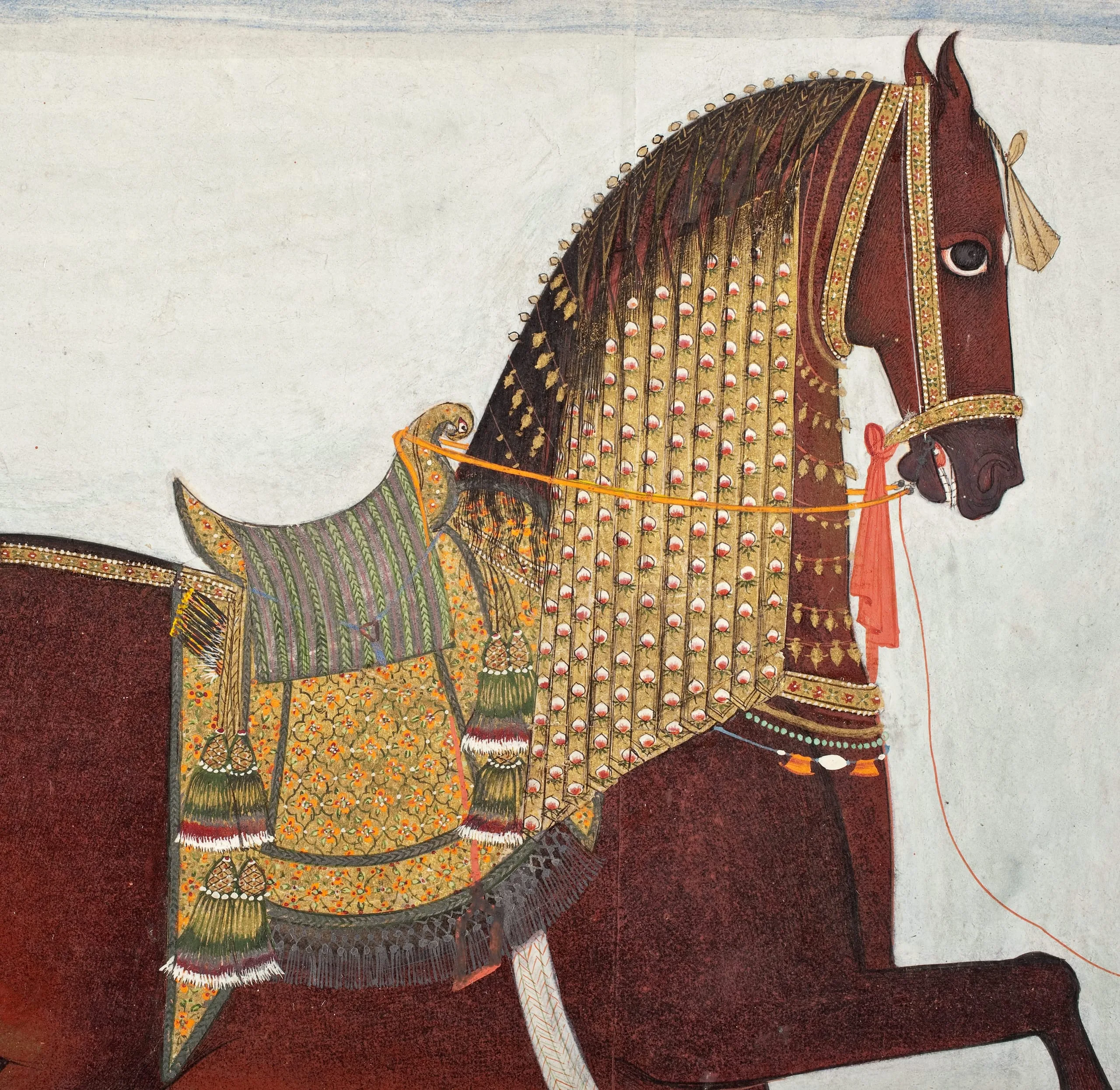
Indian miniature painting of a dark bay horse in profile, adorned with an elaborately decorated mane braided with gold and pink floral ornaments, a jeweled bridle with orange and red tassels, and a layered saddle cloth in gold floral and striped green textile with fringe and tassel details, against a pale grey ground.
Opaque watercolor painting in Pahari or Mughal style; a standing male figure in blue jama, turban, and pointed shoes holds a curved sword, connected by a red cord to a dark-skinned seated figure at upper left, against a pale gray ground.
Artist or Maker
Bagta
India, active circa 1761-1814
Title
A Horse and his Trader
Place Made
India, Rajasthan, Mewar, Deogarh
Date Made
circa 1800
Medium
Opaque watercolor and gold on paper
Dimensions
Image: 7 5/8 x 9 3/4 in. (19.36 x 24.76 cm); Sheet: 9 1/8 x 11 1/2 in. (23.17 x 29.21 cm)
Credit Line
Purchased with funds provided by Mr. Joseph Koepfli
Accession Number
M.79.69
Classification
Drawings
Collecting Area
South and Southeast Asian Art
Curatorial Notes

According to the devanagari inscription on the reverse, this portrait of a spirited chestnut stallion was painted by Bagta (or Bakhta, active circa 1761-1814). He worked in the Mewar royal painting atelier in Udaipur in circa 1761-1768 and then became the court painter at the feudatory (thikana) of nearby Deogarh (or Devgarh) in 1769-1814. He was the father of Chokha (active circa 1799-1826). See AC1993.191.2.

Not only were innumerable equestrian portraits made of the rulers of Mewar and its feudatories (see M.80.223.3), but also in vogue were series of portraits of often named exemplary horses. See six horse portraits in the National Gallery of Victoria, Melbourne (AS201–AS206-1980) and seven horse portraits in the Isabella and Vicky Ducrot Collection (ME 52–58). Several of these horse portraits are dated by inscription between 1762-1765. Horse portraits were also painted by Bagta, as documented by their inscriptions. For example, see two Bagta horse portraits in the Fralin Museum of Art, University of Virginia, Charlottesville (83.17.1–.2).

In this portrait, a spirited chestnut stallion has a gold brocade saddle with a matching saddlecloth and large tassels. He has bejeweled gold headgear and crupper, and gold pleats with floral sprays hanging from his mane. Horse portraits normally include a syce or groom, but here the man’s Central Asian garments, particularly his conical cap with a fur collar, suggest he may be a foreign trader.
Selected Bibliography
  • El Universo de la India: Obras Maestras del Museo de Arte del Condado de Los Angeles. Santiago: Centro Cultural Palacio La Moneda, 2012.