LACMA

ShopMembershipMyLACMATickets
LACMA
Los Angeles County Museum of Art
5905 Wilshire Blvd.
Los Angeles, CA 90036
info@lacma.org
(323) 857-6000
Sign up to receive emails
Subscribe
© Museum Associates 2026
  • About LACMA
  • Jobs
  • Building LACMA
  • Host An Event
  • Unframed
  • Press
  • FAQs
  • Log in to MyLACMA
  • Privacy Policy
© Museum Associates 2026
Collections

Jean-Guillaume Moitte
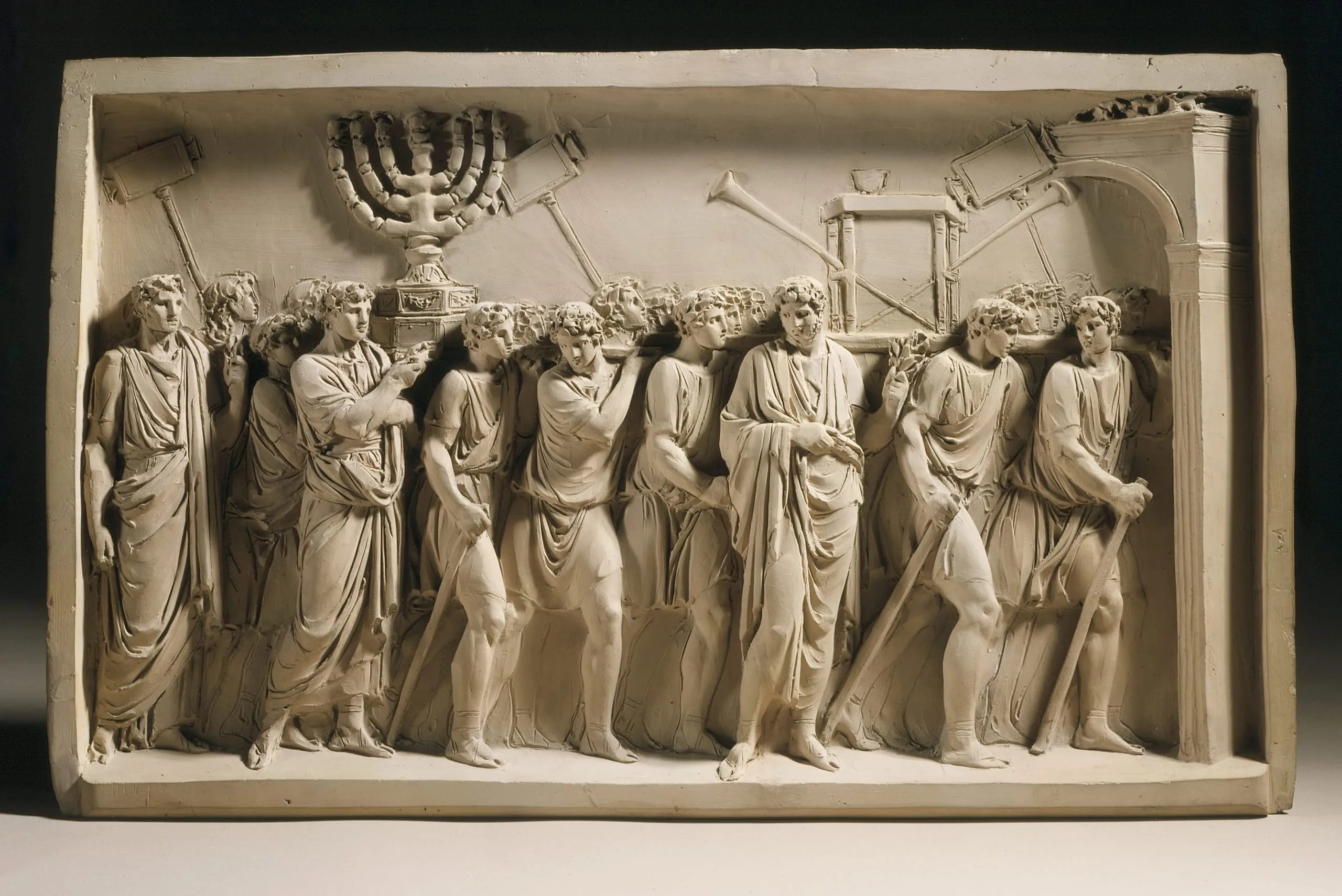
Spoils of the Temple: After a Relief from the Arch of Titus, Romecirca 1791

On view:
Geffen Galleries, Classical Revivals in Europe and America
Horizontal plaster or pale stone relief sculpture depicting a Roman-style procession of robed figures carrying a large menorah, staffs, and a trumpet, with a stone arch at right

Jean-Guillaume Moitte, Spoils of the Temple: After a Relief from the Arch of Titus, Rome, circa 1791, Los Angeles County Museum of Art, Purchased with funds provided by Camilla Chandler Frost, photo © Museum Associates/LACMA

Artist or Maker
Jean-Guillaume Moitte
France, Paris, 1746-1810, active Italy, Rome
Title
Spoils of the Temple: After a Relief from the Arch of Titus, Rome
Date Made
circa 1791
Medium
Earthenware
Dimensions
14 × 23 1/2 × 2 1/2 in. (35.56 × 59.69 × 6.35 cm)
Credit Line
Purchased with funds provided by Camilla Chandler Frost
Accession Number
M.79.49
Classification
Sculpture
Collecting Area
European Painting and Sculpture
Curatorial Notes

In the second half of the eighteenth century, a trip to Rome was not only essential for members of the educated upper class but a prerequisite to artistic success. Artists in training at the French Academy who demonstrated sufficient talent received scholarships for residencies in Rome to study antiquities and the works of Renaissance masters. Jean-Guillaume Moitte won such a scholarship, the Prix de Rome, in 1768. He lived in the city from 1771 to 1773, engaging with the methods and subjects of classical art and architecture.

This work is a study of one of the reliefs on the Arch of Titus (made in 81 CE) and preserves some of the composition of the Roman original that has since been destroyed. It presents the moments after the Romans sacked the temple in Jerusalem and carried Jewish captives and religious objects back to Rome. Its refined detail and linear quality are enlivened by Moitte’s adept draftsmanship. His most successful sculptural works were produced in the same format—multifigure or portrait reliefs—on public monuments in Paris. After teaching at the national school of fine arts in Paris, Moitte returned to Rome in 1796. In the wake of Napoleon’s victory in Italy, he and other high-ranking officials of the arts of France were instructed to seize works from the Capitoline and Vatican museums. Masterworks such as the Apollo Belvedere and the Laocoön were delivered to Paris and paraded around the streets before entering the Louvre, not unlike the procession of spoils depicted in this small study. In 1815, following Napoleon’s defeat, the sculptures were returned to Italy.

2025
Selected Bibliography
  • Schaefer, Scott, and Peter Fusco. European Painting and Sculpture in the Los Angeles County Museum of Art: an Illustrated Summary Catalogue. Los Angeles: Los Angeles County Museum of Art, 1987.