LACMA

ShopMembershipMyLACMATickets
LACMA
Los Angeles County Museum of Art
5905 Wilshire Blvd.
Los Angeles, CA 90036
info@lacma.org
(323) 857-6000
Sign up to receive emails
Subscribe
© Museum Associates 2025

Museum Hours

Monday

11 am–6 pm

Tuesday

11 am–6 pm

Wednesday

Closed

Thursday

11 am–6 pm

Friday

11 am–8 pm

Saturday

10 am–7 pm

Sunday

10 am–7 pm


  • About LACMA
  • Jobs
  • Building LACMA
  • Host An Event
  • Unframed
  • Press
  • FAQs
  • Log in to MyLACMA
  • Privacy Policy
© Museum Associates 2025
Collections

Unknown
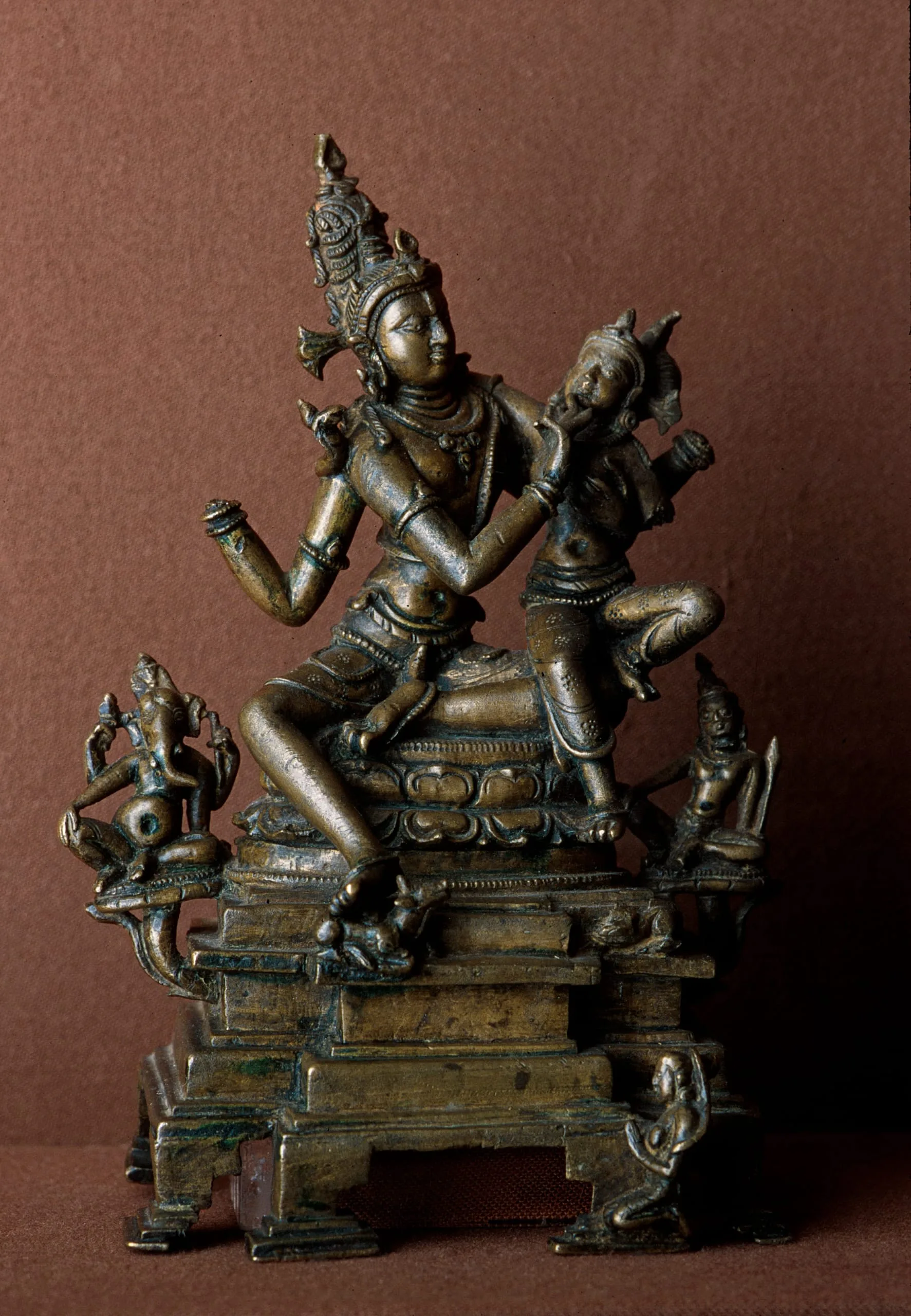
Shiva's Family10th century

Not on view
Bronze sculpture of two figures seated on a lotus throne atop a stepped base, with smaller attendant figures at the corners, gold-toned patina with green verdigris
Artist or Maker
Unknown
Title
Shiva's Family
Place Made
India, Bihar, Gaya District
Date Made
10th century
Medium
Copper alloy with traces of paint
Dimensions
6 3/4 x 4 1/2 x 3 1/2 in. (17.14 x 11.43 x 8.89 cm)
Credit Line
From the Nasli and Alice Heeramaneck Collection, Museum Associates Purchase
Accession Number
M.79.9.3
Classification
Sculpture
Collecting Area
South and Southeast Asian Art
Curatorial Notes

Family portraits of the Hindu god Shiva and his spouse Uma (or Parvati) are generally known in Sanskrit texts as Uma-Maheshvara (“Uma and the Great Lord” [Shiva]). Their children Ganesha and Kumara typically accompany them. In eastern Indian representations of this theme, such as the present example, the divine couple’s love for each other is clearly expressed by their degree of physical intimacy. In contrast, central Indian representations are more formal and their interaction is subdued (see M.75.11).

Shiva and Parvati sit on a double lotus base on a tiered pedestal. They are embracing with their arms around each other. Shiva is turned towards Parvati and caresses her cheek and breast with two of his four hands (the other two are now missing, as is Parvati’s left arm). Shiva is ithyphallic (urdhva linga), symbolizing the generative energy of the universe. His right foot is supported by his bull mount Nandi. Parvati’s lion mount is symmetrically placed opposite Nandi. On their right side, the elephant-headed Ganesha sits on a separate lotus base. They are flanked on their left side by the youthful Kumara sitting on his own lotus base. He holds his spear attribute. At the bottom right of the pedestal, a female donor knells with her hands held in the gesture of adoration (anjali mudra). The remnants of blue paint in Shiva’s piled hair (jata mukuta) likely indicates that the bronze may have once been under worship in Nepal or Tibet.
Selected Bibliography
  • Pal, Pratapaditya. Indian Sculpture, vol.2. Los Angeles: Los Angeles County Museum of Art; University of California Press, 1988.
  • Ray, Nihar Ranjan, Karl Khandalavala, and Sadashiv Gorakshkar. Eastern Indian Bronzes. New Delhi: Lalit Kalā Akademi, 1986.
  • Rosenfield, John. The Arts of India and Nepal: The Nasli and Alice Heeramaneck Collection. Boston: Museum of Fine Arts, Boston, 1966.