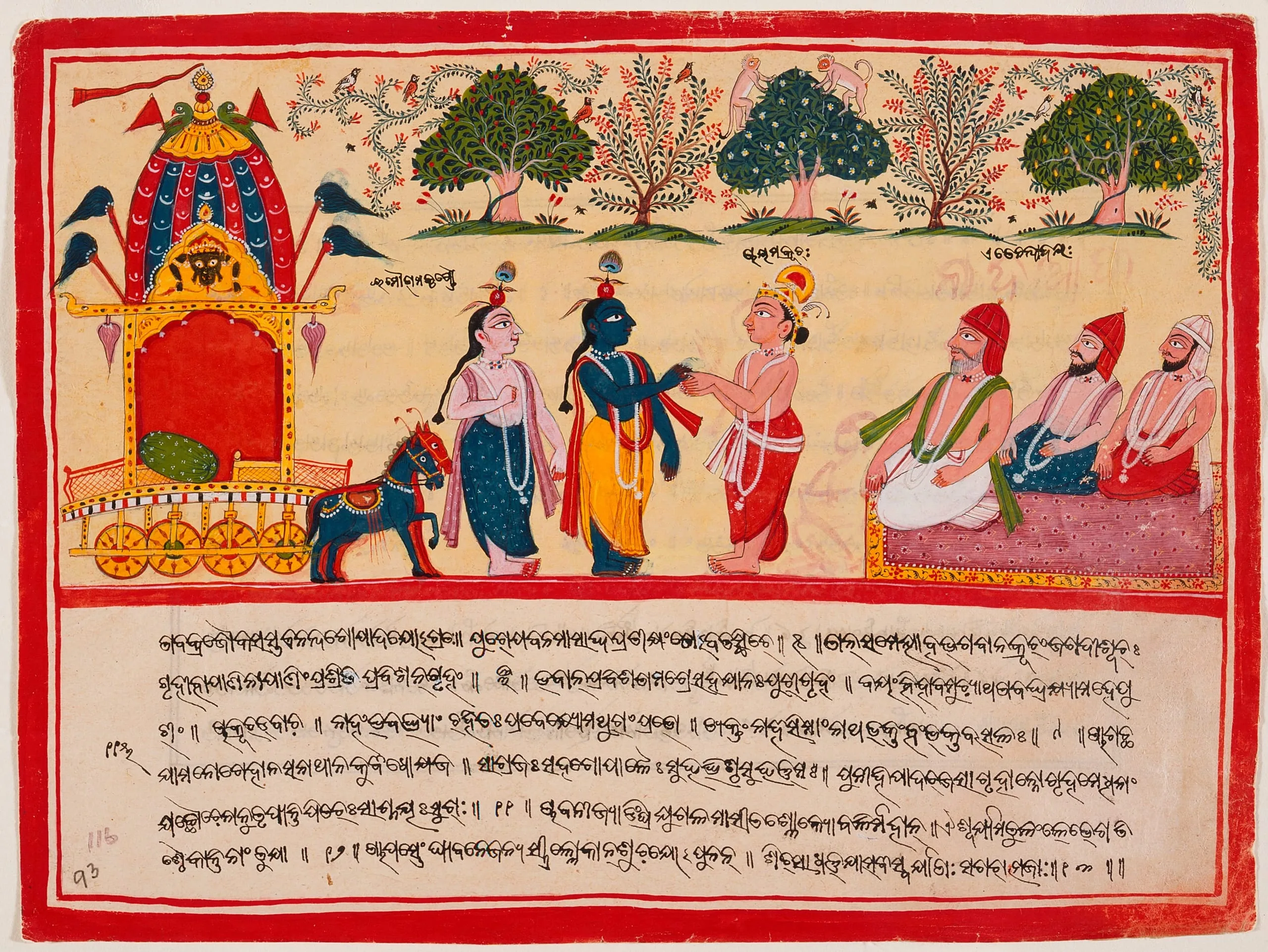
The Bhagavata Purana (Ancient Stories of the Lord) is traditionally ascribed to the legendary poet-sage Vyasa in the 8th-10th century CE. It stresses the path of devotion (bhakti) to Krishna, the eighth incarnation of Vishnu, the Hindu God of Preservation. To fulfill his role as the guardian of the world and savior of humanity, Vishnu appears as a succession of heroic animals and semi-mortal saviors, called avatars, through which he intervenes in times of crisis or unrighteousness.
In this illustration, Krishna and Balarama arrive in the forest to meet the Pandava brothers, heroes of the Mahabharata ([War of the] Great Bharatas). The eldest brother Yudhishthira had lost his kingdom and capital city of Indraprastha in a rigged game of dice. Here, the blue-skinned Krishna and his brother Balarama descend from their chariot to meet Arjuna and three seated Pandava brothers, the eldest Yudhisthira and the two twins Nakula and Sahadeva. Bhima, the second brother, is absent.
In contrast to the slightly earlier Odhisan Bhagavata Purana folio M.75.114.7 in which the Sanskrit text is written in devanagari, here the Sanskrit verses are written in Odia (Oriya) script.
Additional folios from this dispersed series are in the Metropolitan Museum of Art, New York (1981.461) and Norton Simon Museum, Pasadena (P.2003.02.03).