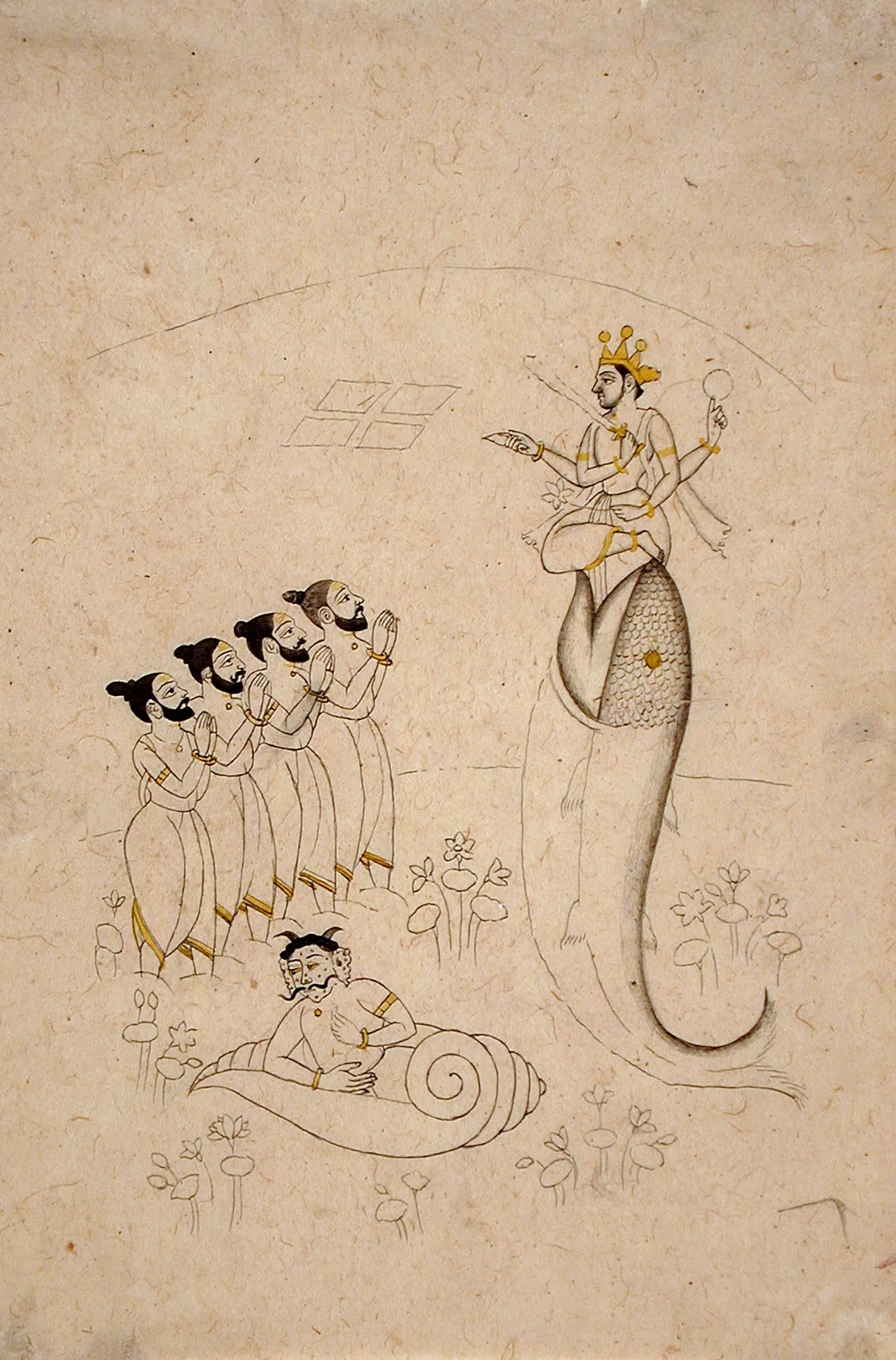
The Hindu god Vishnu is believed to be the preserver of the universe. As the guardian of the earth, Vishnu assumes various forms called avatars, through which he intervenes for the benefit of humankind during times of crisis. The first avatar is Matsya, the fish, whose form Vishnu assumed in order to save Manu, the lawgiver and founder of humanity, from the Great Flood. As Matsya, Vishnu also fought in the cosmic waters to retrieve the four Vedas, the sacred texts of proto-Hinduism and Hinduism. They had been stolen while he was sleeping from Brahma, the Hindu god of creation, by a powerful demon named either Hayagriva (Horse-Neck) or Shankhasura (Conch Demon) depending on the textual source.
Matsya is depicted as a great fish rising vertically out of a lotus pond signifying the cosmic ocean where the Vedas had been hidden. Emerging out of the fish’s mouth and seated on his snout like on a throne in the relaxed posture (lalita asana), the crowned Vishnu is portrayed as a regal figure. He has "golden" armlets, bracelets, and anklets. He wears a dhoti and a long flowing scarf (angavastra). In his four arms, he carries symbolic attributes (from upper left hand clockwise): a discus (chakra), lotus (padma), sword (khadga), and conch (shankha). The horned demon sprawls on his conch shell looking defeated. Four bearded holy men with top knots and sectarian markings on their forehead rise from the waters to venerate Vishnu with their hands joined in the gesture of adoration (anjali mudra). They personify or represent the purloined four Vedas, as do the four rectangles above that reference the physical form of the four sacrosanct manuscripts.
See also AC1995.94.1, AC1998.255.2 and AC1998.255.3