LACMA

ShopMembershipMyLACMATickets
LACMA
Los Angeles County Museum of Art
5905 Wilshire Blvd.
Los Angeles, CA 90036
info@lacma.org
(323) 857-6000
Sign up to receive emails
Subscribe
© Museum Associates 2025

Museum Hours

Monday

11 am–6 pm

Tuesday

11 am–6 pm

Wednesday

Closed

Thursday

11 am–6 pm

Friday

11 am–8 pm

Saturday

10 am–7 pm

Sunday

10 am–7 pm


  • About LACMA
  • Jobs
  • Building LACMA
  • Host An Event
  • Unframed
  • Press
  • FAQs
  • Log in to MyLACMA
  • Privacy Policy
© Museum Associates 2025
Collections

Unknown
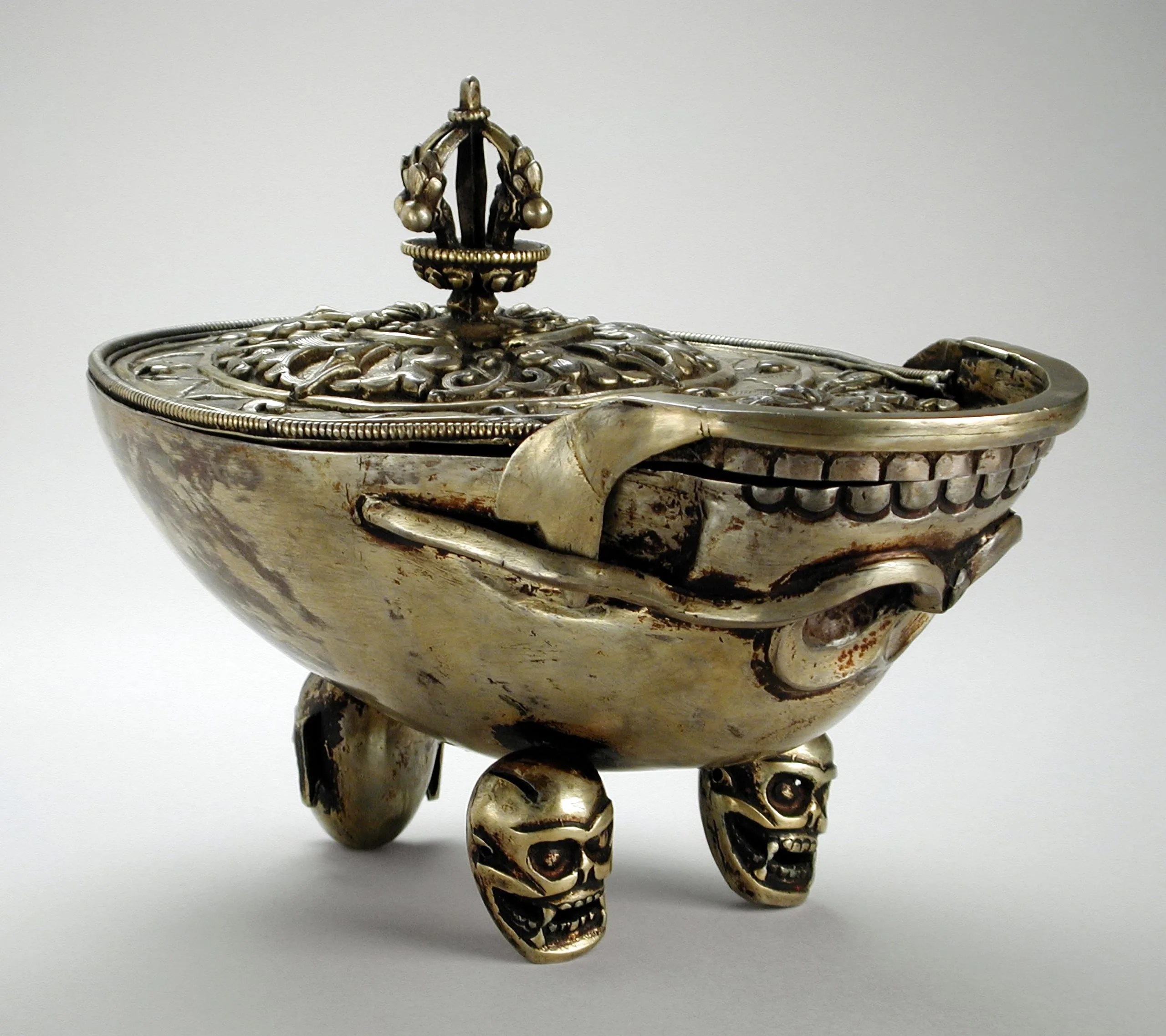
Ritual Skull Cup with Lid18th-19th century

Not on view
Silver-toned metal vessel with an oval body, a repoussé floral lid topped with a vajra finial, a sculpted open-mouthed face on the front, and three skull-form feet in golden brass
Artist or Maker
Unknown
Title
Ritual Skull Cup with Lid
Place Made
Eastern Tibet, Kham region, Derge (?) or China
Date Made
18th-19th century
Medium
Gilt silver and silver
Dimensions
Overall: 6 1/2 x 8 x 6 in. (16.51 x 20.32 x 15.24 cm)
Credit Line
Purchased with funds provided by Anna Bing Arnold
Accession Number
M.79.243.4a-b
Classification
Furnishings
Collecting Area
South and Southeast Asian Art
Curatorial Notes

The skull cup (kapala), symbolic of the transitory nature of existence, is an essential part of the Tantric tradition in Vajrayana Buddhism. Skulls are gathered from the charnel fields, or reportedly bequeathed by the monks themselves. They are never taken from living persons killed for the purpose of obtaining their skull. In the Chakrasamvara meditations, the practitioner or Yogin creates a mandala of impure substances, the five nectars and the five meats, in the skull cup. These meditational substances symbolize all the negativity possessed by that individual. The practitioner would then visualize boiling this negativity into a mercury-like elixir, into which a ritual staff (khatvanga) is melted. Once produced, the liquid is consumed, symbolizing the complete destruction of all negativities, and the practitioner is purified and, thus, prepared for the completion stage of the meditations.

Unlike the other skull cup in LACMA’s collection (M.82.201a-c) that is made from a section of a human cranium, this skull cup is made entirely of gilt silver and silver. It is shaped like an upside down human skull with deep eye sockets and two rows of silver teeth, one on the edge of the cup and the corresponding set on the lid. In contrast to the plain body of the cup, the lid is exquisitely adorned with natural and cosmic symbols. The area over the jaw of the skull has a lotus rising from the cosmic waters. The center of the lid has a mandala with two receding circles. The other circle has a band of mountain peaks. The inner circle has a double thunderbolt or double dorje (vishva vajras) surmounted by a five-pronged thunderbolt (vajra) that functions as the lid’s handle. The skull cup is supported by two grinning skulls in the front and a placid human or divine head in the rear.
Selected Bibliography
  • Pal, Pratapaditya. Art of Tibet. Los Angeles; Berkeley, CA: Los Angeles County Museum of Art; University of California Press, 1983.
  • Maxwell, Gail. Visual Art for Meditation: Resource Book. Los Angeles: Museum Associates/Los Angeles County Museum of Art, 2005.
  • Pal, Pratapaditya. "Art and Ritual in Buddhism." Asian Art vol. II, no. 3 (Summer 1989): 33-55.
  • McArthur, Meher. Reading Buddhist Art: An Illustrated Guide to Buddhist Signs and Symbols. London: Thames & Hudson, 2002.
  • Pal, Pratapaditya. Art of Tibet. Expanded edition. Los Angeles: Los Angeles County Museum of Art, 1990.