LACMA

ShopMembershipMyLACMATickets
LACMA
Los Angeles County Museum of Art
5905 Wilshire Blvd.
Los Angeles, CA 90036
info@lacma.org
(323) 857-6000
Sign up to receive emails
Subscribe
© Museum Associates 2026
  • About LACMA
  • Jobs
  • Building LACMA
  • Host An Event
  • Unframed
  • Press
  • FAQs
  • Log in to MyLACMA
  • Privacy Policy
© Museum Associates 2026
Collections

Unknown
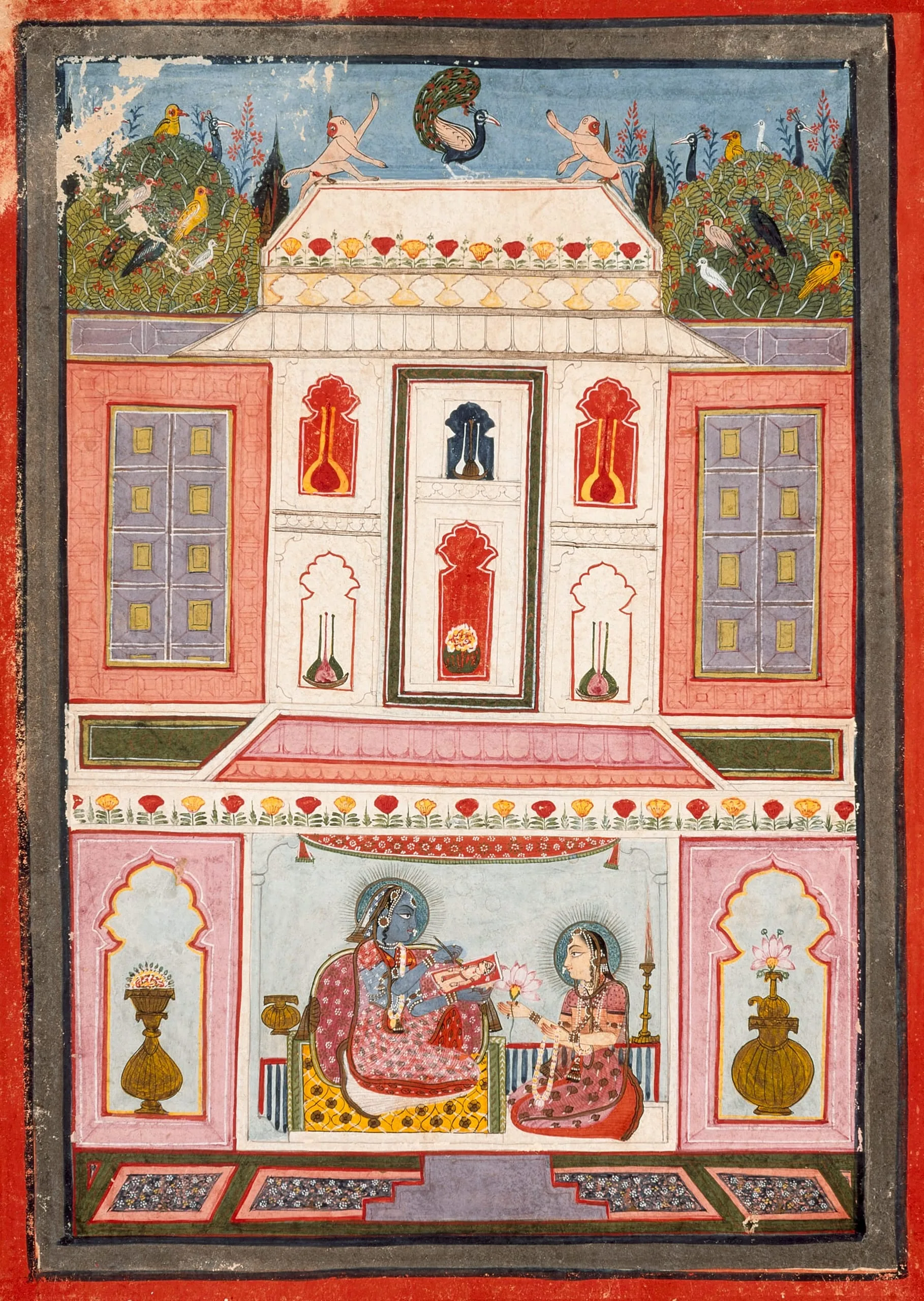
Dhanashri Ragini, First Wife of Dipak Raga, Folio from a Ragamala (Garland of Melodies)circa 1700

Not on view
Indian opaque watercolor painting showing two haloed figures — one blue-skinned, one fair-skinned — seated in a palace alcove, with a detailed architectural facade above and birds on the rooftop terrace

Unknown, Dhanashri Ragini, First Wife of Dipak Raga, Folio from a Ragamala (Garland of Melodies), circa 1700, Los Angeles County Museum of Art, Gift of Paul F. Walter, photo © Museum Associates/LACMA

Artist or Maker
Unknown
Title
Dhanashri Ragini, First Wife of Dipak Raga, Folio from a Ragamala (Garland of Melodies)
Place Made
India, Madhya Pradesh, Bundelkhand or Malwa
Date Made
circa 1700
Medium
Opaque watercolor, gold, and ink on paper
Dimensions
Sheet: 11 x 8 in. (27.94 x 20.32 cm); Image: 9 1/2 x 6 3/8 in. (24.13 x 16.19 cm)
Credit Line
Gift of Paul F. Walter
Accession Number
M.79.191.27
Classification
Drawings
Collecting Area
South and Southeast Asian Art
Curatorial Notes

On the reverse is a Sanskrit inscription describing the melody (written twice), the title written in red, and the set number thirty. The verse reads:
With a complexion like the tender shoots of grass (durba), the charming lady sheds drops of tears as, drawing board in hand, she draws her lover.

Dhanashri Ragini is the first wife of Dipak Raga in the predominant ragamala (garland of melodies) classification system generally known as the Rajasthani system. The devanagari inscription in the header identifies the melody by the variant spelling of “Dhanasari Ragani.” It is a pining melody associated with the afternoon and Autumn (September–November). The melody is personified as a heroine painting her absent lover’s portrait.

Here, a heroine with dark skin the color of grass (durba) is seated against a bolster on a verandah in a two-story palace. She is painting a portrait of a Rajput prince. A female companion sits in front of her holding a lotus and a floral garland. Both women are atypically nimbate. A golden lota is behind her. Behind her companion is a lamp (dipak), signifying her association with Dipak Raga. The blue sky indicates it is a daytime melody. See also M.81.8.10.

A Malashri Ragini from this series is in the Chazen Museum of Art, University of Wisconsin–Madison (1981.281).