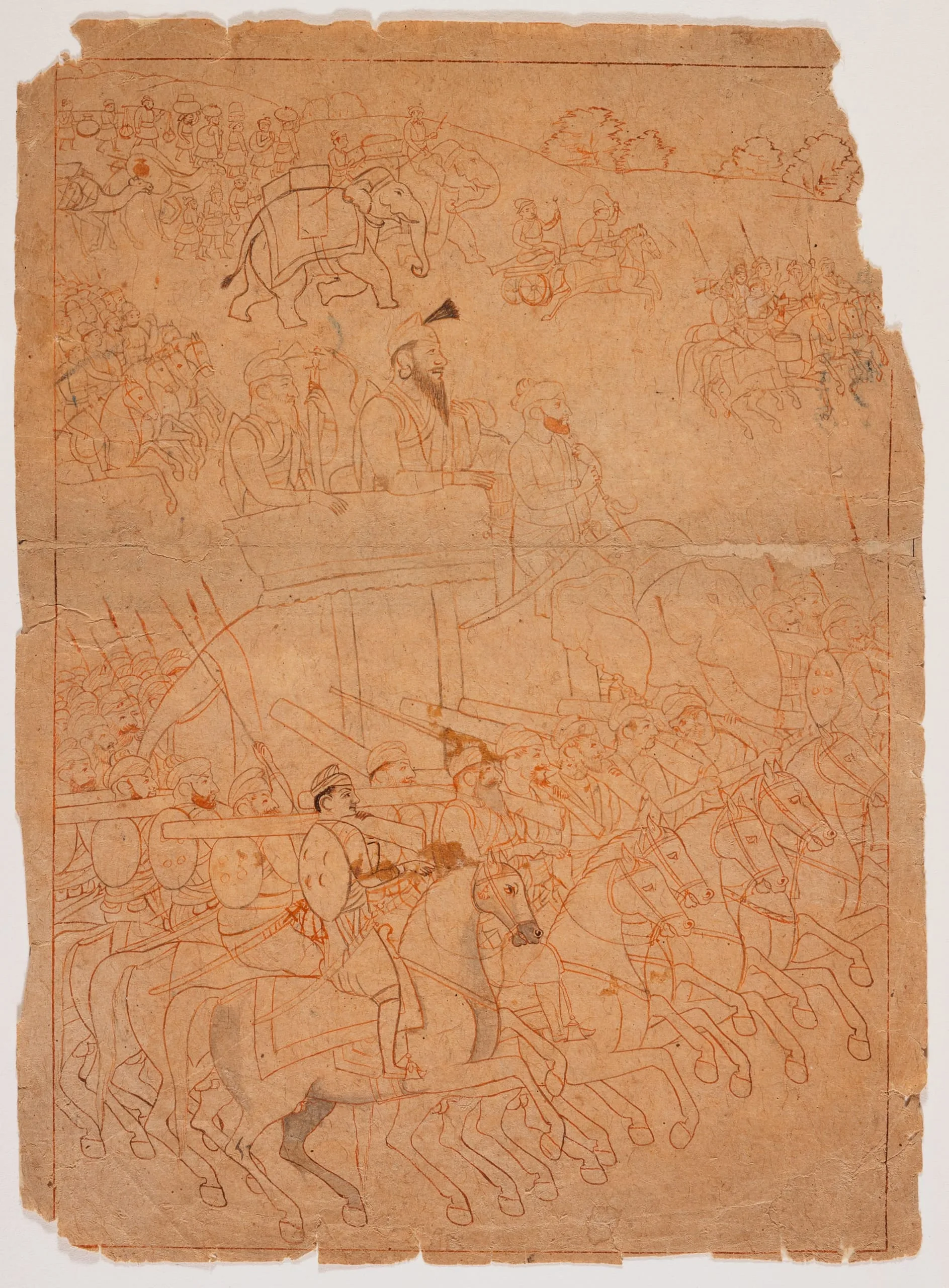
This preparatory sketch possibly depicts Yuvraj (Crown Prince) Kharak Singh (1801–1840). He was the eldest son of Maharaja Ranjit Singh (r. 1801–1839), founder of the Sikh Empire (1799–1849). (See also AC1994.59.5.) Kharak Singh led a major military expedition in October 1835 to Shikarpur, a thriving commercial and manufacturing hub on the caravan trade routes through the Bolan Pass into Afghanistan. The expedition and impending siege were halted by Ranjit Singh in December 1835, however, in the face of fierce diplomatic opposition by the British East India Company that feared a total Sikh annexation of the region. Following the death of Ranjit Singh in June 1839, Kharak Singh became the second Maharaja of the Sikh Empire (r. June–October 1839). He served in that position for only six months until he was deposed in a coup led by his son Prince Nau Nihal Singh (1821–1840), whose subsequent reign as Maharaja (r. 1839–1840) lasted only one year until his possibly accidental death.
The focal point of the composition is the bearded commander riding in a howdah on an elephant in the center of the drawing. Based on comparisons with other portraits, he may be Kharak Singh, who is typically portrayed with a slightly bulbous nose and long pointed beard. Kharak Singh wears a low, pointed turban with an aigrette. He is accompanied by a sword bearer and a mahout. Beneath him is a large brigade of soldiers on horseback. Above him are vignettes of additional mounted soldiers as well as an officer on a racing horse-drawn cart and a supply chain with elephants, camels, and men carrying various provisions.
Comparable portraits of Kharak Singh, attributed to circa 1838–1870, are in the Victoria and Albert Museum, London (IM.57-1936, IS.338-195, IS.113-1953, IS.157-1954, and 03601(IS)).