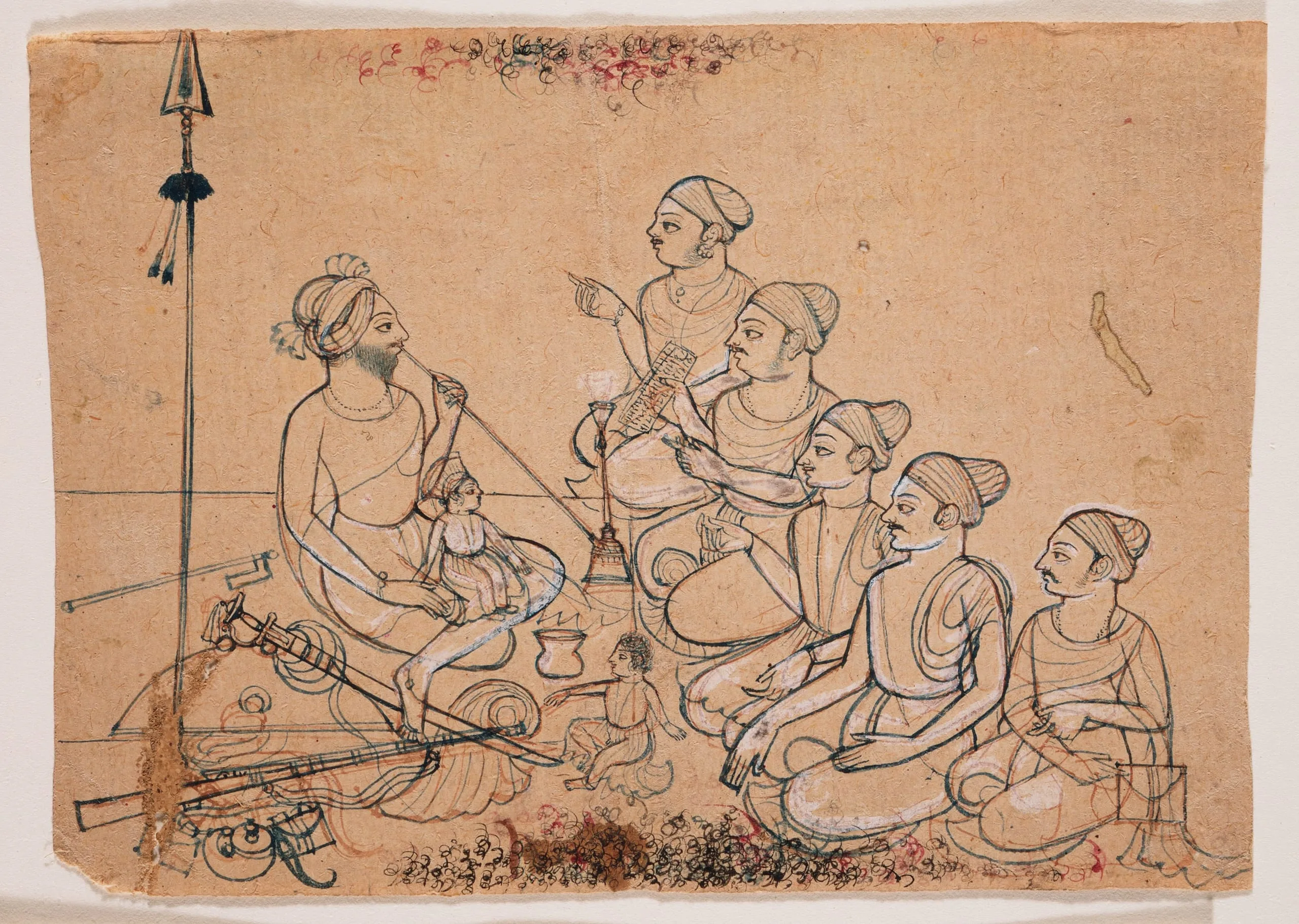
Recto: This preparatory sketch is dated to 1786 (VS 1844) by a devanagari inscription on the reverse (Translation by Stephen Markel.) Inscribed during the reign of Maharao Umaid Singh I (r. 1771–1819), the genre sketch likely portrays one of the younger brothers of Umaid Singh I since his own sons were either infants or still unborn in 1786. Accordingly, the depicted prince may be Maharaj Govardhan Singh (b. c. 1761–1771) or Maharaj Gopal Singh (b. c. 1762–1771), the second and third sons respectively of Maharao Guman Singh (r. 1764–1771).
The turbaned and bearded youthful prince is represented in the mardana (the men's and public quarters of the royal palace). He is seated with a young toddler on his lap, and another toddler is before him. The prince is smoking a hookah and has his royal paraphernalia arranged beside him. From top to bottom, it consists of an elephant goad, a sword in a scabbard, shield, rifle, and his waist belt with two ammo pouches (toshdan) flanking a powder flask made of a hollowed-out shell of a Green Sea Snail (see AC1992.36.1) and a powder primer flask used to prime the flashpan and touchhole of early muskets (see M.76.2.9a-b and M.83.218.6). A water jar (lota) is also present. The prince is having a meeting with five court officials. The first and third official are gesticulating to clarify a matter, while the second official holds a manuscript with the name "Rama" repeated. The fourth and fifth officials are passive, with the younger last official also holding a portfolio or document holder. There is black and red scrawling along the top and bottom borders.
Verso: Possibly a portrait of Zalim Singh (1739-1824), the Diwan (Chief Minister) of Kota (appointed in 1764) and from 1771 onward, the Faujdar (Commander) and de facto ruler of Kota. See a hunting portrait dated 1787 in the National Museum of Asian Art, Washington (S2018.1.39). The inscription reads, Var (day): Tuesday, Su (abbreviation for Shukla Paksha) [Bright Waxing Moon Phase], Samvat (Vikram era) 1844 [1786 CE].