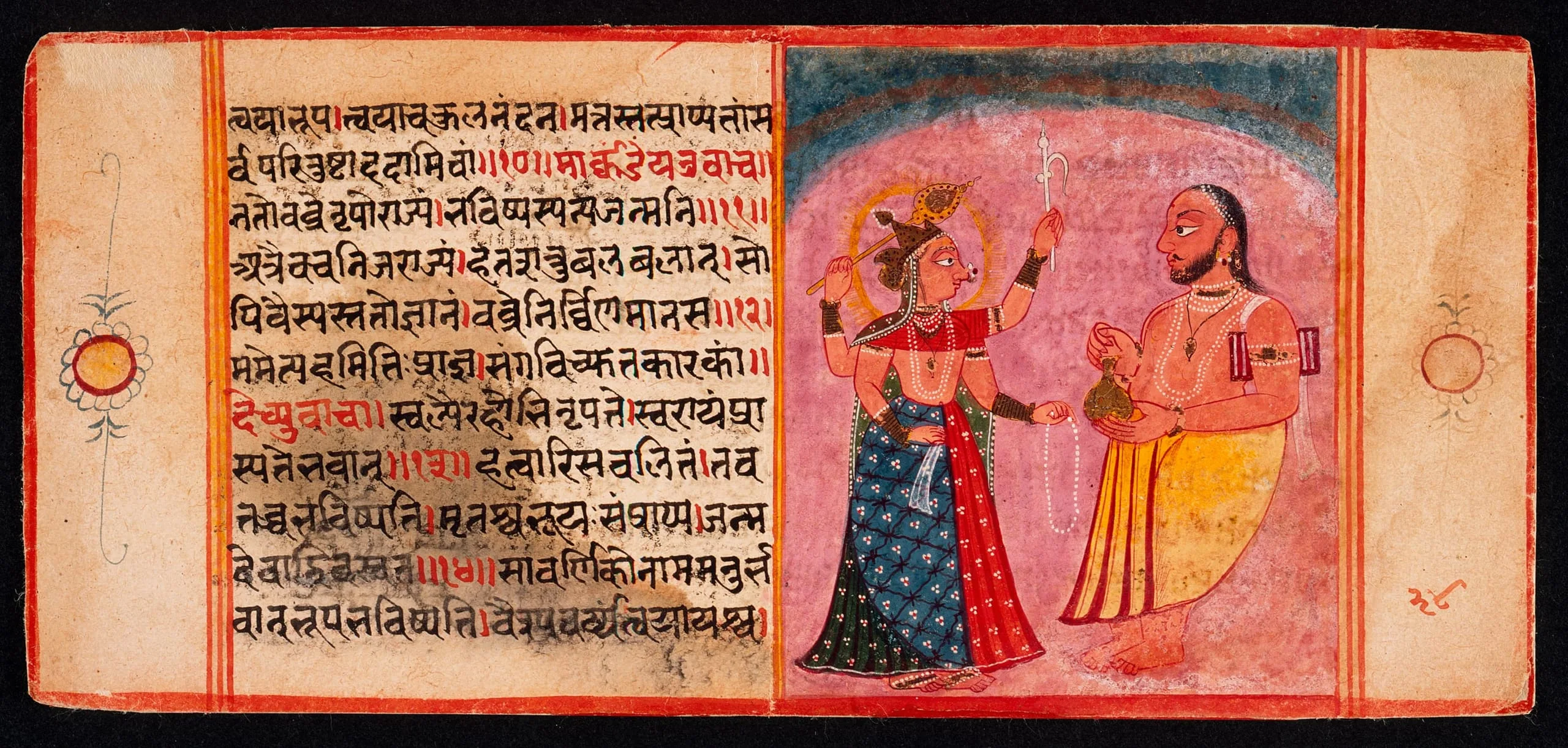
Dating from circa 550 CE, the Devimahatmya (Glory of the Goddess) is a devotional text of 700 Sanskrit verses that extol the Goddess (Devi) as the supreme power and creator of the universe. The verses were interpolations to the earlier Markandeya Purana dating from circa 250 CE and then extracted as a stand-alone text.
The recto side of this folio [#38] likely illustrates an episode from Chapter 13, “The Bestowing of Boons to King Suratha and the Merchant.” Raja Suratha was the ruler of ancient Balipura (modern Bolpur in West Bengal). He was a renowned devotee of Durga and undertook ardent penance for three years to beseech her help in regaining his kingdom lost through his ministers’ betrayal. Here, Chandika, a fierce form of Durga, is manifesting before the king to grant his boon. She is nimbate, crowned, has copious gold and pearl jewelry, and wears brightly patterned garments. In her four arms she carries a mace, elephant goad, pearl necklace, and handkerchief. Raja Suratha wears a pearl necklace, choker, headband, and armlet, and a yellow dhoti. He carries a golden water flask and has a sacred manuscript tucked under his left arm. The folio’s horizontal manuscript format with the marginal decorations of a stylized flower (a decorative remanent of the string hole) was assimilated from the contemporaneous Jain manuscript tradition of western India.
An additional folio from this dispersed series in the Cleveland Museum of Art (1968.72).