- Title
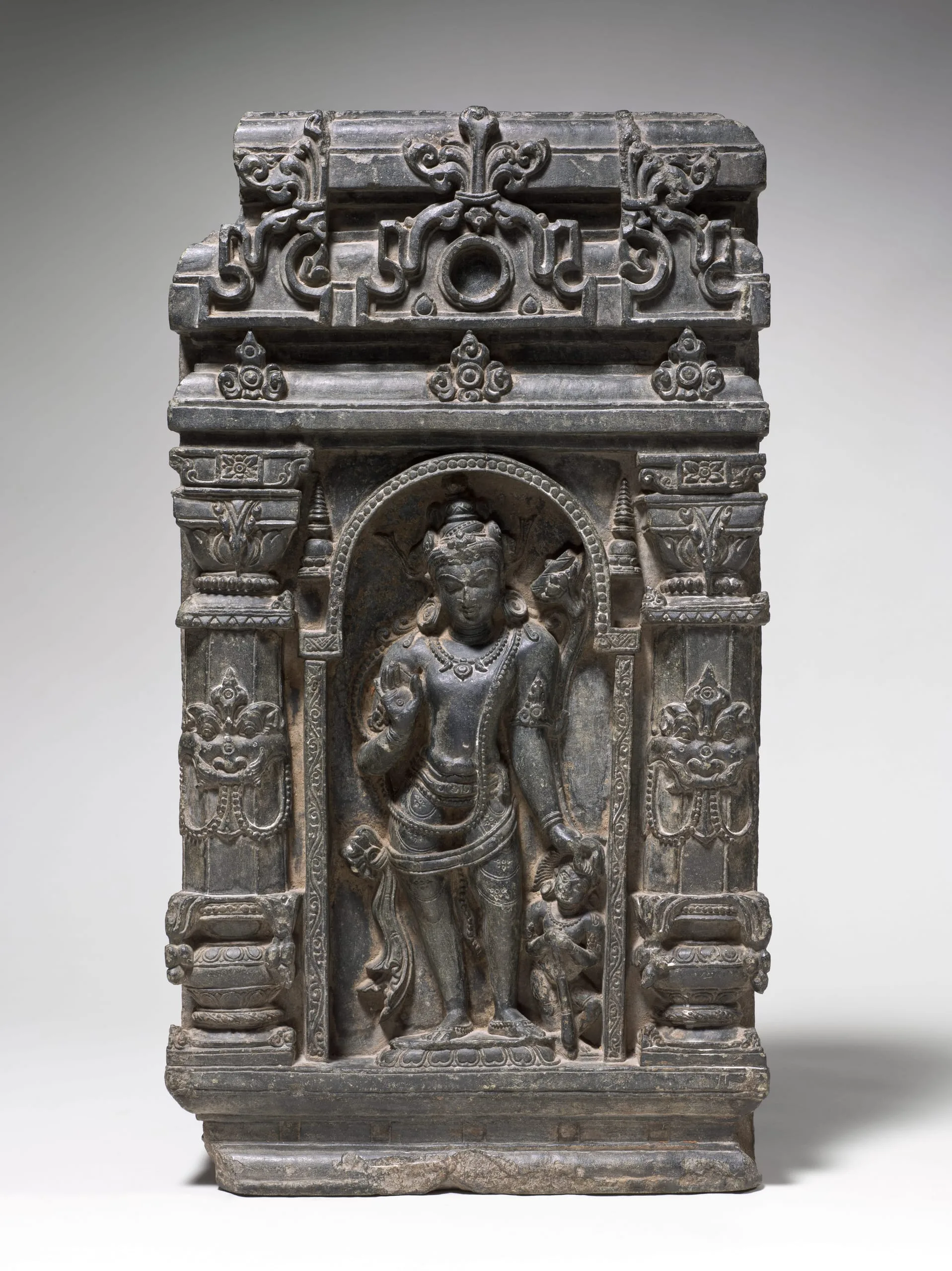
- The Bodhisattva Manjushri
- Date Made
- 9th century
- Medium
- Black schist
- Dimensions
- 19 1/2 x 11 x 3 3/4 in. (49.53 x 27.94 x 9.52 cm)
- Accession Number
- M.79.188
- Curatorial Notes
This black schist stele may have been originally installed in an exterior niche of a brick temple in eastern India. The central figure under the archway depicts Manjushri, the Bodhisattva of transcendent wisdom (prajña) in Mahayana Buddhism. He is represented here as an adolescent known as Manjushikumara (youth or prince of pleasing appearance). In this form he wears a necklace of tiger claws believed to protect children. He is crowned and wears ornate jewelry, the Brahmanical sacred thread (yajnopavita) over his left shoulder, a dhoti with elegant patterns, and a swaying waist sash. His right hand is held in the gesture of reassurance (abhaya mudra). His left hand holds the stock of a blue lotus topped with his attribute of a sacred manuscript. It rests on the head of a dwarf representing his personified weapon (ayuydha purusha), which is a sword used to cut through the fog of ignorance (see also M.82.95.1). The arched niche is flanked by two small stupas (funerary monuments). The architecture consists of standard elements, including the "cow’s eye window" (gavaksha) in the upper register and the flanking columns set in water pots and graced with an apotropaic "face of glory" (kirttimukha).
- Selected Bibliography
- Pal, Pratapaditya. Indian Sculpture, vol.2. Los Angeles: Los Angeles County Museum of Art; University of California Press, 1988.
- Newman, Richard. The Stone Sculpture of India: a Study of the Materials Used by Indian Sculptors from ca. 2nd Century B.C. to the 16th Century. Cambridge, MA: Center for Conservation and Technical Studies, Harvard University Art Museums, 1984.
- Little, Stephen, Tushara Bindu Gude, Karina Romero Blanco, Silvia Seligson, Marco Antonio Karam. Las Huellas de Buda. Ciudad de México : Instituto Nacional de Antropología e Historia, 2018.
- Little, Stephen, and Tushara Bindu Gude. Realms of the Dharma: Buddhist Art across Asia. Los Angeles: Los Angeles County Museum of Art, 2025.