Recto: This vibrant sketch depicts a royal boar hunt (shikar). In the top center, a hunter on horseback spears a boar. In the lower left, three boars are flushed by a beater (hankwa) towards a hunting pavilion (baradari). See also M.75.19.
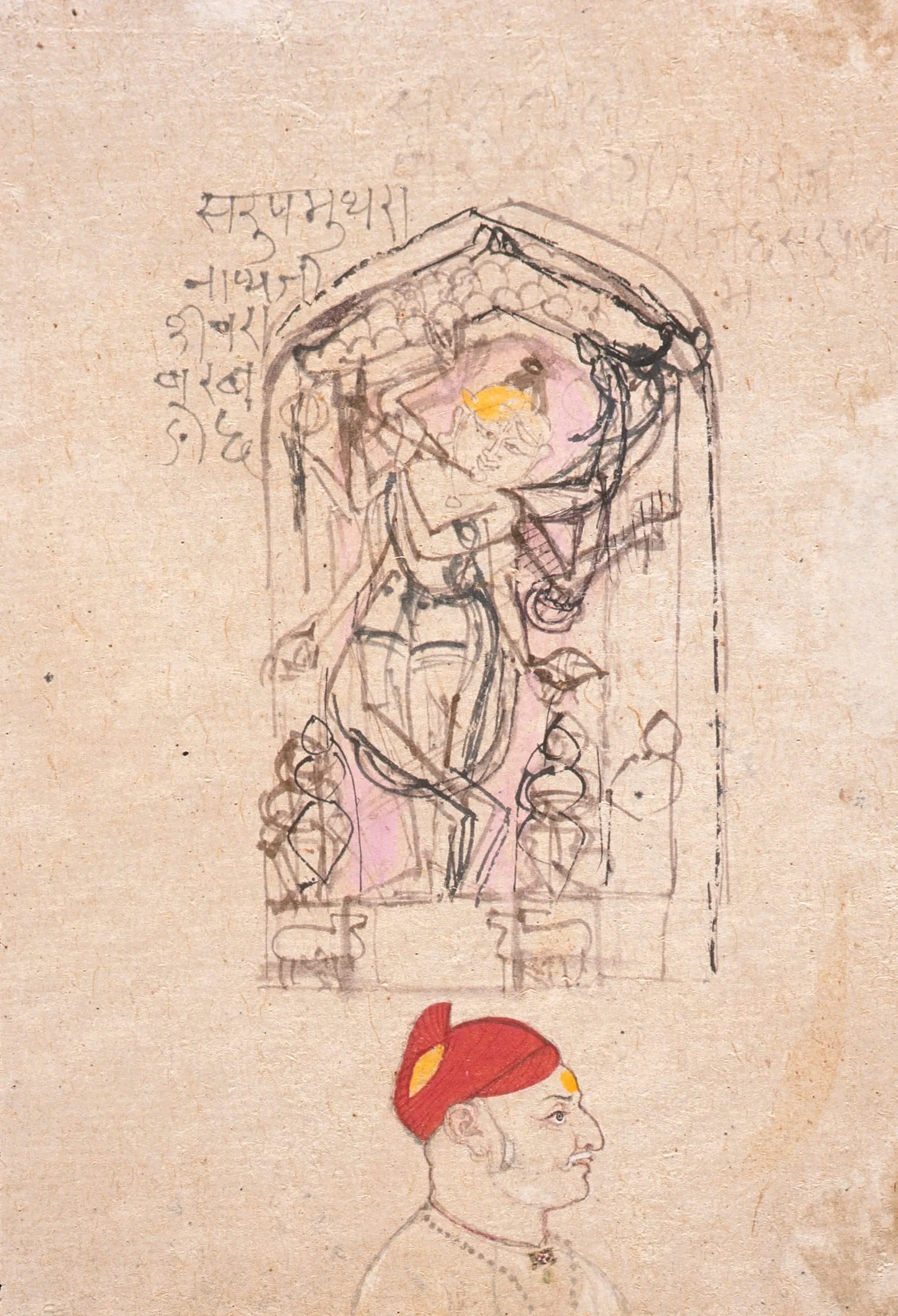
Verso: The devanagari inscription in the upper left identifies the image as the Svarup (divine form) of Mathuranathji [Sarup Muthuraa Naathjii] (Translation by Stephen Markel.) Mathuranathji (or Mathureshji), the Lord of Mathura who was originally manifested from the Yamuna River, is the presiding Nidhi (deity) of the Pratham Peeth (First Seat) of the Pushtimarg Sampradaya (Path of Nourishing Spiritual Lineage) founded by Vallabhacharya (1479–1530). Like the primary idol of Sri Nathji, the principal deity of the entire Pushtimarg sect of Vaishnavism, the idol of Mathuranathji was secretly moved by the Goswamis (priests) to protect it from desecration by the iconoclastic Mughals. In 1738, under the patronage of Maharao Durjan Sal, the Rajput ruler of Kota (r. 1723–1756), the sacred image was relocated to the kingdom of Kota and is presently housed in the Shree Mathuradheesh Ji Temple, Kota. See Robert Skelton, Rajasthani Temple Hangings of the Krishna Cult: From the Collection of Karl Mann, New York (New York: American Federation of Arts, 1973), p. 82, no. 2; and "Shree MathuraNath Ji, at Kota," https://www.shreenathjibhakti.org/post/shree-mathuranath-ji-at-kota
In the standard iconography of Mathuranathji, he stands in a stiff, frontal pose (samapada sthanaka). He is four-armed (chaturbhuja) and carries in his hands a discus (UL), mace (UR), conch (LL), and lotus (LR). Here, however, his representation is merged with Krishna’s iconographic form of Venugopala (the Flute-Playing Cowherd), in which he plays his transverse flute (murali) to call Radha and his female devotees to dally with him in spiritual bliss. In this aspect, the divine flutist stands in his characteristic pose with his feet crossed at the ankle (pada-svastika). See also M.75.4.13 and M.87.278.7. The exact number of arms the LACMA Mathuranathji has is difficult to discern because it is a preparatory sketch with overlapping corrections in the position of the arms (called pentimenti). Therefore, the identification of his handheld attributes may help determine the intended final arm count. His two primary hands play the flute. His additional radiating proper left arms (top to bottom) hold a lotus bud, bowl of ambrosia (amrita), discus, conch. His proper right arms (top to bottom) are raised to support Mt. Govardhan, which is represented in the rocky ogee arch of the stele, carry a mace, and display the gesture of charity (varada mudra). Given the large number of arms, the LACMA Mathuranathji may also incorporate Krishna's cosmic manifestation (viratarupa) or his eight-armed (ashtabhuja) form. Mathuranathji is flanked by rough sketches of adoration figures, likely gopis or gopas (female and male cowherds). On the base are two small cows with their calves.
Beneath the image of Mathuranathji is a sketch of a Kota nobleman. See also M.79.191.12.