- Title
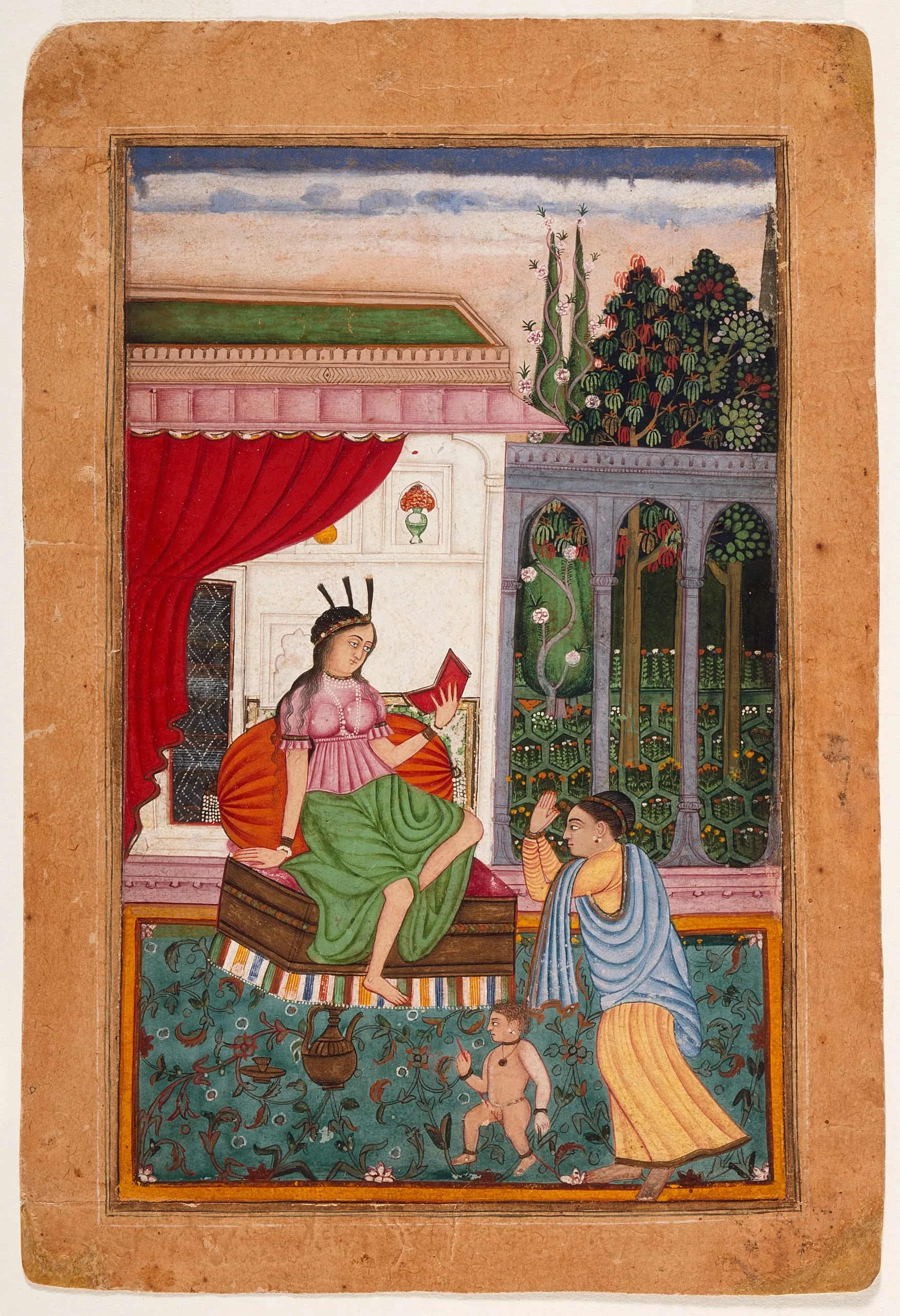
- The Annunciation
- Date Made
- circa 1725-1775
- Medium
- Opaque watercolor and gold on paper
- Dimensions
- Image: 8 7/8 x 5 5/8 in. (22.54 x 14.28 cm); Sheet: 10 3/4 x 7 1/4 in. (27.31 x 18.42 cm)
- Accession Number
- M.79.191.26
- Curatorial Notes
A stylish European woman, perhaps modeled on an Armenian, is seated on an elevated seat or throne on a palace terrace. She wears a crown of feather plumes and is leaning against a bolster while reading a book. A woman in a flowing garment and a long shawl joins her hands in the gesture of reverence towards the seated woman. She is accompanied by a naked boy.
The figure of the seated woman may be derived iconographically from European engravings of the Annunciation, in which the Virgin Mary is shown in an interior setting and reading in her psalter the prophecy of Isaiah (7:14) foretelling the birth of the Christ child. The figure of the reverential standing woman may be the artist’s misunderstanding or an Indianized adaptation of the original source’s depiction of the archangel Gabriel, who is typically portrayed in The Annunciation as wearing a long tunic with a cloak and standing or kneeling in a reverential posture with a hand extended towards the Virgin Mary. The boy may represent one of the cherubs (putti) who sometimes appear heralding the Annunciation.
A Mughal painting attributed to circa 1590 of a seated European woman with a similar crown and reading a book, interpreted as the Annunciation, is in the San Diego Museum of Art (1990.296).