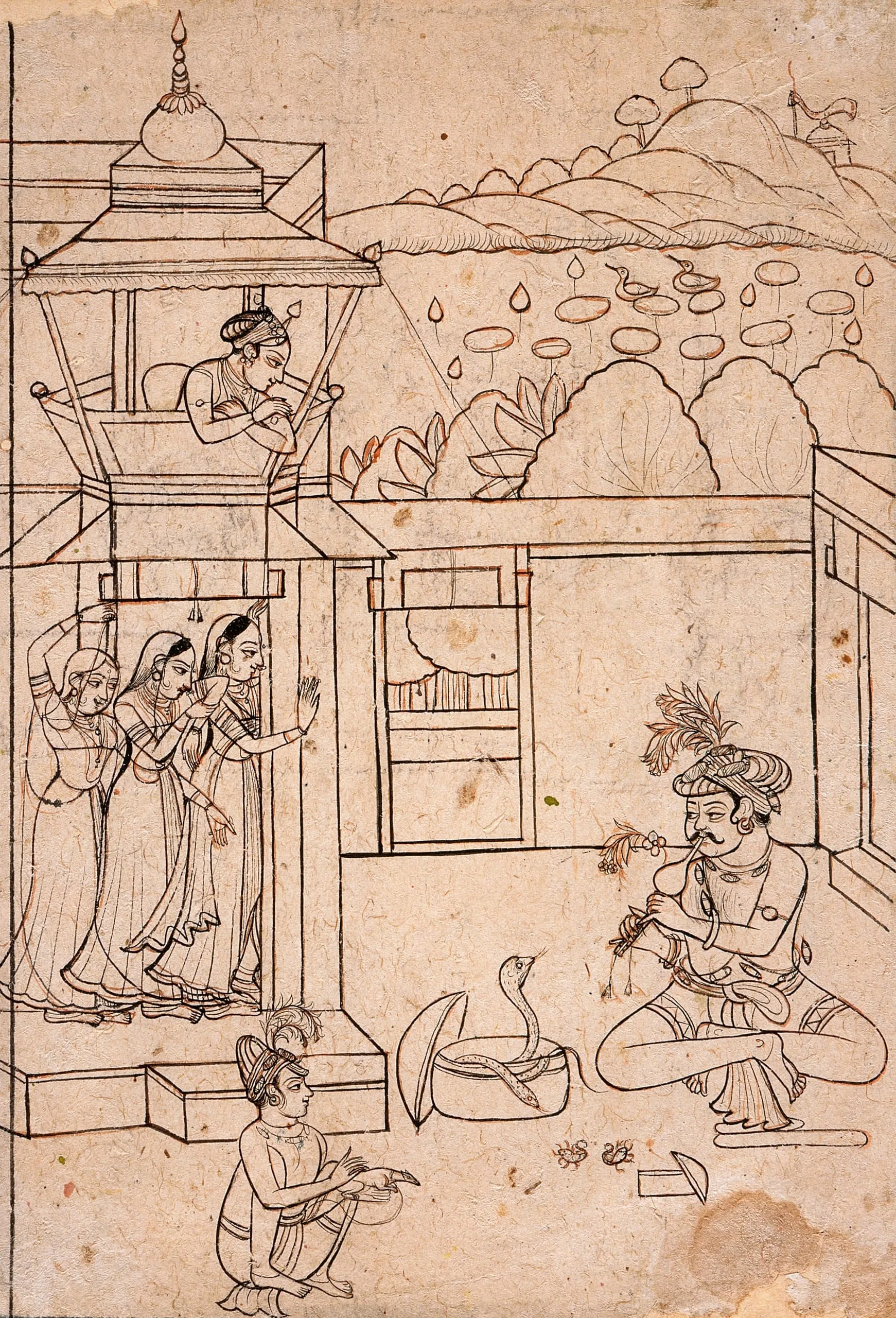
This drawing of a snake charmer (sapera) illustrates a frequent occurrence during a pan-Indian festival known as Naga Panchami (Fifth Day of the Serpents). It is generally observed on the fifth day of bright half of the lunar month of Shravana (July–August). Itinerant snake charmers and their assistants carry snakes in bamboo baskets to perform in front of the doorstep of villagers or palace residents who make an offering of milk to a captive serpent (naga), generally a cobra or viper, for protection against snake bite. The snake charmer sits on the ground before a closed basket or pot containing the snake. He removes the lid and begins to play a special wind instrument called a pungi (or bin), which is a dry hollowed gourd with a double-reed bamboo attachment. The serpent will be attracted and mesmerized by the movement because it simulates prey, rather than by the hypnotic music which it cannot hear. Snake charming for entertainment purposes was banned throughout India in 1991 under the Wildlife Protection Act, 1972.
The snake charmer is accompanied by his assistant who holds a mongoose used later in the performance to stage a mock fight to entertain the audience, here comprised of palace women. The two scorpions in front of the snake charmer will also participate in the mock fight.
The LACMA drawing is a preparatory sketch in black ink with red underdrawings and a few overlapping corrections in the position of the women’s feet (called pentimenti). It is a virtual copy of a painting attributed to Bundi, circa 1760–1770, in the Chhatrapati Shivaji Maharaj Vastu Sangrahalaya, Mumbai (53.88). The variations between the two renditions are minor for the most part. Note, for instance, the lack of lily pads in the painting’s river that are present in the drawing, a peacock on the painting’s roof that is omitted in the drawing, and the difference in the structure of the palace’s architectural finials. The most puissant variance is the possible transformation of the figure observing the performance from a hexagonal balcony terrace. In the painting, the figure is nimbate, blue-skinned, and has a lotus in his turban ornaments. Accordingly, he represents the popular Hindu god of devotion, Krishna. In the drawing, the figure is nimbusless, has not been darkened in skin color, but does have a turban ornament with a lotus. Therefore, this figure in the drawing may portray a prince. See also M.77.154.2.