LACMA

ShopMembershipMyLACMATickets
LACMA
Los Angeles County Museum of Art
5905 Wilshire Blvd.
Los Angeles, CA 90036
info@lacma.org
(323) 857-6000
Sign up to receive emails
Subscribe
© Museum Associates 2025

Museum Hours

Monday

11 am–6 pm

Tuesday

11 am–6 pm

Wednesday

Closed

Thursday

11 am–6 pm

Friday

11 am–8 pm

Saturday

10 am–7 pm

Sunday

10 am–7 pm


  • About LACMA
  • Jobs
  • Building LACMA
  • Host An Event
  • Unframed
  • Press
  • FAQs
  • Log in to MyLACMA
  • Privacy Policy
© Museum Associates 2025
Collections

Unknown
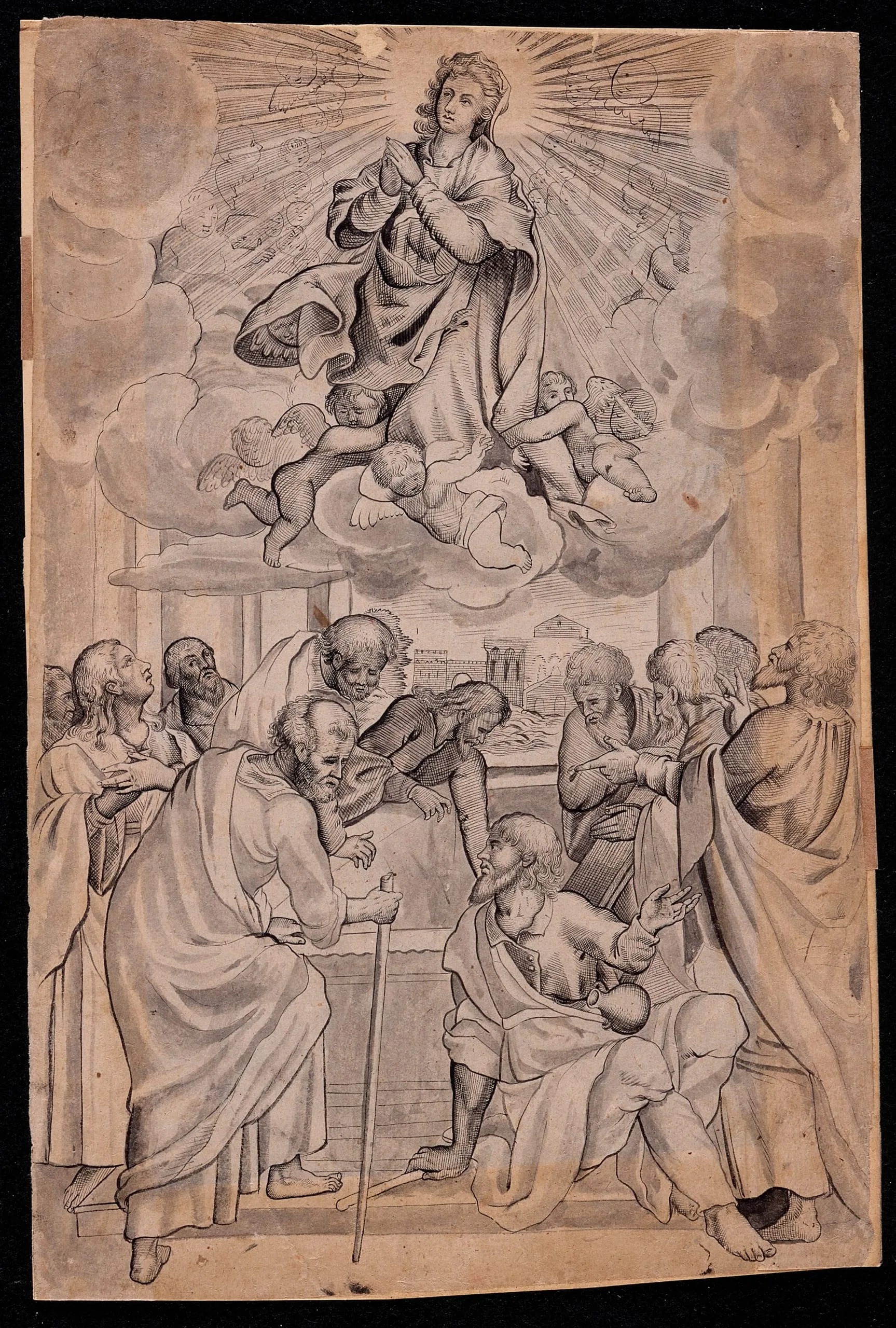
Assumption of the Virgin Mary18th century

Not on view
Ink and wash drawing on tan paper, a luminous figure floats on clouds above a crowd of robed figures in a two-register composition
Artist or Maker
Unknown
Title
Assumption of the Virgin Mary
Place Made
India, Delhi, Mughal Empire
Date Made
18th century
Medium
Ink on paper
Dimensions
10 3/8 x 6 7/8 in. (26.35 x 17.46 cm)
Credit Line
Gift of Paul F. Walter
Accession Number
M.75.113.1
Classification
Drawings
Collecting Area
South and Southeast Asian Art
Curatorial Notes

The Assumption of the Virgin Mary is one of the four Marian dogmas of the Catholic Church. Although not mentioned in the New Testament, in Western Christian art during the 12th century it became a popular narrative scene from the Life of the Virgin Mary. In the Renaissance art of the 15th-16th centuries, representations of the Assumption are sometimes conflated with her Coronation as the Queen of Heaven. The Assumption was a common subject for illustrating the ceilings of Christian cathedrals.

In this Mughal copy of an unidentified European engraving, the Virgin is being borne aloft by cherubim (putti) to Heaven, where she is to be crowned by Christ. She radiates a corona of light, and her hands are clasped in prayer in the iconographic tradition of medieval European images of the Assumption. Beneath her, the Twelve Apostles gather around her empty tomb. They either stare up in awe at the Virgin or are weeping. A European fortress is visible in the distant background in the center of the composition. The composition, figures, modeling, architecture, and perspective are rendered in a faithful Western artistic style, rather than some of the elements being Indianized as done in M.75.113.4

See also M.83.105.5a-b.
Selected Bibliography
  • Larson, Gerald et al. In Her Image: The Great Goddess in Indian Asia and the Madonna in Christian Culture. Santa Barbara: UCSB Art Museum, University of California, 1980.