- Title
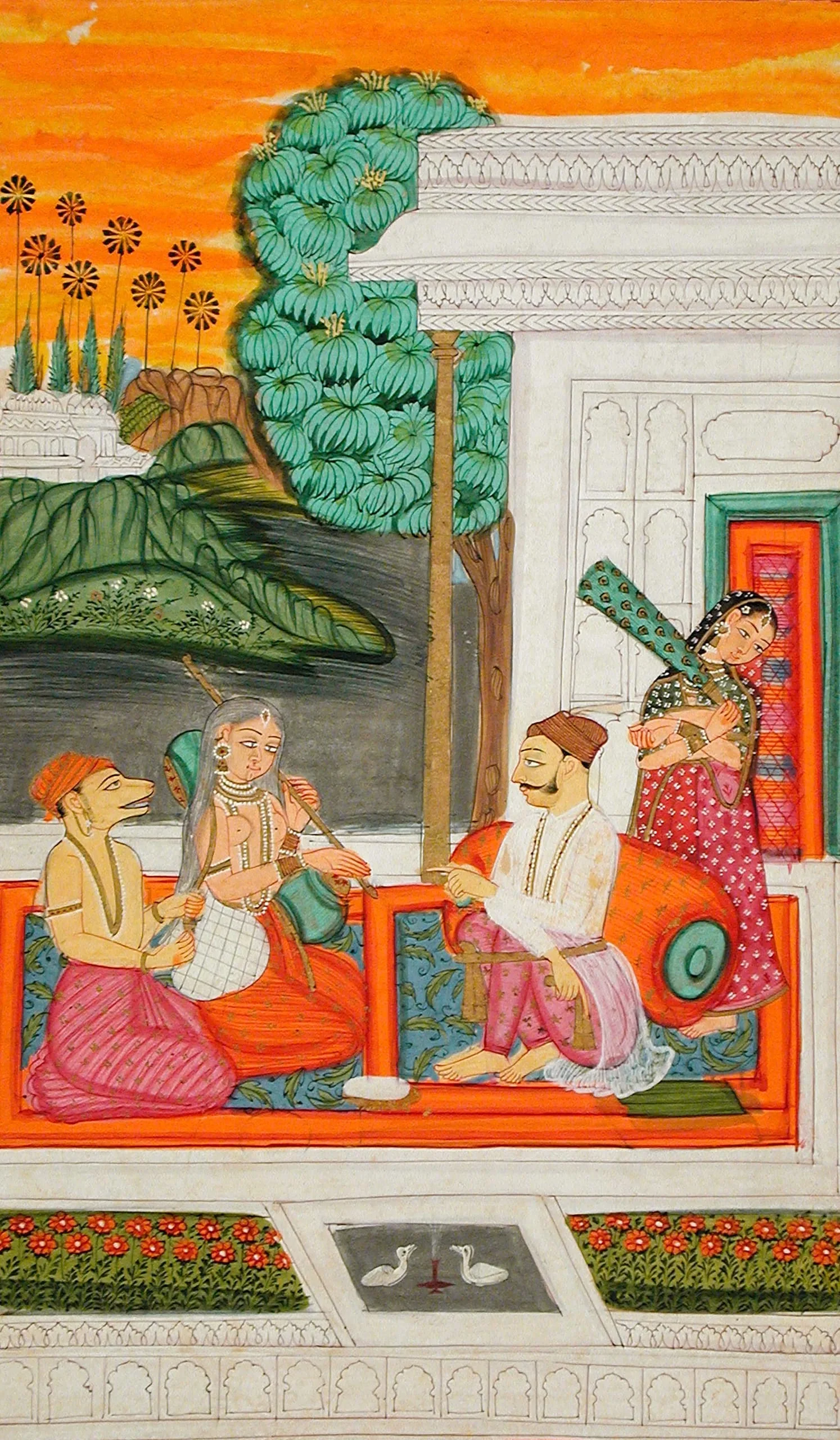
- Shri Raga, Folio from a Ragamala (Garland of Melodies)
- Date Made
- circa 1800
- Medium
- Opaque watercolor and gold on paper
- Dimensions
- Sheet: 9 1/2 x 5 3/4 in. (24.13 x 14.61 cm); Image: 9 1/16 x 5 1/4 in. (23.02 x 13.34 cm)
- Accession Number
- M.75.113.3
- Curatorial Notes
Shri Raga is the fifth raga in the variant ragamala (garland of melodies) classification system known as Hanuman’s system (developed by the ancient musical theorist Hanuman), which was followed in parts of the Deccan during the 18th century. In the more widespread Rajasthani system, Shri Raga is the sixth raga. It is a melancholic melody associated with late afternoon or early evening and Winter (December-January).
Here, Shri Raga is envisioned as a prince seated on a palace terrace listening to a musical performance. He is pointing at the musicians and keeping the rhythm with his left hand and holds a gold handkerchief in his right hand. The singer is Tumburu, a horse-headed celestial singer and musician (gandharva). A gray-haired female musician plays a vina in place of the more customary legendary poet-saint Narada. Behind the prince, an attendant holds an honorific peacock feather fly whisk (morchal). The painting is now cropped, but originally had a silver and red border. The bright orange sky at sunset, silhouetted Palmyra fan palm trees, and exuberant rock formations reflect stylistic assimilations from the pictorial landscapes rendered in the dominions of the Nizam of Hyderabad. See also M.70.59, M.73.59, and AC1999.127.27.