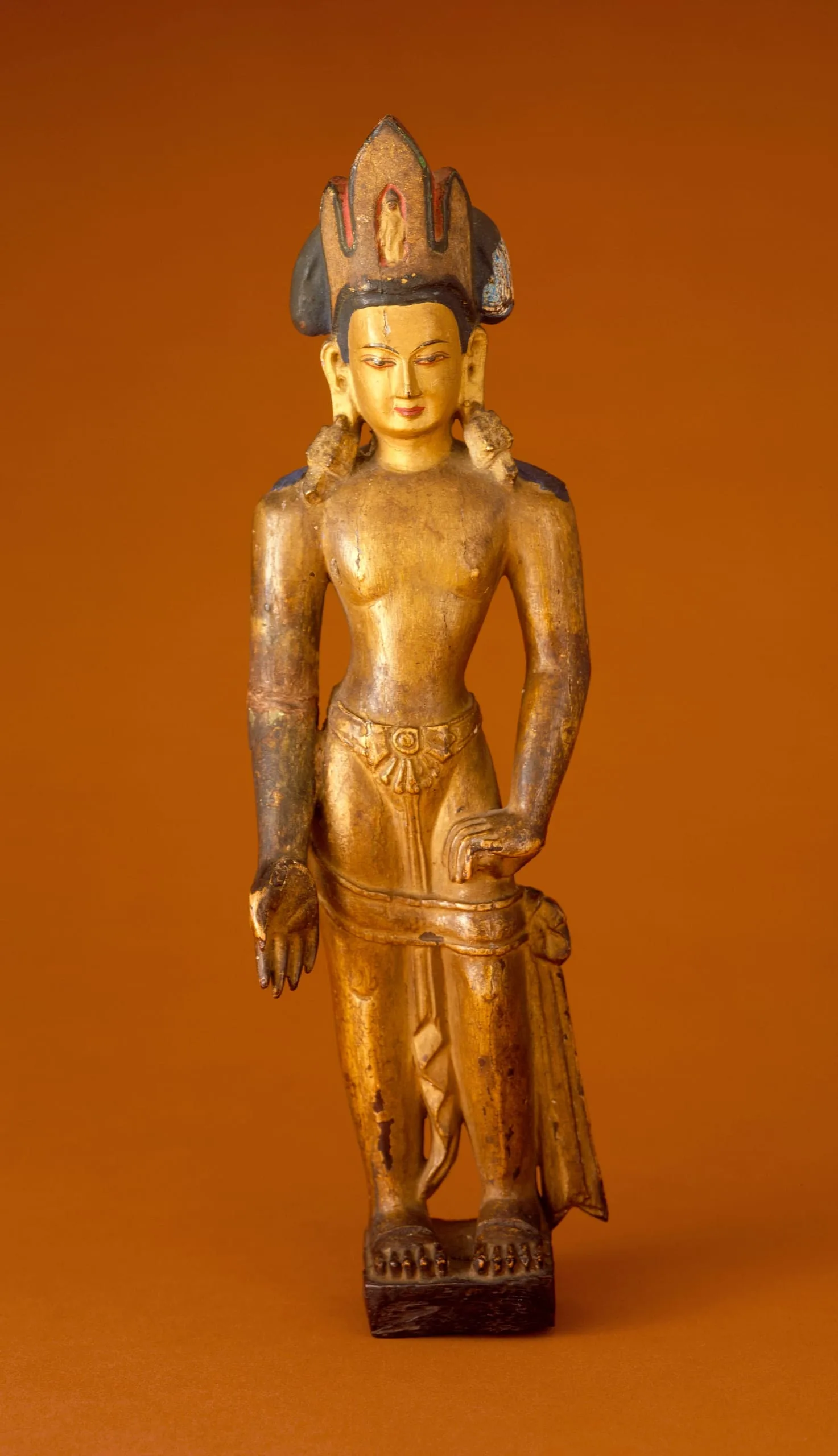
This is a copy attributed to Central Tibet, 13th-14th century, of the venerated sandalwood sculpture of Avalokiteshvara, known as the Phagpa Lokeshvara, in the Phagpa Lhakhang (Holy Temple), the oldest temple hall in the Potala Palace in Lhasa. The original image attributed to Nepal, 7th century, is believed to have been brought to Lhasa by the first wife and Nepalese queen, Bhrikuti Devi (r. 622-649), of King Songtsen Gampo (r. 618-649). Numerous copies were made for personal use by religious pilgrims and devotees. Comparable copies are in the Newark Museum (73.130), Victoria and Albert Museum, London (IM.382-1914), and Musée Guimet, Paris. See Ian Alsop, "Phagpa Lokes'vara of the Potala," Asianart.com (1999), https://www.asianart.com/articles/phagpa/phagpa.pdf; and "Copies in Tibetan Sacred Art: Two Examples," Oriental Art 46:2 (2000): 4-13.
The bodhisattva wears a distinctive tripartite crown with a small forehead image (bimba) of a standing Jina Buddha, perhaps Ratnasambhava rather than Amitabha, Avalokiteshvara’s customary emanation source deity. He is two-armed with his right hand extended in the gesture of charity (varada mudra) and his left hand resting on his thigh. He wears unusual bell-shaped earrings.