LACMA

ShopMembershipMyLACMATickets
LACMA
Los Angeles County Museum of Art
5905 Wilshire Blvd.
Los Angeles, CA 90036
info@lacma.org
(323) 857-6000
Sign up to receive emails
Subscribe
© Museum Associates 2025
  • About LACMA
  • Jobs
  • Building LACMA
  • Host An Event
  • Unframed
  • Press
  • FAQs
  • Log in to MyLACMA
  • Privacy Policy
© Museum Associates 2025
Collections

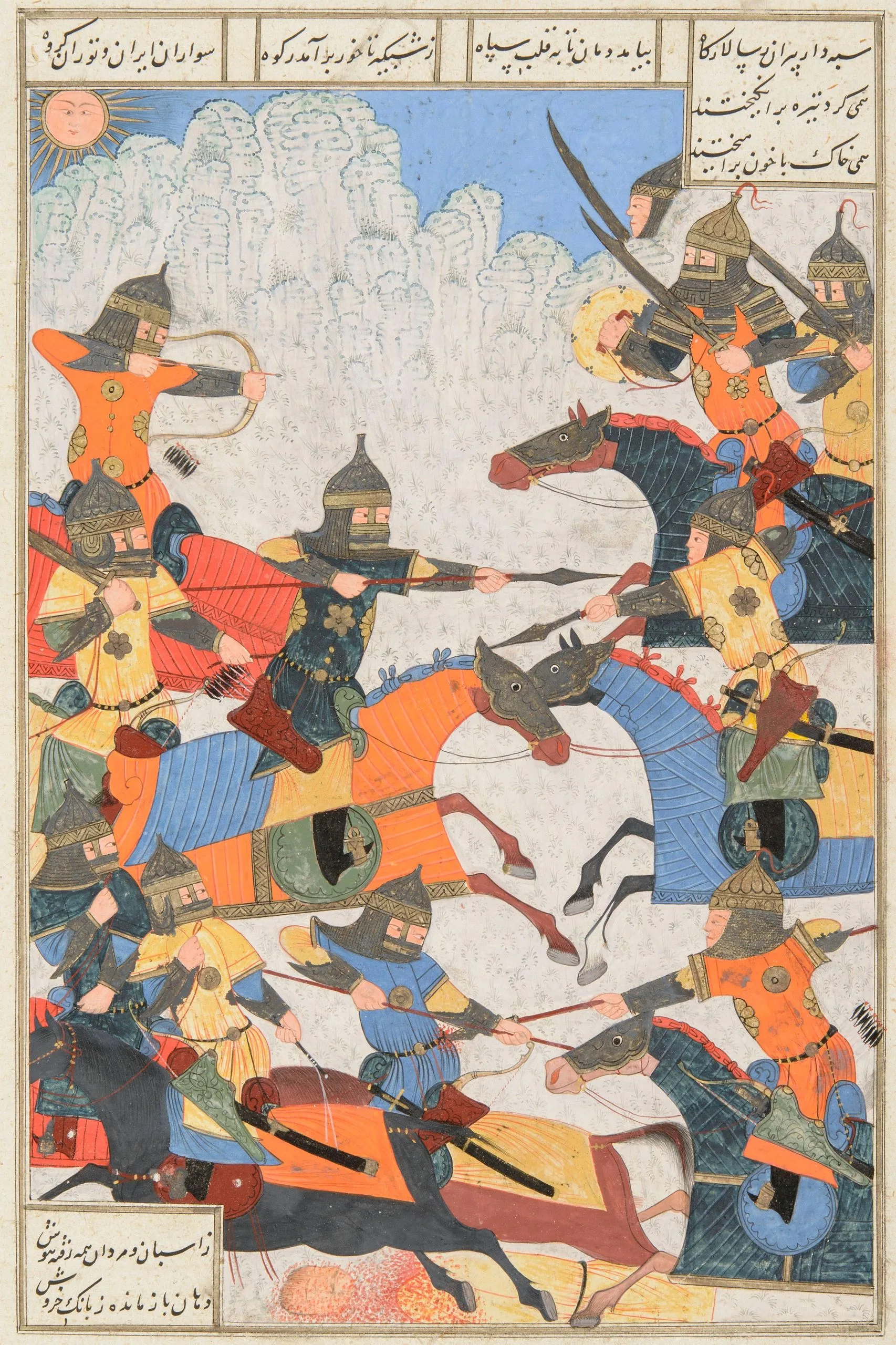
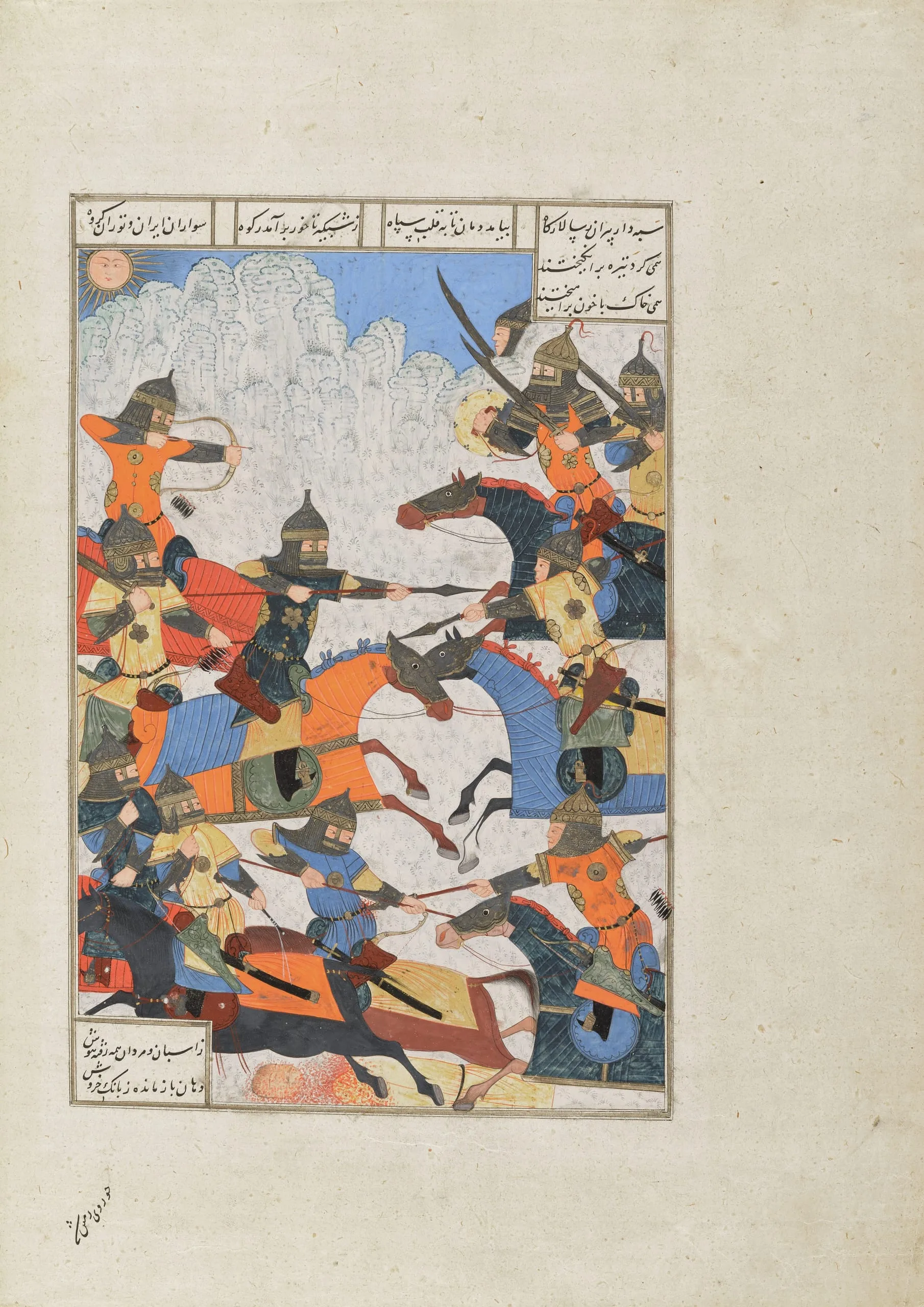
Giv fights Lahhak and Farshidvard, Page from a Manuscript of the Shahnama (Book of Kings) of Firdawsi1494/A.H. 899

On view:
Geffen Galleries, Persianate Arts: The Ardabil Carpet and Manuscript Painting
Persian manuscript painting, vertical, depicting a dense mounted battle scene with armored warriors in colorful robes wielding swords and bows on horseback, framed by Persian script text panels
Illustrated manuscript page with Persian script captions above and below; battle scene depicting armored cavalry in combat, figures in orange, blue, and black garments wielding swords and bows on horseback against a blue sky with billowing white clouds; flat, layered composition with fine opaque pigments.

Unknown, Giv fights Lahhak and Farshidvard, Page from a Manuscript of the Shahnama (Book of Kings) of Firdawsi, 1494/A.H. 899, Los Angeles County Museum of Art, The Nasli M. Heeramaneck Collection, gift of Joan Palevsky, by exchange, photo © Museum Associates/LACMA

Title
Giv fights Lahhak and Farshidvard, Page from a Manuscript of the Shahnama (Book of Kings) of Firdawsi
Place Made
Iran, Gilan
Date Made
1494/A.H. 899
Period
Timurid (1370-1506)
Medium
Ink, opaque watercolor, and gold on paper
Dimensions
9 1/2 × 6 in. (24.13 × 15.24 cm) Frame: 20 × 15 × 1 1/2 in. (50.8 × 38.1 × 3.81 cm)
Credit Line
The Nasli M. Heeramaneck Collection, gift of Joan Palevsky, by exchange
Accession Number
M.75.24
Classification
Manuscripts
Collecting Area
Art of the Middle East: Islamic
Curatorial Notes

The Shahnama (Book of Kings), the Iranian national epic, was composed by Firdawsi and completed around 1010. It chronicles in verse the legendary and historical kings and heroes of the Persian Empire up to the Arab Muslim conquest in the seventh century. Illustrated manuscripts of the text, usually made under courtly patronage, only survive from the early fourteenth century onward; many of these were broken up in modern times for the sake of their paintings. Typically, the architectural settings and costumes of the depicted characters reflect the era in which the manuscript was made, drawing a connection between ancient kings and heroes and the then present-day court. On that account, the commissioning of such anachronistically illustrated manuscripts appealed to great kings and provincial rulers alike.

Combat is a major theme of the Shahnama, which is divided into fifty sections, each devoted to a king. Their reigns are often punctuated by warfare, and the heroes who fight on their behalf. As this painting from a late fifteenth-century manuscript demonstrates, artists rarely shied away from depicting the battlefield violence described throughout the poem (see also M.85.237.71). Here, Iranian soldiers and their traditional Turanian rivals are shown in pitched battle galloping over the corpse of a slain trooper as one soldier pierces the side of his enemy with a spear, while the sun shines brightly above at left. The figures sport armor and weapons not of the epic’s ancient setting but of the period in which they were painted (see M.73.5.323, M.73.5.729.1, and M.73.5.729.8).
Selected Bibliography
  • Pal, Pratapaditya, Thomas W. Lentz, Sheila R. Canby, Edwin Binney, 3rd, Walter B. Denny, and Stephen Markel. "Arts from Islamic Cultures: Los Angeles County Museum of Art." Arts of Asia 17, no. 6 (November/December 1987): 73-130.

  • Çakir Phillip, Filiz. "A Reflection on Armour of Then and Now." In Iranian Art from the Sasanians to the Islamic Republic: Essays in Honour of Linda Komaroff, edited by Sheila S. Blair, Jonathan M. Bloom and Sandra S. Williams. Edinburgh University Press, 2024.