LACMA

ShopMembershipMyLACMATickets
LACMA
Los Angeles County Museum of Art
5905 Wilshire Blvd.
Los Angeles, CA 90036
info@lacma.org
(323) 857-6000
Sign up to receive emails
Subscribe
© Museum Associates 2026
  • About LACMA
  • Jobs
  • Building LACMA
  • Host An Event
  • Unframed
  • Press
  • FAQs
  • Log in to MyLACMA
  • Privacy Policy
© Museum Associates 2026
Collections

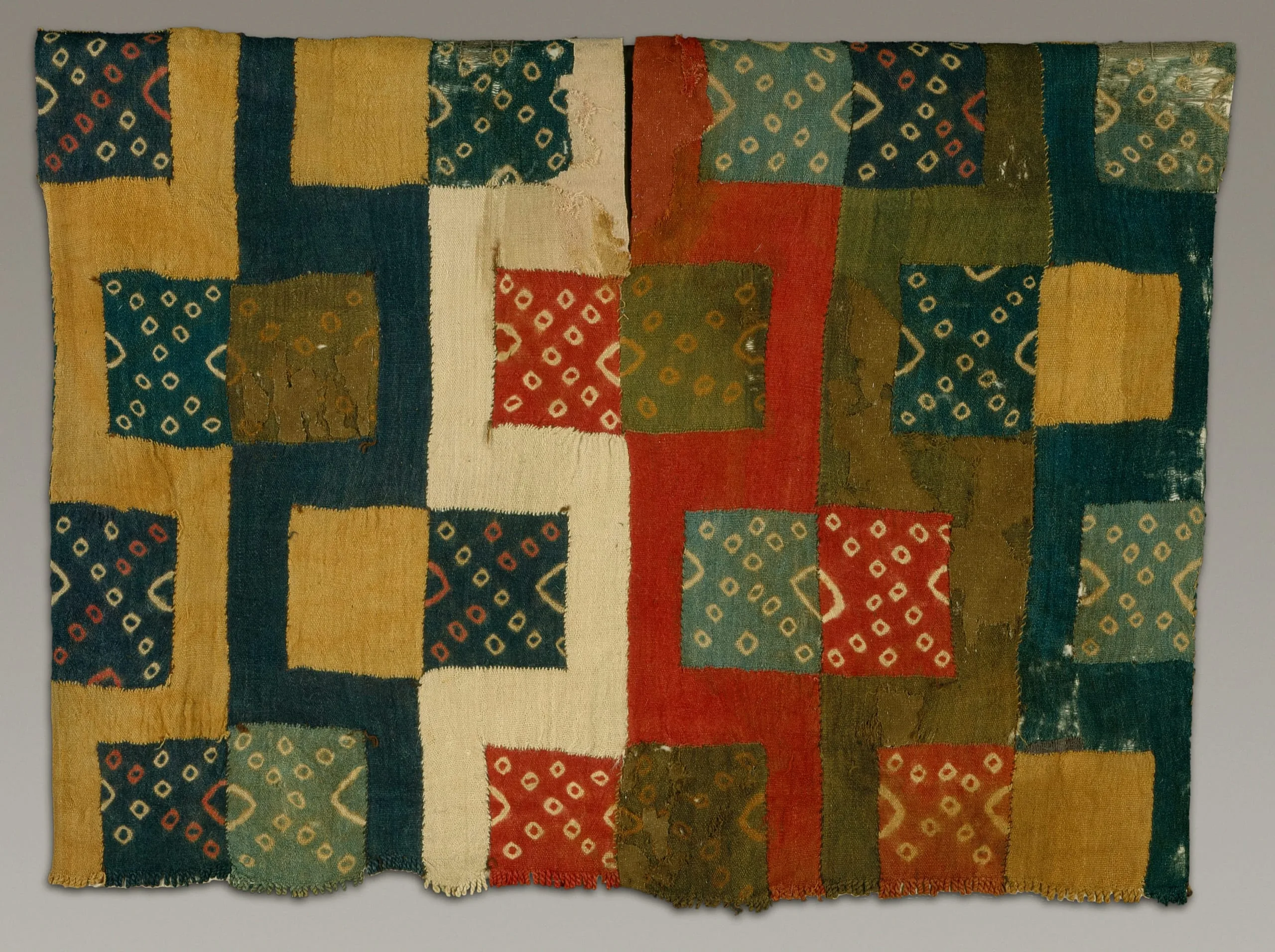
Man's Tunic500-800

On view:
Geffen Galleries, Textiles of the Andes
Horizontal patchwork textile panel with resist-dyed blocks in marigold yellow, teal blue, brick red, and olive-brown, decorated with small diamond motifs in off-white; shows fraying and wear

Unknown, Man's Tunic, 500-800, Los Angeles County Museum of Art, Costume Council Fund, photo © Museum Associates/LACMA

Title
Man's Tunic
Culture
Nasca, Wari-related
Place Made
Peru, South Coast
Date Made
500-800
Medium
Camelid fiber plain weave with discontinuous warps and wefts, and tie-resist dyed
Dimensions
33 × 45 1/2 in. (83.82 × 115.57 cm)
Credit Line
Costume Council Fund
Accession Number
M.75.50.1
Classification
Costumes
Collecting Area
Costume and Textiles
Curatorial Notes

Due to their importance, Wari textiles were never cut but were instead woven to the size necessary for the finished garment. Inventive Wari artists took this method even further by creating an entire textile composed of “cut” sections that were in fact separate and complete.

By using “scaffold” threads as a temporary armature, each square and S-shaped meander was woven separately, with threads turning back on themselves. Strips of finished shapes were tie-dyed different colors using tightly wound threads that resisted dye and left a pattern of colored rings. After the scaffold threads were removed, the pieces were reassembled by reinserting a thread into the alternate loops of two shaped pieces (like dropping a pin into a hinge) and sewing the vertical sides of adjoining pieces together.

Splintering the integrity of the cloth, originally woven on scaffold threads before dyeing, the textile artists shuffled and reassembled its random component parts into a completely new “whole.” In the global history of textiles, this complex manipulation of discontinuous warp and weft was practiced only in the Andes.

Nicole LaBouff via Kaye Spilker

2009
Selected Bibliography
  • Phipps, Elena. "An Artist's Journey." Hali no.219 (2024): 138-147.

Related Unframed

Now on View: Graziella Laffi and Modern Peruvian Silver
  • February 25, 2015
  • Ilona Katzew, Curator and Department Head, Latin American Art and Ellen Dooley, Assistant Curator, Latin American Art
Design Inspiration
Design Inspiration
  • December 26, 2013