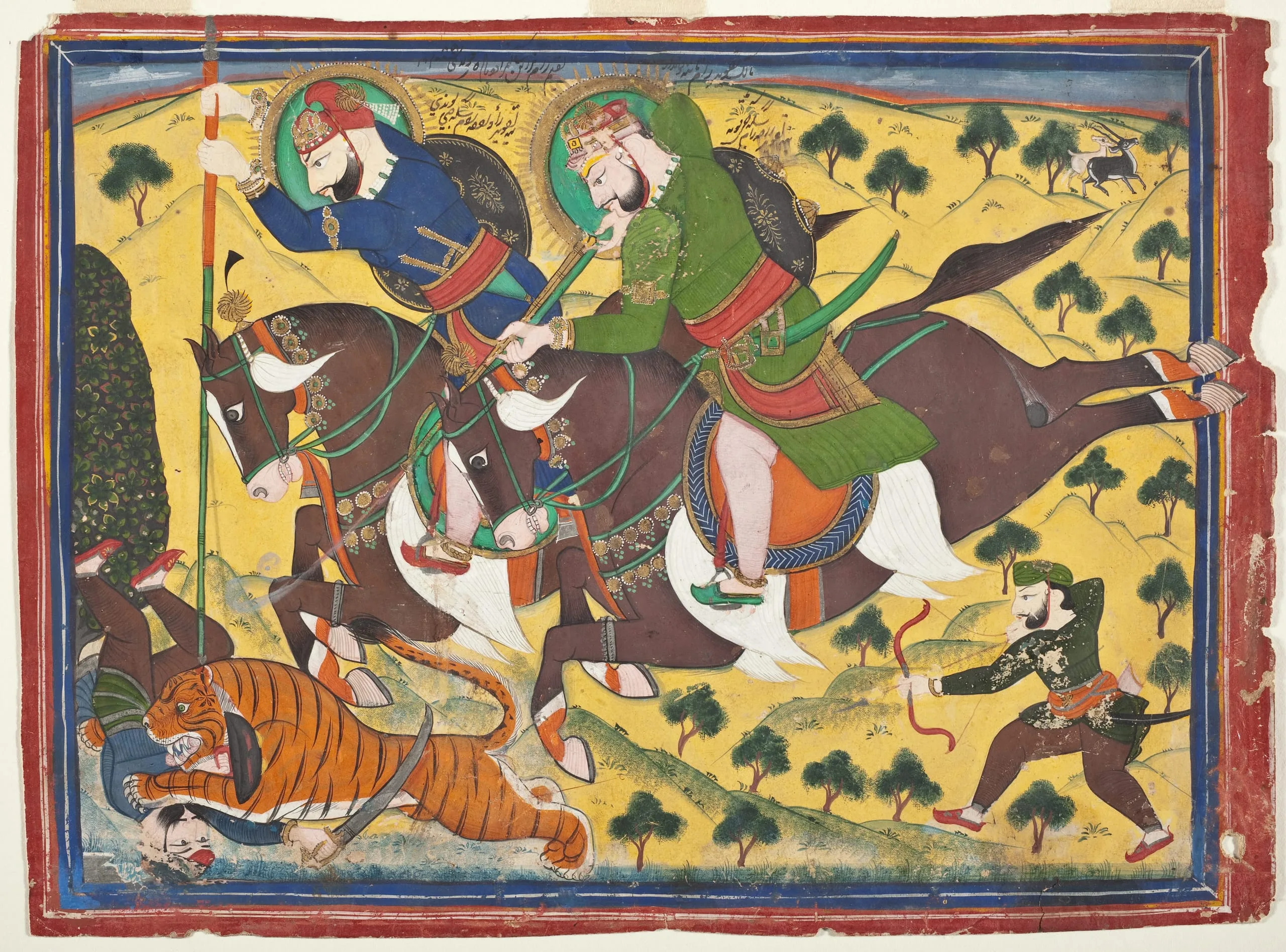
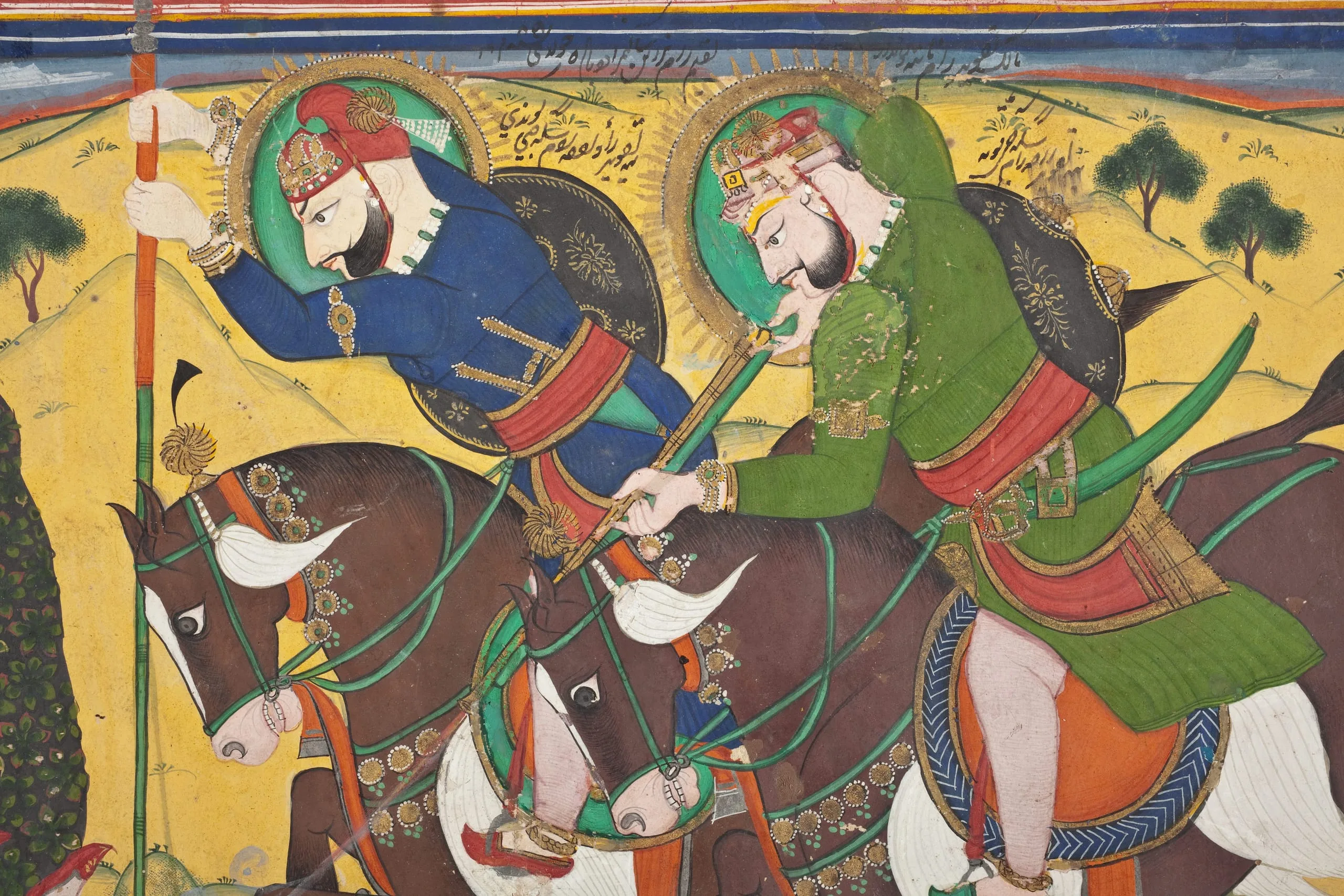
The Urdu inscriptions above the horseback figures identify them as portraits of Maharao Ram Singh II of Kota [“Raja Ram Singhji”] (r. 1827-1866) on the right and Maharao Raja Ram Singh of Bundi [“Rao Raja Ram Singhji”] (r. 1821-1889) on the left. The captions were written on 5 July (18)85 by Ram Narayan, resident of Muradabad [“Muradahbad”] in modern Uttar Pradesh. “Firuz” may be the painter (?). The paintings were owned by Ram Nath Havaldar. (Translation by Z. A. Desai.)
Maharao Ram Singh II of Kota (r. 1827-1866) was born in 1808, ascended the throne at age nineteen, and died in 1866. He is portrayed in numerous dated paintings engaged in a wide variety of activity ranging from his official duties (durbars, state meetings, royal processions, and festivals; see M.77.154.21) to his pastimes (hunting, entertainment, and erotic liaisons; see M.77.154.22). In his early portraits in the 1830s his side whiskers are short, but from around 1840 onward they are longer. He wore a distinctive style of headgear of his own design: a flat turban with a peak in the front.
Maharao Raja Ram Singh of Bundi (r. 1821-1889) was born in 1811, knighted as Sir Ram Singh in 1877, and died in 1889. He was a learned orthodox Hindu. See his photograph in the Royal Collection Trust, London (RCIN 2107601).
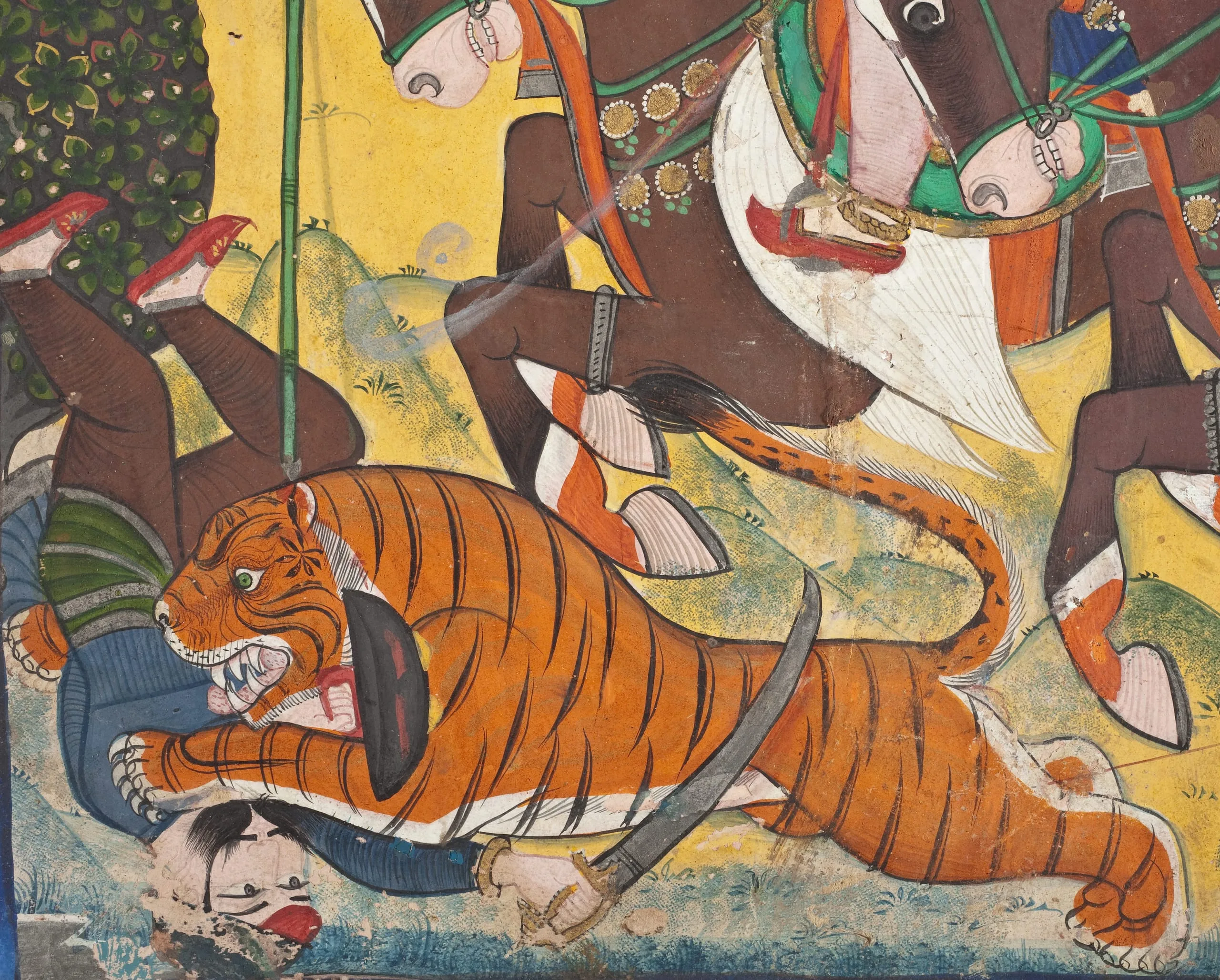
Painted in 1885 during the reign of Maharao Chattarsal of Kota (r. 1865-1888), Ram Singh II of Kota fires a rifle at, and Ram Singh of Bundi thrusts a lance into, a tiger mauling a fallen hunter.