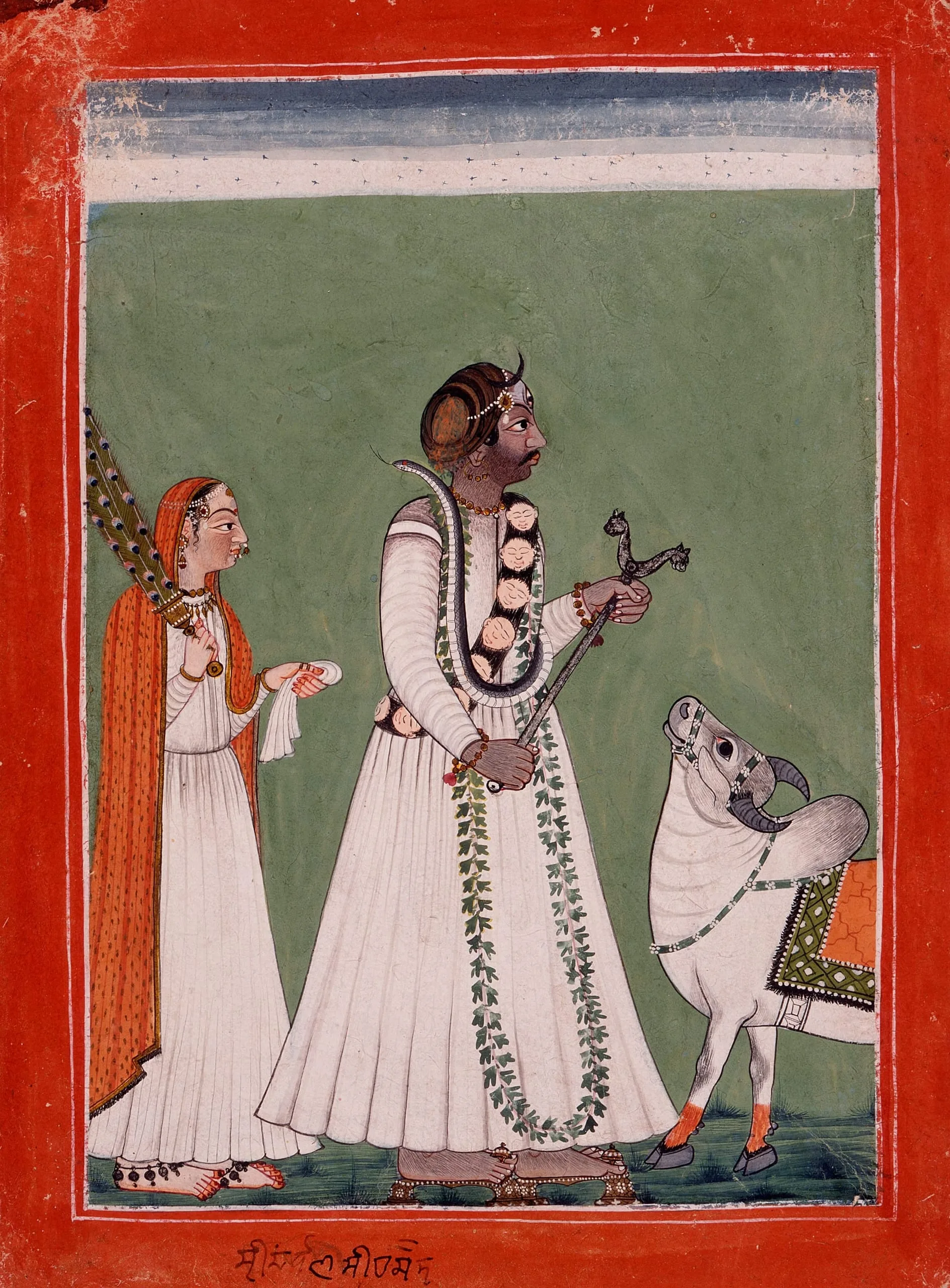
Raja Sidh Sen (r. 1684-1727) was born in 1634. At the age of fifty in 1684 he ascended the throne of the princely state of Mandi in present-day Himachal Pradesh and ruled for forty-three years until his death in 1727. Sidh Sen was noteworthy for his primary devotion to Shiva and commissioned several temples dedicated to Shiva and the Goddess. His legendary stature, over seven feet tall, is affirmed by numerous portraits. He was a great warrior and a deeply religious man who followed tantric practices and was believed to have supernatural powers. His golden amulet (gutka) was said to enable him to fly to the source of the Ganges River each morning for his daily bath.
In this portrait, Sidh Sen is portrayed iconographically as a manifestation of Shiva. On his forehead is Shiva’s emblematic crescent moon and third eye of wisdom. His turban is inscribed with a mantra, likely “Namah Shivaya” (adoration to Shiva). He wears a garland of skulls across his left shoulder, a long floral garland, bracelets made of Rudraksha (eye of Rudra/Shiva) beads (elaeo carpus seeds), and mendicant sandals (paduka) made of teak inlaid with ivory (see M.81.155a-b). He holds an ascetic’s crutch. A serpent, sacred to Shiva, is coiled around his torso like a garland. Shiva’s bull mount, Nandi, gazes up at him in adoration. Behind him a woman holds an honorific peacock feather fly whisk (morchal) and a handkerchief.
A comparable portrait of Sidh Sen as Shiva is in the Museum of Fine Arts, Boston (2001.137).