- Title
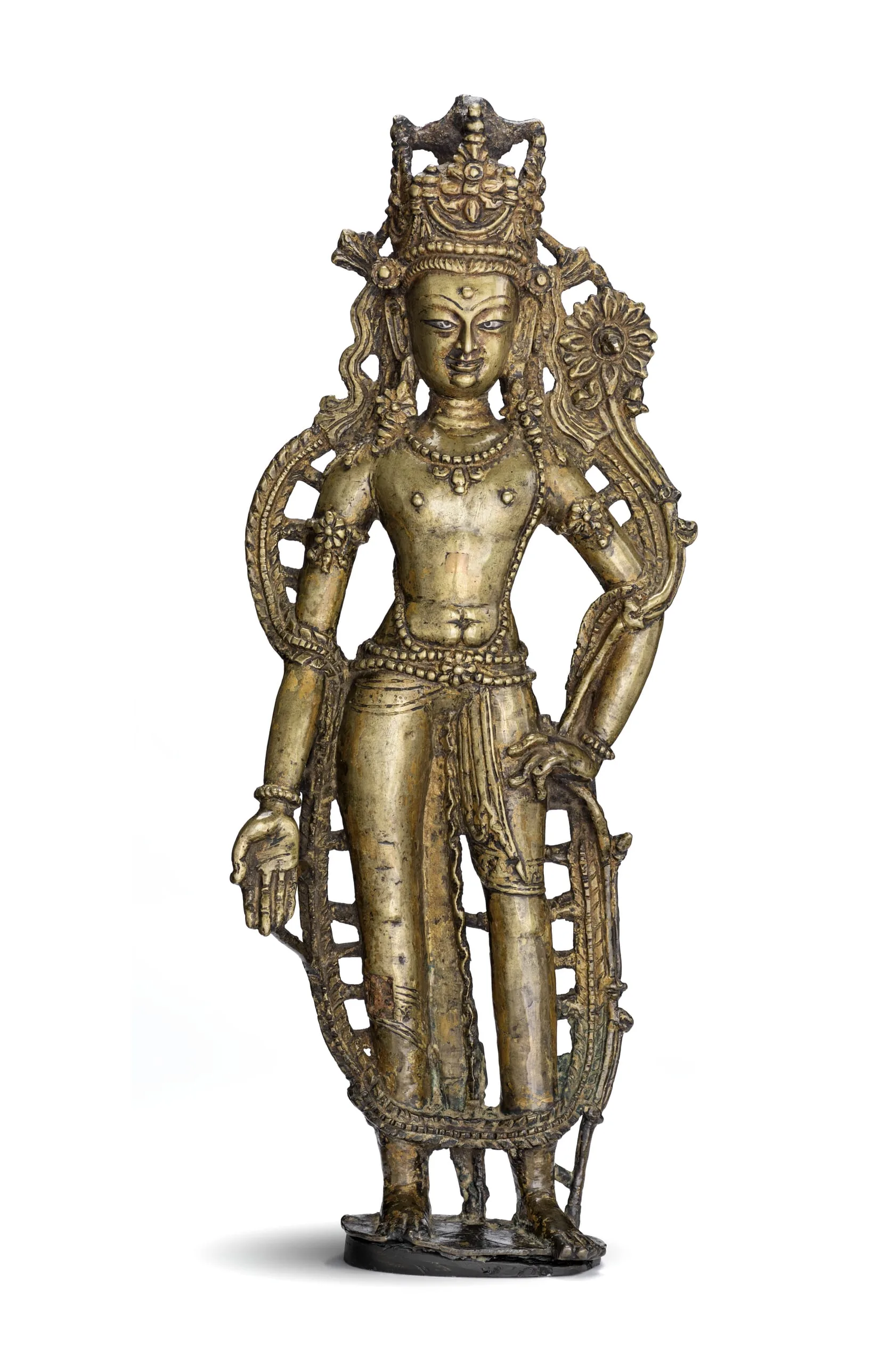
- The Bodhisattva Avalokiteshvara
- Date Made
- circa 12th century
- Medium
- Leaded copper-zinc-tin alloy inlaid with silver and copper; traces of paint
- Dimensions
- 14 1/2 x 6 1/8 x 1 7/8 in. (36.83 x 15.55 x 4.76 cm)
- Accession Number
- M.75.4.1
- Curatorial Notes
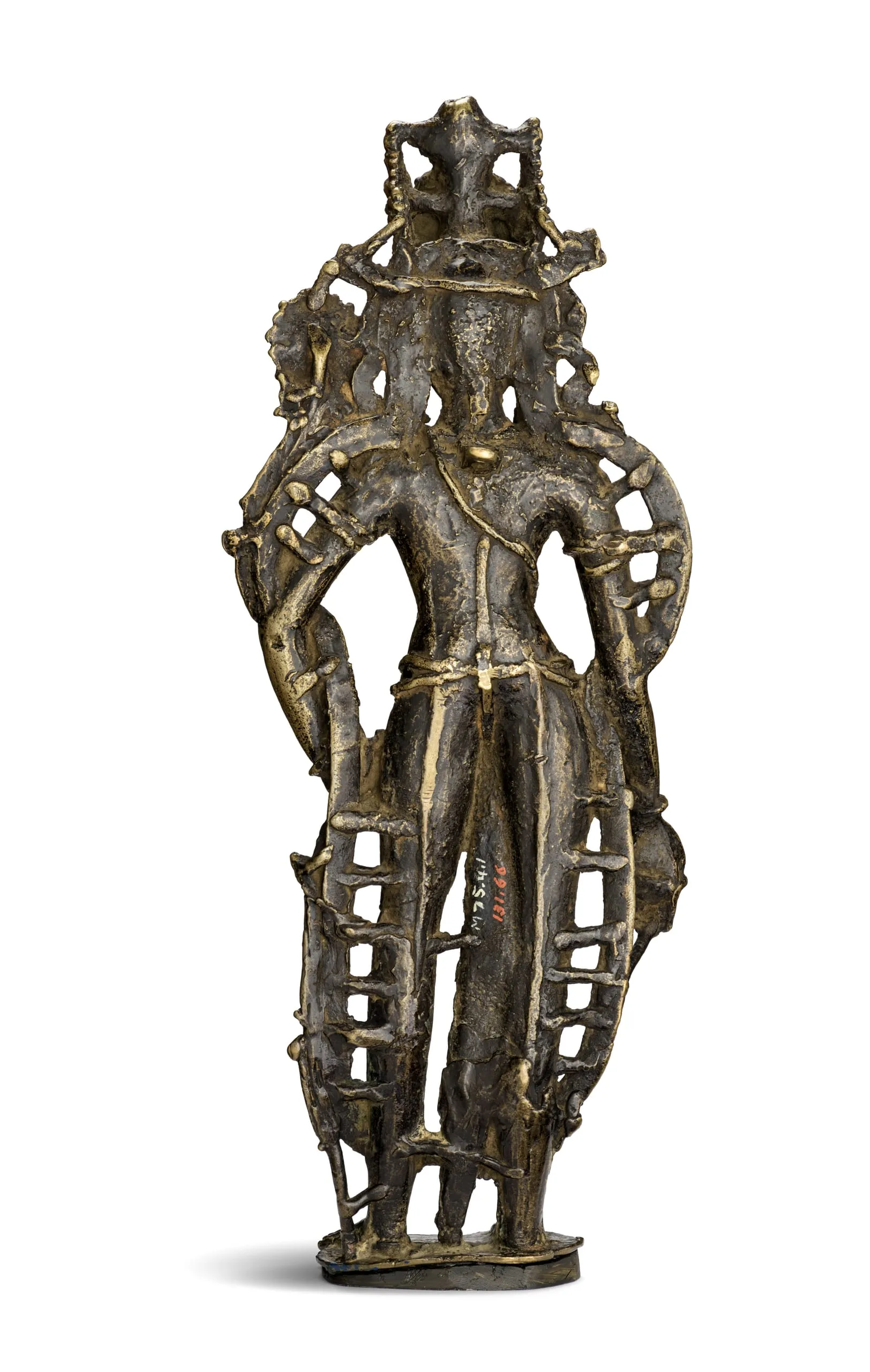
This representation of Avalokiteshvara, the Bodhisattva of Compassion, stands on a base plate that was once attached to a lotus base. He has a third eye in his forehead, silver-inlaid eyes, and copper-inlaid lips. He wears a tripartite crown and abundant ornaments, including the Brahmanical sacred thread (yajnopavita) over his left shoulder and a long floral garland (vanamala) around his neck that hangs down to his ankles. He is bare chested, barefooted, and wears a plain dhoti with decorated borders. In his left hand he holds a blossoming lotus with a long stalk. The back is roughly finished with multiple casting sprues remaining that function as support struts.
A stylistically comparable image of Manjushri is in the Asia Society Museum, New York (1979.045).
- Selected Bibliography
- Pal, Pratapaditya. Art of Tibet. Los Angeles; Berkeley, CA: Los Angeles County Museum of Art; University of California Press, 1983.
- Reedy, Chandra L. Himalayan Bronzes: Technology, Style and Choices. Newark: University of Delaware Press, 1997.
- Pal, Pratapaditya. Art of Tibet. Expanded edition. Los Angeles: Los Angeles County Museum of Art, 1990.
- Rosenfield, John. The Arts of India and Nepal: The Nasli and Alice Heeramaneck Collection. Boston: Museum of Fine Arts, Boston, 1966.
- Beguin, Gilles. Dieux et Demons de l'Himalaya: Art du Bouddhisme Lamaique. Paris: Grand Palais, 1977.
- Linrothe, Rob. Collecting Paradise: Buddhist Art of Kashmir and its Legacies. New York: Rubin Museum of Art, 2014.
- Little, Stephen, Tushara Bindu Gude, Karina Romero Blanco, Silvia Seligson, Marco Antonio Karam. Las Huellas de Buda. Ciudad de México : Instituto Nacional de Antropología e Historia, 2018.
- Little, Stephen, and Tushara Bindu Gude. Realms of the Dharma: Buddhist Art across Asia. Los Angeles: Los Angeles County Museum of Art, 2025.