LACMA

ShopMembershipMyLACMATickets
LACMA
Los Angeles County Museum of Art
5905 Wilshire Blvd.
Los Angeles, CA 90036
info@lacma.org
(323) 857-6000
Sign up to receive emails
Subscribe
© Museum Associates 2026
  • About LACMA
  • Jobs
  • Host An Event
  • Unframed
  • Press
  • FAQs
  • Log in to MyLACMA
  • Privacy Policy
© Museum Associates 2026
Collections

Unknown
The Bodhisattva Maitreya16th century

Not on view
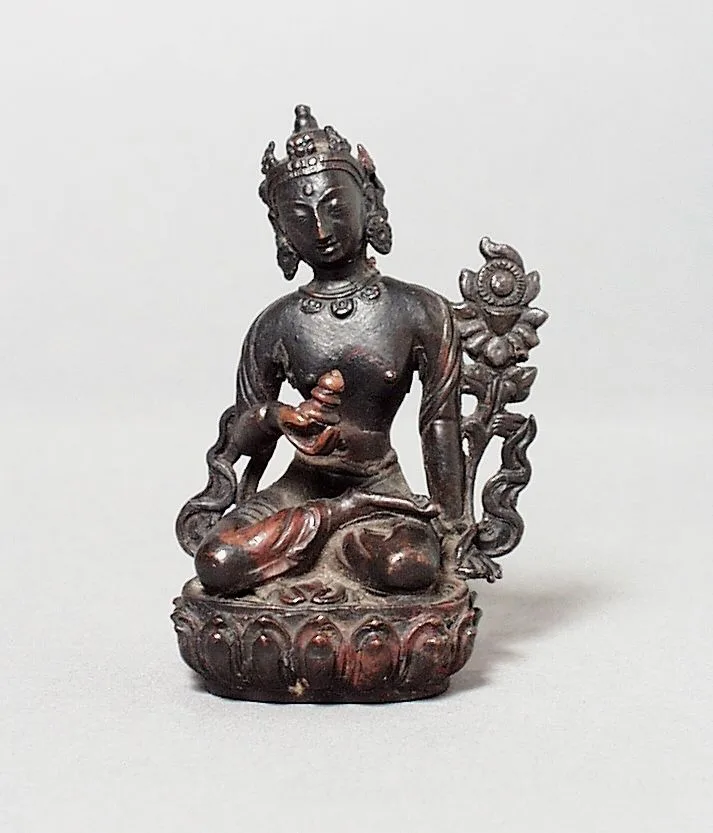
Small bronze sculpture of a seated deity on a lotus base, reddish-brown patina, with a lotus stem rising on the right side

Unknown, The Bodhisattva Maitreya, 16th century, Los Angeles County Museum of Art, From the Nasli and Alice Heeramaneck Collection, Museum Associates Purchase, photo © Museum Associates/LACMA

Artist or Maker
Unknown
Title
The Bodhisattva Maitreya
Place Made
Nepal or Central Tibet (by a Newar artist)
Date Made
16th century
Medium
Brass
Dimensions
3 5/8 x 2 3/8 x 1 3/4 in. (9.2 x 6.03 x 4.44 cm)
Credit Line
From the Nasli and Alice Heeramaneck Collection, Museum Associates Purchase
Accession Number
M.75.4.12
Classification
Sculpture
Collecting Area
South and Southeast Asian Art
Curatorial Notes

In an early publication, Pratapaditya Pal tentatively identified this brass sculpture as the Bodhisattva Samantahadra based on his interpretation of the handheld lotus having as wheel (chakra) on the bloom (Pal in Rosenfield 1966, p. 77, no. 75). Later, he equated about whether the object on the lotus is actually a wheel or part of the lotus flower itself. Consequently, he theorized that the figure is "some other bodhisattva." He also maintained that the attribute in the figure’s right hand cannot be identified (Pal 1983/1990, p. 204, no. S15).

The figure is now reidentified as the Bodhisattva Maitreya (Benevolent One) on the basis that the "unidentified" attribute is a dome-shaped votive stupa (funerary monument; see M.70.18, M.76.130, M.79.67 and M.85.224.6). The rounded topknot of his ascetic’s piled hair may also be in the form of a stupa. Further, the large blossoming lotus flower on the long stalk held in the figure’s left hand is the blue lotus (Utpala or Nymphaea nouchali). Both the stupa and blue lotus are attributes associated with Maitreya. The figure wears a five-point tiara representing the transcendental Five Jina Buddhas, otherwise standard jewelry, dhoti, and scarf around his shoulders. He sits in the lotus position (padma asana) on a lotus base.

Maitreya can be represented as the Buddha of the Future or as a Bodhisattva because before his manifestation on earth as the future Buddha he is believed to live in Tushita Heaven as a Bodhisattva (one who postpones their own Enlightenment to assist all sentient beings in their quest for Enlightenment).
Selected Bibliography
  • Pal, Pratapaditya. Art of Tibet. Los Angeles; Berkeley, CA: Los Angeles County Museum of Art; University of California Press, 1983.
  • Reedy, Chandra L. Himalayan Bronzes: Technology, Style and Choices. Newark: University of Delaware Press, 1997.
  • Pal, Pratapaditya. Art of Tibet. Expanded edition. Los Angeles: Los Angeles County Museum of Art, 1990.
  • Rosenfield, John. The Arts of India and Nepal: The Nasli and Alice Heeramaneck Collection. Boston: Museum of Fine Arts, Boston, 1966.