- Title
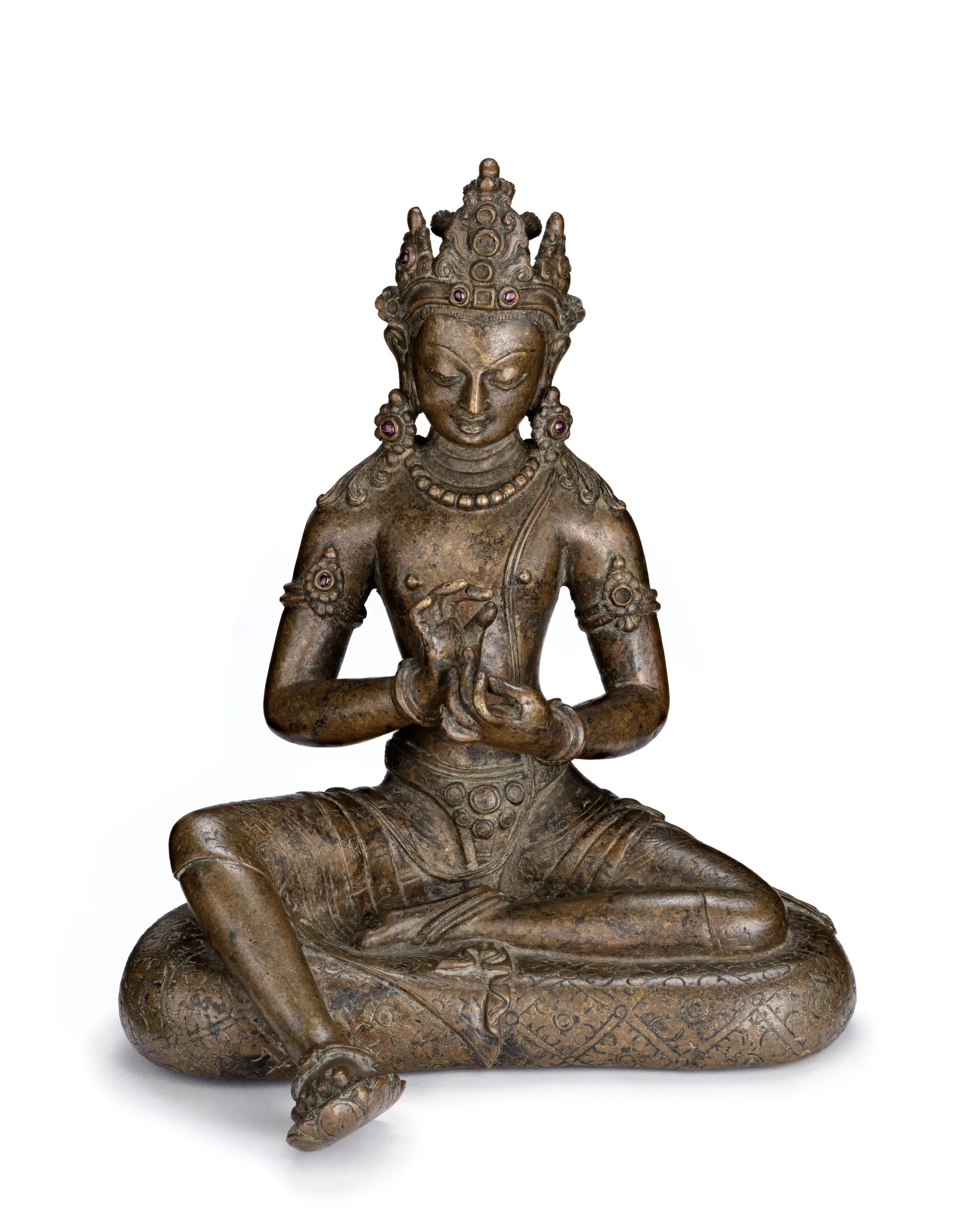
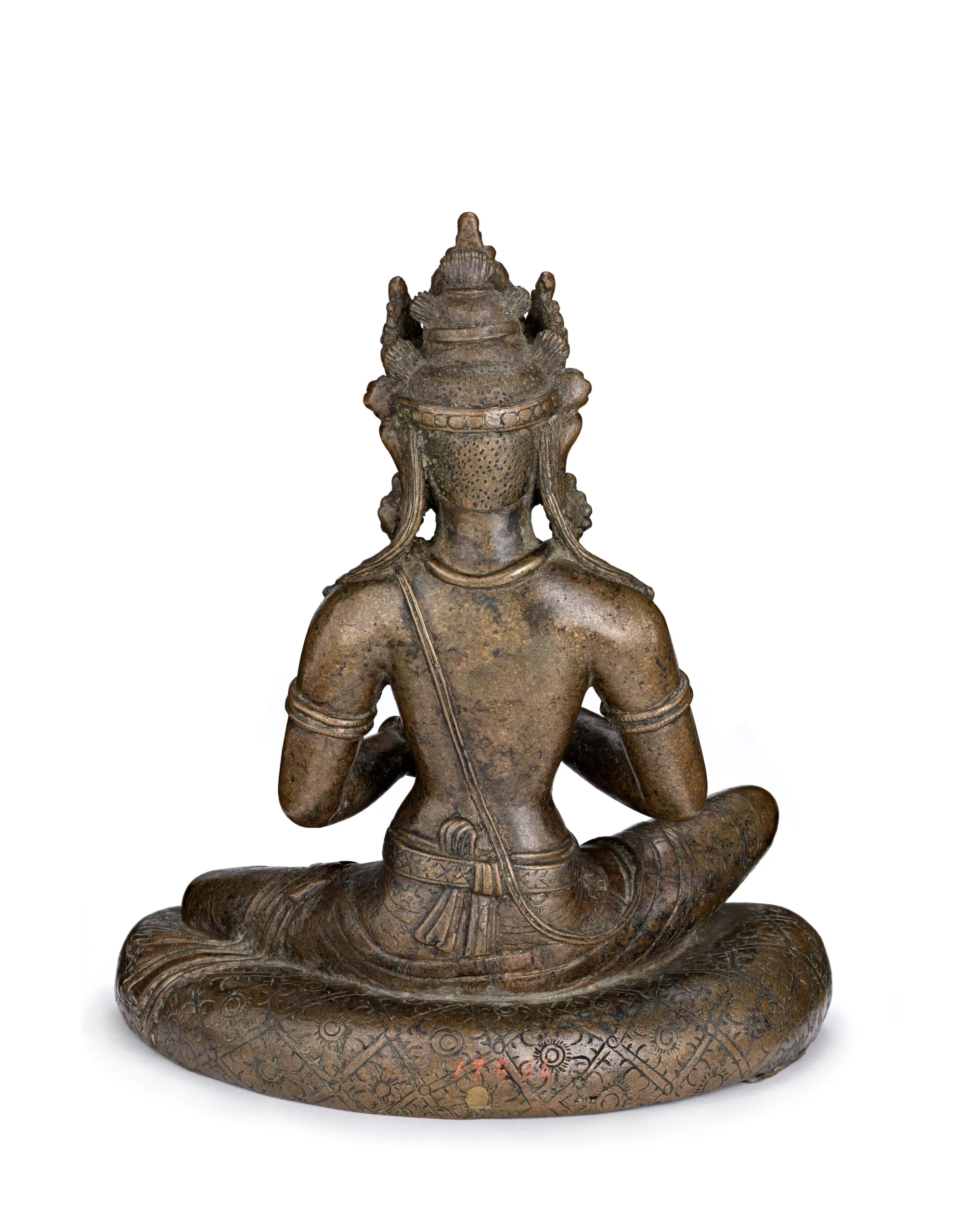
- The Bodhisattva Manjushri (Dharmachakra Manjushri)
- Date Made
- 11th century
- Medium
- Unalloyed copper inlaid with rubies
- Dimensions
- 6 3/4 x 6 1/4 x 5 1/2 in. (17.14 x 15.87 x 13.97 cm)
- Accession Number
- M.75.4.19
- Curatorial Notes
Manjushri (Beautiful Glory/Goddess) is the Bodhisattva of Wisdom. He is the patron deity of the Newar Buddhists and is credited with the creation of the Kathmandu Valley. According to the local narrative, the Valley was originally a great lake, and Manjushri used his sword of wisdom to cut a cleft in the mountains that contained the lake. With the lake thus drained, he created Valley, making it habitable for all sentient beings.
Manjushri is envisioned in at least fourteen iconographic forms per religious textual sources. He is often shown brandishing his sword of wisdom and holding a manuscript of the Prajnaparamita (Perfection of Wisdom) surmounted on a lotus stalk (M.78.136 and M.75.4.6). Or he sometimes carries only the sacred manuscript (M.75.4.9). Here, in a form known as Dharmachakra Manjushri, he holds his hands in the gesture of Turning the Wheel of the Law (dharmachakra mudra). He is crowned and has long locks of hair cascading onto his shoulders. He wears jewelry inlaid with rubies and the Brahmanical sacred thread (yajnopavita) worn over his left shoulder. He sits on an ovoid patterned cushion in the relaxed posture (lalita asana) with his right leg pendant and supported by the pericarp of a lotus flower (karnika).
- Selected Bibliography
- Reedy, Chandra L. Himalayan Bronzes: Technology, Style and Choices. Newark: University of Delaware Press, 1997.
- Glynn, Catherine. Aspects of Asian Art from the Los Angeles County Museum of Art. University of Redlands, 1972.
- Rosenfield, John. The Arts of India and Nepal: The Nasli and Alice Heeramaneck Collection. Boston: Museum of Fine Arts, Boston, 1966.
- Pal, Pratapaditya. Art of Nepal. Los Angeles: Los Angeles County Museum of Art; University of California Press, 1985.
- Little, Stephen, Tushara Bindu Gude, Karina Romero Blanco, Silvia Seligson, Marco Antonio Karam. Las Huellas de Buda. Ciudad de México : Instituto Nacional de Antropología e Historia, 2018.
- Little, Stephen, and Tushara Bindu Gude. Realms of the Dharma: Buddhist Art across Asia. Los Angeles: Los Angeles County Museum of Art, 2025.