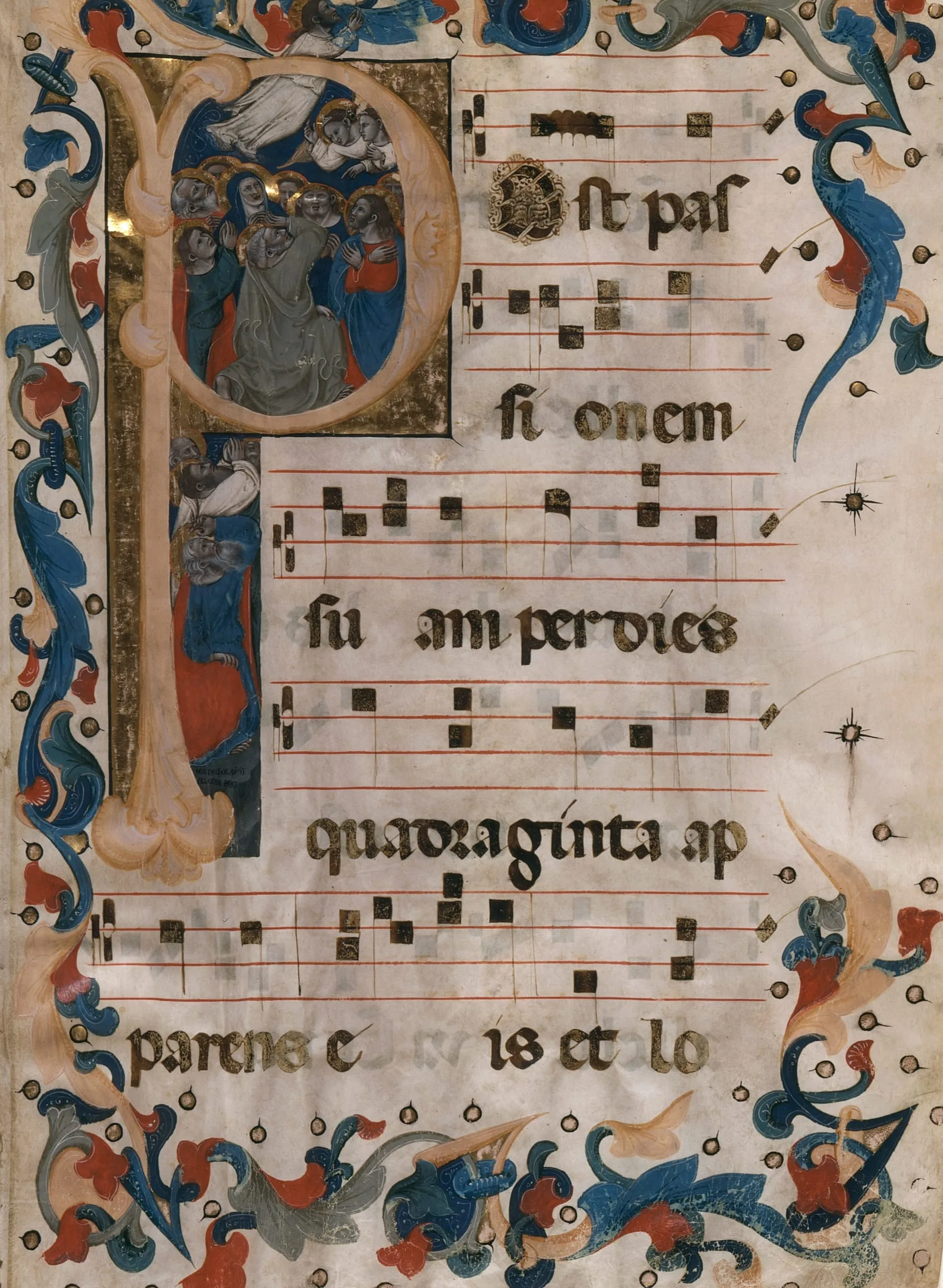
This ornately decorated leaf from a fourteenth-century Bolognese antiphonary, or choirbook, is distinctive for its inclusion of the illuminator’s signature: barely visible in the blue tempera at the base of the initial “P” is the inscription “Ego Nichola d Bolonia Fecit” (“I, Niccolò da Bologna, made it”), assigning the manuscript’s authorship to a miniaturist whose workshop decorated university texts, liturgical documents, and private devotional manuscripts. Later in his career, Niccolò would sign his illuminations merely “Nicolaus F” (“Niccolò made it”), suggesting that LACMA’s manuscript leaf is likely from the early phase of his career, probably around 1365. The historiated “P” that begins the handwritten musical score has been decorated at its center with a miniature rendering of the Ascension of Christ after the Passion, with his disciples and the Virgin Mary looking skyward toward a group of angels as he rises to heaven. This leaf was cut out of a larger manuscript and trimmed, possibly several centuries after its production; the original antiphonary to which it belonged has yet to be found and was probably broken up and dispersed.
A university center from the late twelfth century onward, Bologna’s unique status as a city with a prominent secular, civil nature resulted in a distinctive hybrid style to its tre- and quattrocento manuscript illumination. Works such as this folio exhibit elements of French decoration through Bologna’s book trade with France, and Byzantine stylistic principles through its proximity to the ancient city of Ravenna.
Claire Spadafora Baes
2025