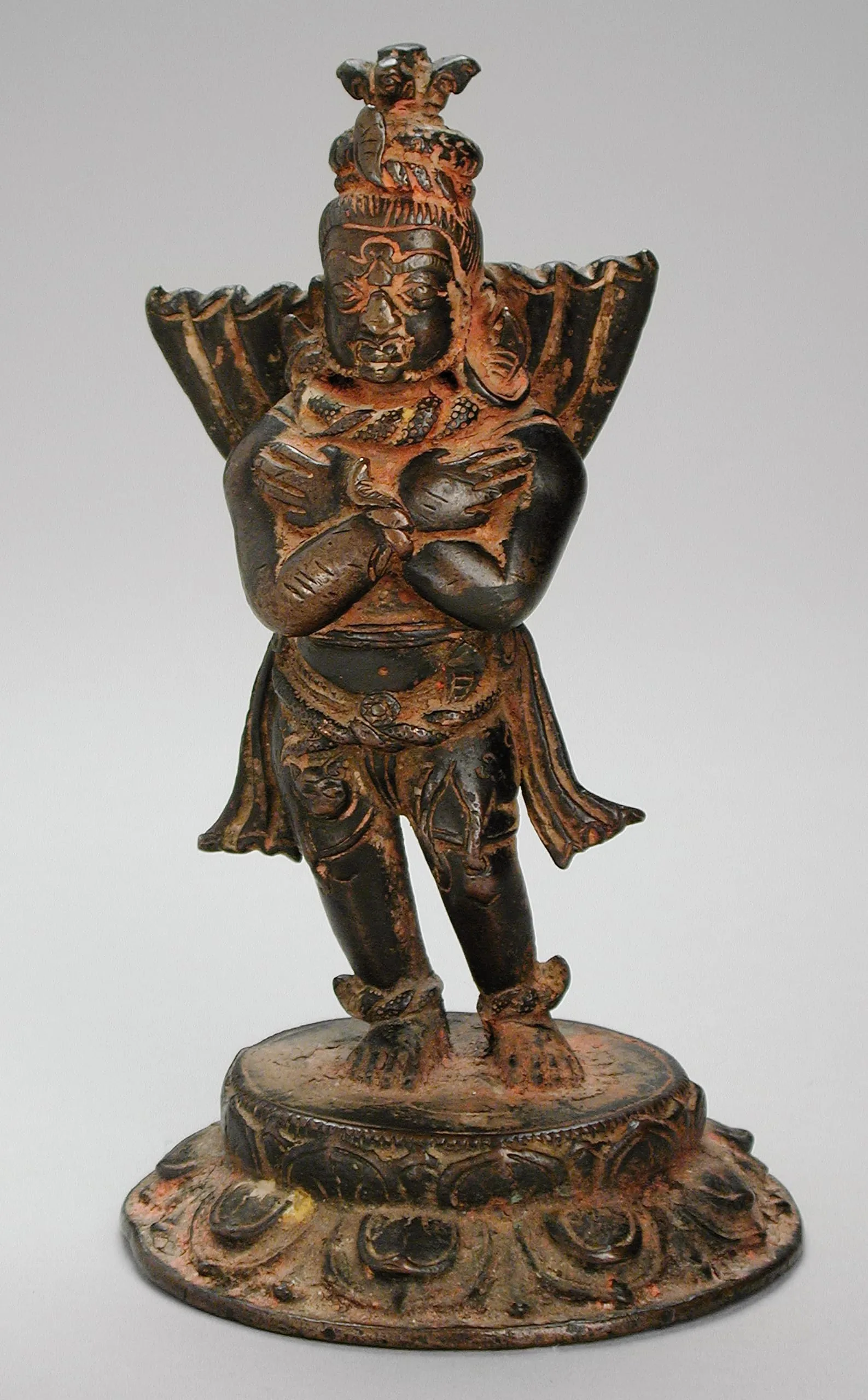
- Title
- Personified Thunderbolt (Vajra Purusha)
- Date Made
- 10th century
- Medium
- Unalloyed copper with traces of red devotional paint
- Dimensions
- 5 1/4 x 3 x 2 7/8 in. (13.34 x 7.62 x 7.3 cm); 5 1/4 in. (13.34 cm)
- Accession Number
- M.74.105.2
- Curatorial Notes
Personified weapons or emblems (ayudha pursha) of deities, particularly those of Vishnu, began to appear in Indian art by the 4th century and in Nepalese art by the early 6th century. Anthropomorphic figures with a thunderbolt (vajra) emerging from the top of their head, known as a Vajra Purusha, represent the personified thunderbolt of either the Bodhisattva Vajrapani (Vajra-Holder) or Indra, the god of thunder and lightning. Such attendant figures are intended as dwarves, as clearly indicated in a Nepalese sculpture depicting Vajrapani besides his smaller aide Vajra Purusha (M.75.4.14).
This representation of a Vajra Purusha follows the Nepalese convention of standing on a lotus base with a fierce expression and his arms crossed against his chest in a gesture of subservience (vinaya hasta). The prongs of the thunderbolt protrude from his hair bun. He wears a serpent as a necklace and another as a belt. He also has a leopard skin draped around his waist. His short cape billows behind him.
A comparable but larger image of a Nepalese Vajra Purusha is in the Norton Simon Museum, Pasadena (F.1973.13.3S). These independent images of Vajra Purusha suggest a cult to the divine acolyte existed in Nepal during this period.
- Selected Bibliography
- Bhattacharya, Gouriswar. "The Buddhist Deity Vajrapani." Silk Road Art and Archaeology vol. 4 (1995-1996): 323-354.
- Reedy, Chandra L. Himalayan Bronzes: Technology, Style and Choices. Newark: University of Delaware Press, 1997.
- Pal, Pratapaditya. Nepal: Where the Gods are Young. New York: Asia House Gallery, 1975.
- Pal, Pratapaditya. Art of Nepal. Los Angeles: Los Angeles County Museum of Art; University of California Press, 1985.
- Little, Stephen, and Tushara Bindu Gude. Realms of the Dharma: Buddhist Art across Asia. Los Angeles: Los Angeles County Museum of Art, 2025.