- Title
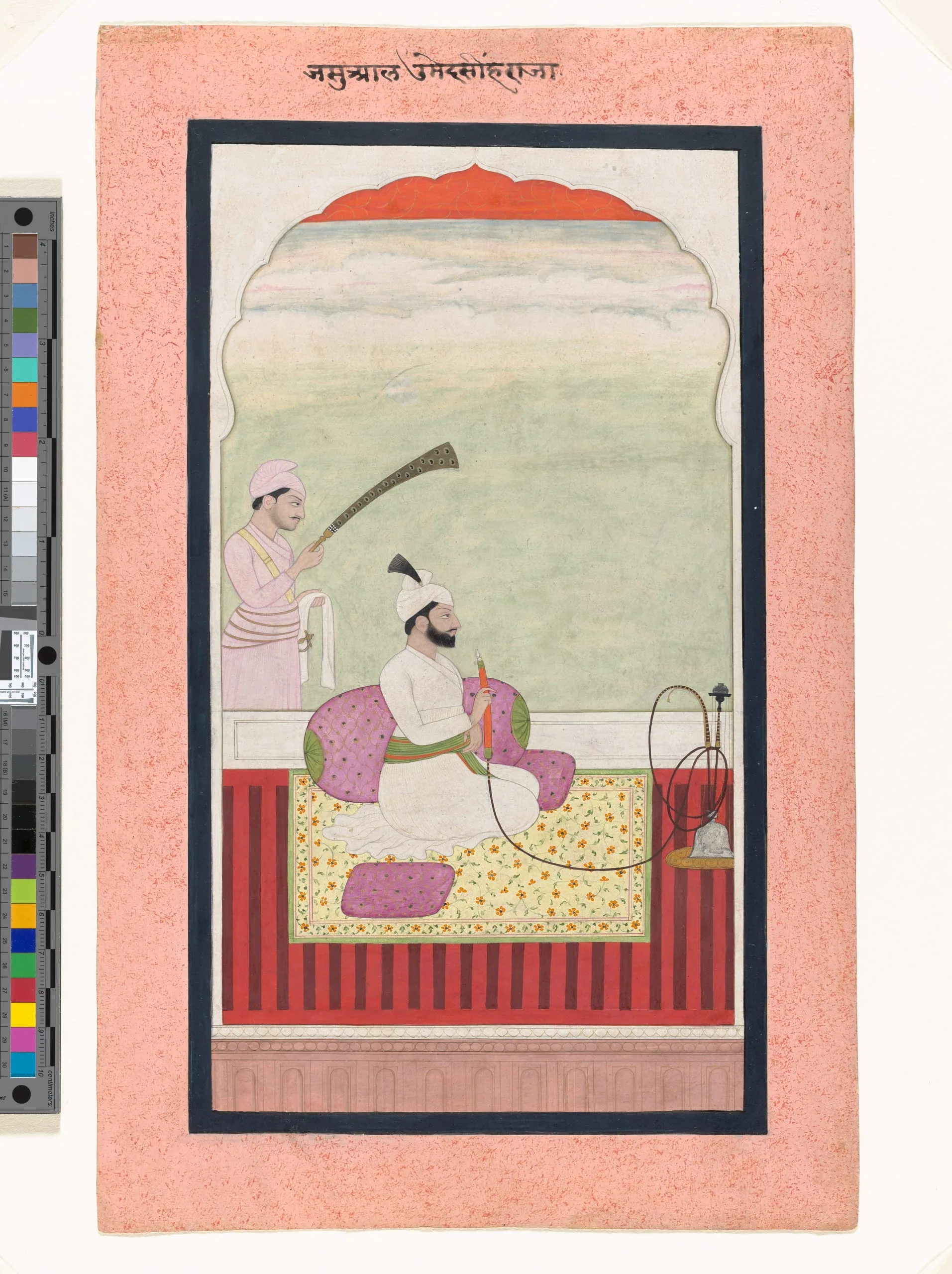
- Raja Jaswal Umed Singh of Jaswan (r. 1782-1815)
- Date Made
- circa 1815-1820
- Medium
- Opaque watercolor, gold, silver, and ink on paper
- Dimensions
- Image (Image): 9 3/4 x 5 3/8 in. (24.765 x 13.6525 cm)
Sheet (Sheet): 12 1/8 x 7 3/4 in. (30.7975 x 19.685 cm)
Frame: 19 × 14 in. (48.26 × 35.56 cm)
- Accession Number
- M.74.102.2
- Curatorial Notes
A devanagari inscription in the upper border identifies the subject as “Raja Jaswal Umed Singh” of Jaswan (r. 1782-1815). He was born in circa 1770 and died in 1849. Located in present-day Himachal Pradesh, Jaswan had been subjected to Mughal domination since the time of Emperor Akbar (r. 1556-1605). By 1786, when Mughal decline was well under way, struggles among the hill states resulted in the acquisition of power by Raja Sansar Chand II of Kangra (r. 1775-1823) and Jaswan became a tributary to Kangra. In 1805, Umed Singh joined a confederacy of hill states in a successful revolt against Sansar Chand. In 1815, the Sikh Maharaja Ranjit Singh (r. 1801-1839) summoned all his military forces to assemble at Sialkot in present-day Pakistan. Umed Singh ignored the summons and was levied an exorbitant fine. He abdicated and retired to a modest estate, and Jaswan was annexed by Ranjit Singh. In 1848, he joined the Sikhs in the Second Anglo-Sikh War (1848-1849) fought unsuccessfully against the British East India Company. He was then exiled to Almora in present-day Uttarakhand.
In this painting, Umed Singh is seated on a floral carpet leaning against a bolster on a palace terrace behind a cusped archway. He has a feather plume in his white turban, which matches his white coat (jama). His only jewelry is a gold pinky ring. He is smoking a flat-bottomed hookah, which is his sole royal accoutrement. An attendant waves an honorific peacock feather fly whisk (morchal) over his head.