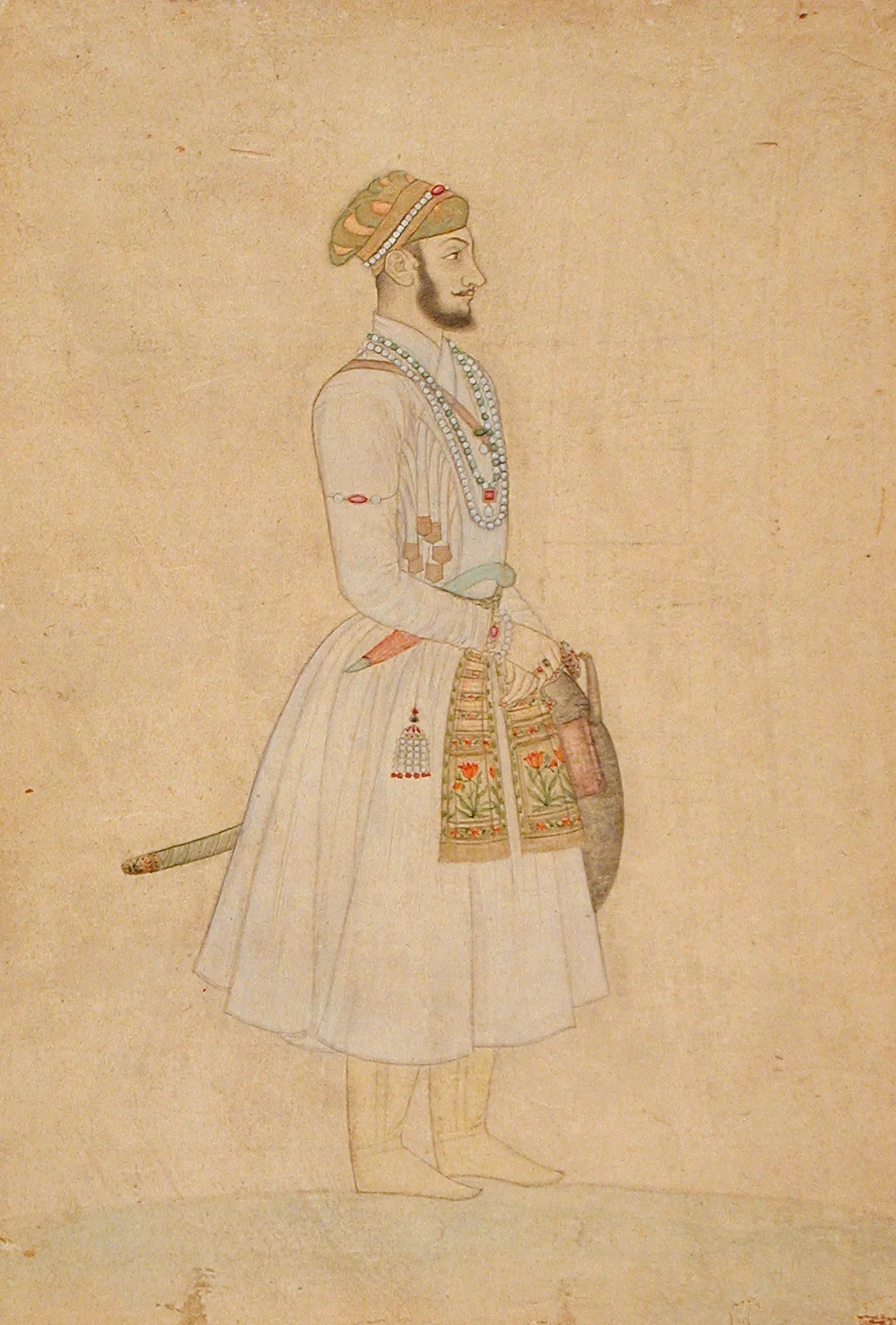
- Title
- Emperor Shah Alam Bahadur (Bahadur Shah I, r. 1707-1712) when he was Prince Muhammad Muazzam
- Date Made
- circa 1675
- Medium
- Ink, opaque watercolor, and gold on paper
- Dimensions
- 7 1/16 x 4 15/16 in. (17.94 x 10.16 cm)
- Accession Number
- M.74.123.5
- Curatorial Notes
Emperor Shah Alam Bahadur (Bahadur Shah I, r. 1707-1712), portrayed here when he was Prince Muhammad Muazzam (1643-1712), was the second son of Emperor Aurangzeb (r. 1658-1707). He served as the governor of Akbarabad (later known as Agra), Kabul, and Lahore. During the war of succession between Aurangzeb’s sons following his death in 1707, Bahadur Shah I defeated Aurangzeb’s eldest son, Muhammad Azam Shah, in the Battle of Jajau and claimed the throne. He reigned for only five years before dying from health complications in Lahore in 1712. He was buried in the courtyard of the Moti Masjid (Pearl Mosque) in Delhi.
In this nim qalam (half-pen) lightly tinted drawing, Bahadur Shah I stands in three-quarter view with his head facing left in full profile. On his head is a flat green-and-orange turban embellished with a string of pearls with a ruby centerpiece. Around his neck he wears a long strand of pearls and a shorter strand of pearls and emeralds with a ruby and pearl pendant. He wears a pearl and ruby armlet and matching bracelet and a pearl bracelet. He wears a white coat (jama), with pleats dangling where the coat is tied under his right arm, and a brocaded waist sash. He has a dagger (khanjar) with a light green jade pistol-grip shaped hilt and a pendant bejeweled tassel. A sword and shield are suspended on his far side.
On the reverse Shah Alam is inscribed in both Devanagari and Arabic.
- Selected Bibliography
- Pal, Pratapaditya. Indian Painting, vol.1. Los Angeles: Los Angeles County Museum of Art, 1993.
- Pal, Pratapaditya and Catherine Glynn. The Sensuous Line: Indian Drawings from the Paul F. Walter Collection. Los Angeles: Los Angeles County Museum of Art, 1976.