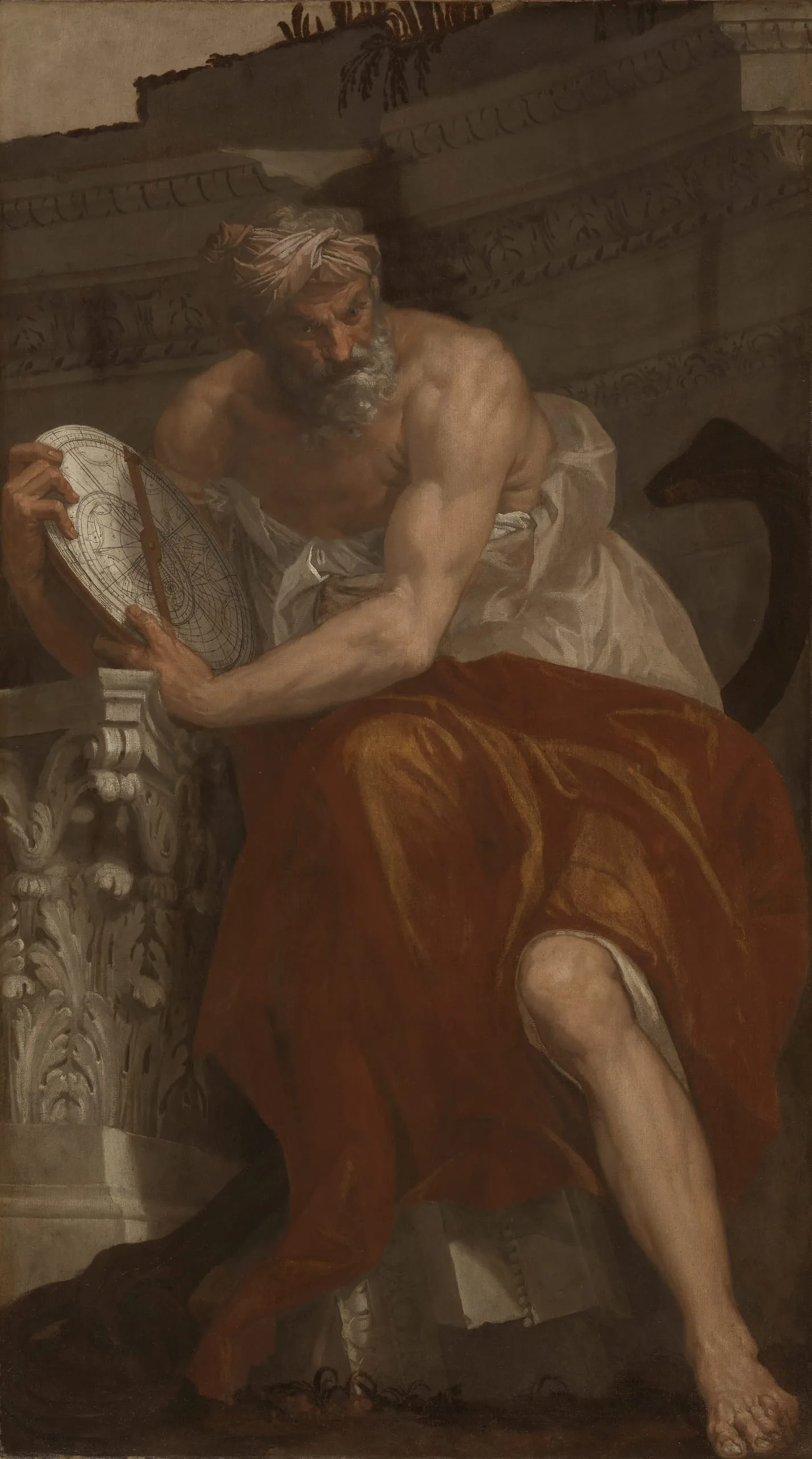
Two bearded figures are depicted in a pair of sizable paintings executed by Paolo Veronese. One figure, seen here, crouches against a Corinthian column, his muscular body exposed; he guards an astrolabe, essential for establishing the position of the stars. The other figure (M.74.99.2) twists his body to gaze upward, thrusting forward a cross-staff (balestriglia)—an instrument used in fifteenth-century navigation to measure latitude—while clutching an elaborate frieze fragment. These two figures, identified as the ancient astronomers Ptolemy and Averröes and resembling Greek and Roman sculpture, represent the Allegory of Navigation, a fitting subject for the Venetian Republic, renowned for its nautical advancements and advantageous geographical position that facilitated its commercial success. The Republic’s trade exchange is further evidenced by the objects to which artists had access. Planispheric astrolabes—such as the one held by Ptolemy—gained popularity in the Islamic world during the eighth and ninth centuries and were manufactured in western Europe by the fifteenth century. Ptolemy’s black-and-white astrolabe resembles a wood model crafted at Georg Hartmann’s workshop in Nuremberg in the 1540s. Hartmann, a friend of Albrecht Dürer, was among the first to systematically print astrolabe parts on paper, which were then mounted onto wood. Veronese’s depiction of this astrolabe thus affirms the Republic’s stature as an important early modern entrepôt.
Veronese, among the most successful painters in Venice during this time, fulfilled commissions ranging from private portraits to elaborate decorative schemes in the Ducal Palace. The architectural backgrounds in this pair of allegories, when viewed together, appear as an extension of one another. They likely belonged to a larger series, probably conceived as part of a public library in Venice. Late sixteenth-century copies, preserved in the Musée des Beaux-Arts, Chartres, reveal that the pair were part of at least four paintings. The figures have thus mostly been interpreted as serving the function of decorative allegories. LACMA’s canvases recently underwent conservation, revealing a sumptuous color palette and intricate details.
Yet the figures also offer more than mere allegorical representation. Their tense bodies may in fact convey the urgency and danger associated with the unpredictability of maritime navigation. The military and commercial pursuits of the Republic, moreover, resulted in constant warfare with the Ottoman Empire. Veronese moved to Venice between 1553 and 1555, at a time of escalating tensions in Venetian-Ottoman relations. The figures’ protective stance and wary expression thus may also reflect a sense of anxiety about the ongoing conflicts and pervasive threat of invasion—primarily through maritime routes—during this tumultuous period.
2024