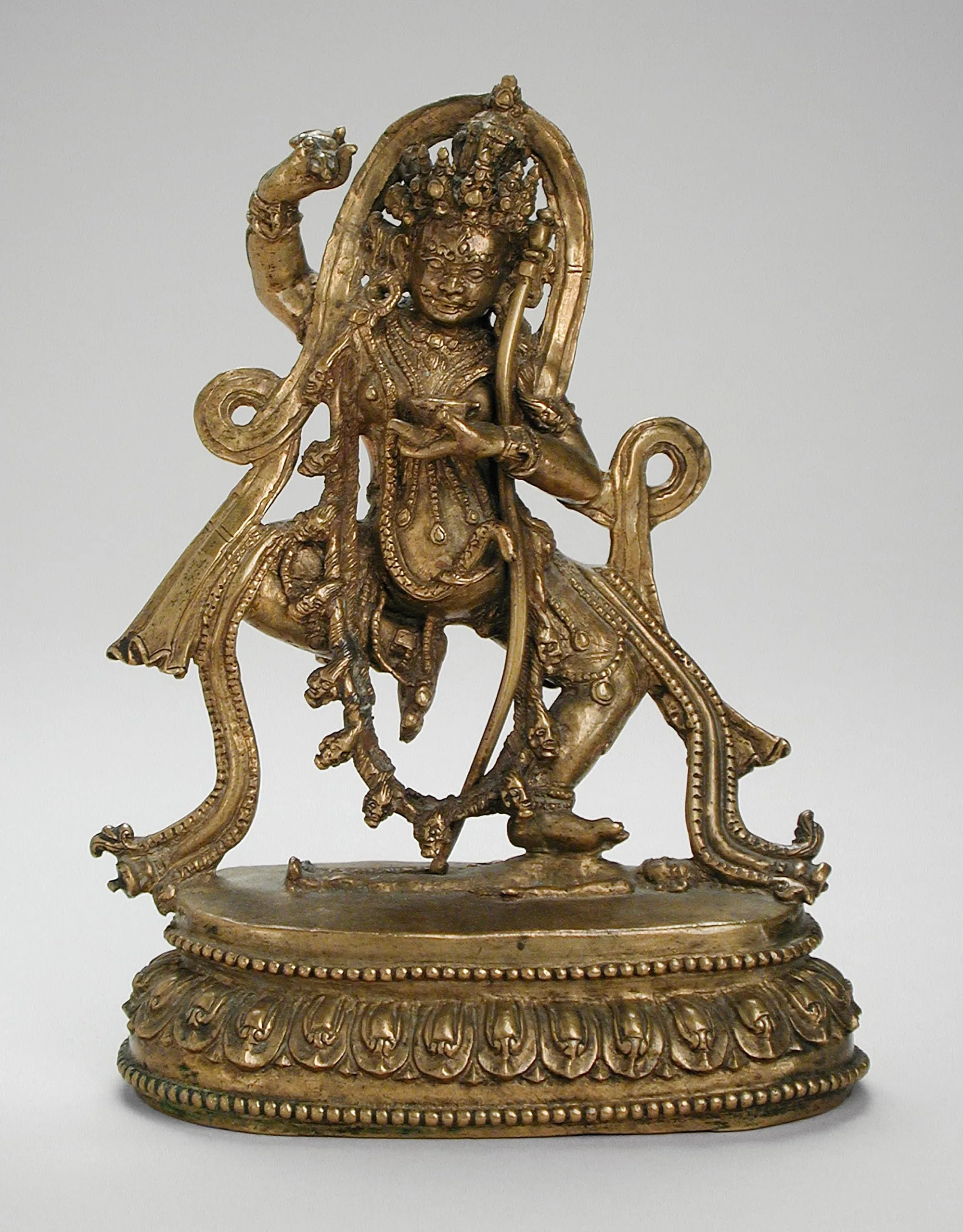
The esoteric Buddhist goddess Vajravarahi (Adamantine Sow) is the embodiment of transcendent wisdom. Highly venerated in her own right, Vajravarahi is also the consort of Chakrasamvara, the personification of transcendent compassion. In her dancing posture depicted here, she is the supreme dakini (Female Sky-goer), a group of wrathful female divinities who represent the generative power and innate presence of the Buddha that is found in all sentient beings. Her ecstatic dance of enlightenment overcomes and dispels delusion, which is symbolized by the small head of a female pig projecting as an excrescence above her right ear. Her flying scarf forms a nimbus around her head and conveys the exuberance of her dance by lending an energetic sense of movement to the sculpture.
Vajravarahi has a third eye indicative of her mystical insight. She is profusely ornamented with an elaborate tiara, necklaces, armlets, bracelets, anklets, long garland of severed skulls (mundamala), animal skin waist wrap, and a serpent encircling her body. The fierce goddess holds a flaying knife (kartika) in her raised right hand and a skull cup (kapala) in her left, which she uses respectively to cut through the fog of ignorance and to hold the blood symbolic of wisdom's triumph over delusion. A tall ritual staff (khatvanga) rests against her left shoulder. She dances in the half-squatting dancing posture (ardha paryanka asana) with her left foot trampling a human corpse representing the delusions of the illusory self.
See also M.70.1.3, M.71.73.131, M.73.2.1, M.80.110, M.84.224.1, M.88.213.12, and M.90.195.