- Title
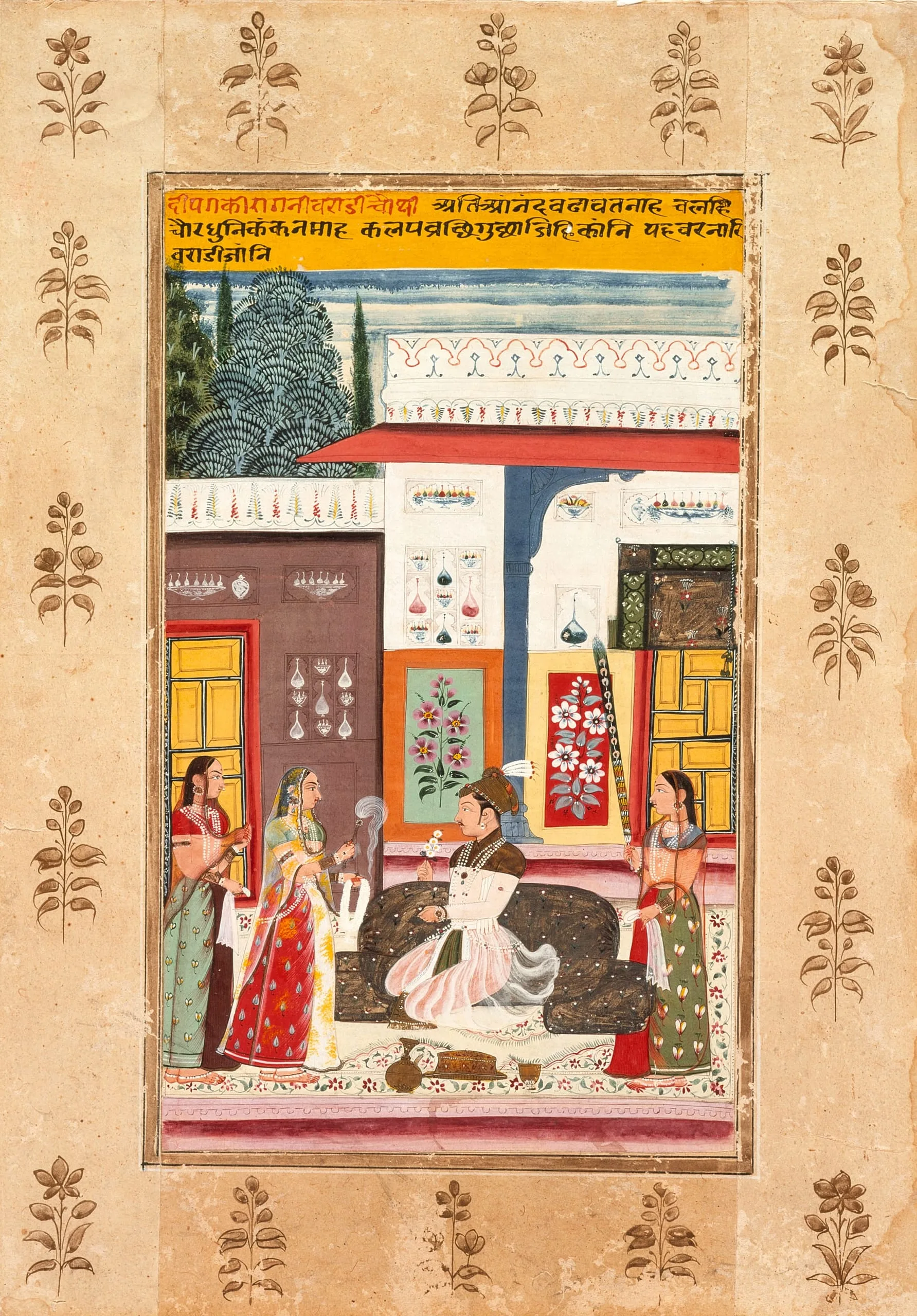
- Varadi Ragini, Fourth Wife of Dipak Raga, Folio from a Ragamala (Garland of Melodies)
- Date Made
- circa 1675-1700
- Medium
- Opaque watercolor, gold, and ink on paper
- Dimensions
- Image: 8 3/4 x 6 in. (22.22 x 15.24 cm); Sheet: 14 x 10 in. (35.56 x 25.4 cm)
- Accession Number
- M.74.88.2
- Curatorial Notes
Varadi Ragini is the fourth wife of Dipak Raga in the predominant ragamala (garland of melodies) classification system generally known as the Rajasthani system. The poetic verses in the header states that Varadi is said to provide a great deal of pleasure when she walks and wears bunches of leaves and blossoms of the wish-fulfilling tree for earrings. Varadi Ragini is a full-toned melody associated with the afternoon and Autumn (September–November). It is envisioned as a heroine approaching a seated prince.
In this folio from a dispersed ragamala set, a beautiful heroine approaches her seated lover who holds a nosegay. Beside him are a golden ewer, an enameled golden betel box (pandan) trimmed with pearls, and a golden goblet. The heroine carries a fly whisk made from the white tail-hairs of a yak (cauri or chowri) and a floral garland. An attendant behind the prince holds an honorific peacock feather fly whisk (morchal) and a handkerchief. An attendant behind the heroine holds the hem of her transparent shawl and a handkerchief. The setting is a verandah of a white palace with finely detailed architectural motifs, several decorative arrangements of painted wine bottles, and two large painted panels of flowering plants. The beige outer border has prominent floral sprays. Additional folios from this series are in the Brooklyn Museum (86.227.53), Chhatrapati Shivaji Maharaj Vastu Sangrahalaya, Mumbai (56.29-.30) and State Museum, Lucknow (57.65-.66 and .68).