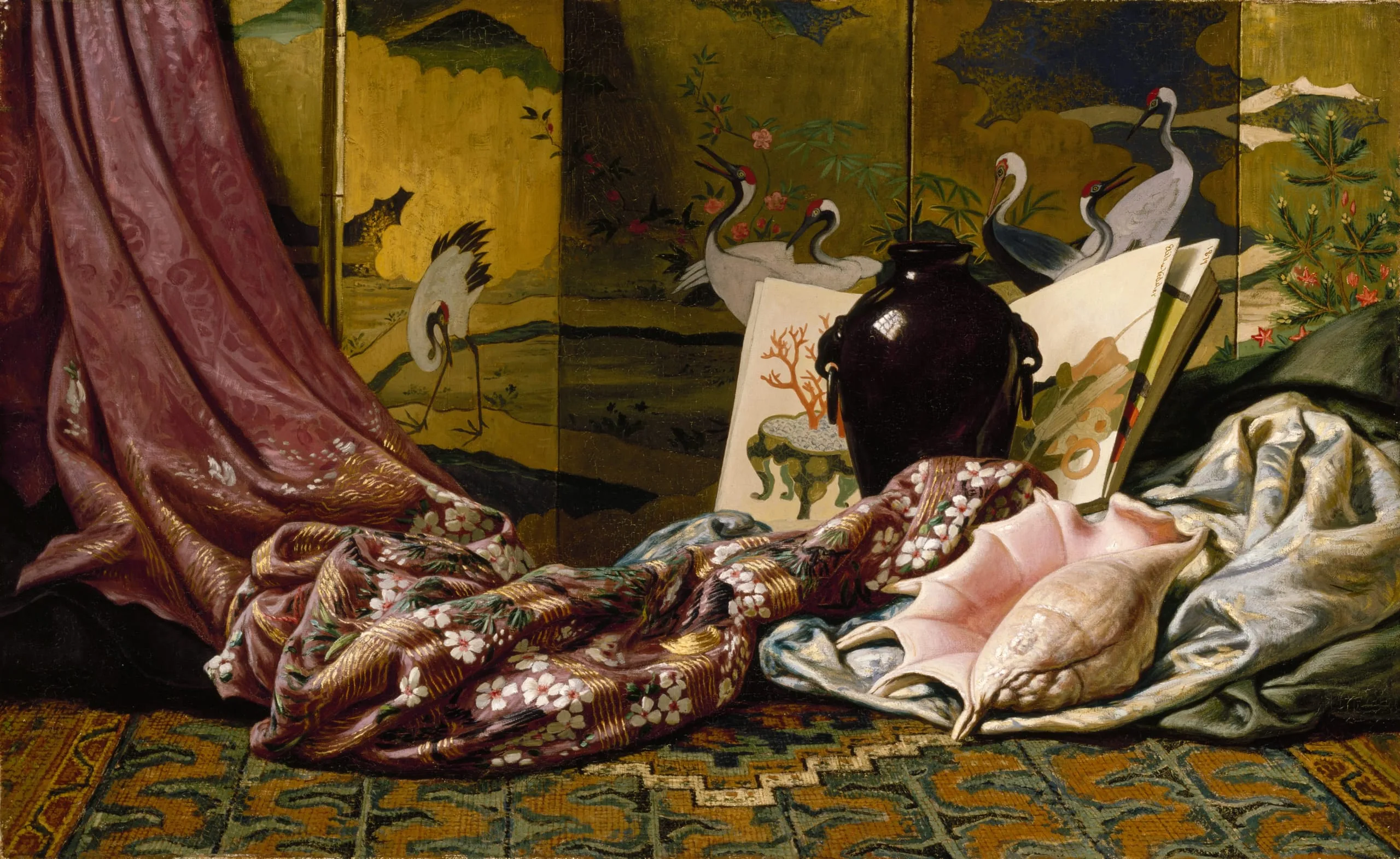
Vedder did few still-life paintings and only four of Japanese objects. The collecting of oriental bric-a-brac became very popular in America among artists and the general public with the initiating of trade relations between Japan and the West by Commodore Matthew C. Perry in 1853 and with the exhibition of many exotic objects at the 1876 Centennial Exhibition in Philadelphia. Vedder was particularly fortunate as a collector; for his brother Alexander Madison Vedder was a physician practicing in Japan from 1865 to 1870, first privately and then as head of the Imperial Hospital at Kobe. Dr. Vedder was well aware of the beauty and exoticism of oriental items and purchased many objects. After Alexander’s death in 1870, Vedder received three trunks containing his brother’s effects, including his Japanese purchases. The objects in Vedder’s Japanese still-life paintings may have been among them. This painting depicts nineteenth-century items: the golden heron screen in the style of the Kano school, a shiny, black Meijiperiod vase, an album of paintings with a bonsai on the left page, and a carpet probably of Japanese manufacture but with a Western-influenced design.
Despite his awareness of the nature of Japanese aesthetics, and unlike his friend Charles Caryl Coleman, who used the Japanese aesthetic in his still lifes of this period, Vedder conceived his painting in traditional Western terms. The arrangement resembles the way in which Japanese items were displayed at the 1876 Centennial and pictured in various books commemorating the fair. The manner in which Vedder luxuriated in the voluminous folds of the rich drapery reveals his long-standing love of elegant textiles, seen more often in his single-figure paintings of the 1870s.
During his lifetime Vedder exhibited still lifes that included oriental objects and were sometimes titled Japanese Still Life. It is possible that the museum’s example was the one exhibited in Vedder’s showings of 1880. However, since the painting was privately owned by then, it is unlikely that the museum’s painting was the still life included in Vedder’s 1900-1901 traveling exhibition or his exhibitions in New York and Boston in 1912.