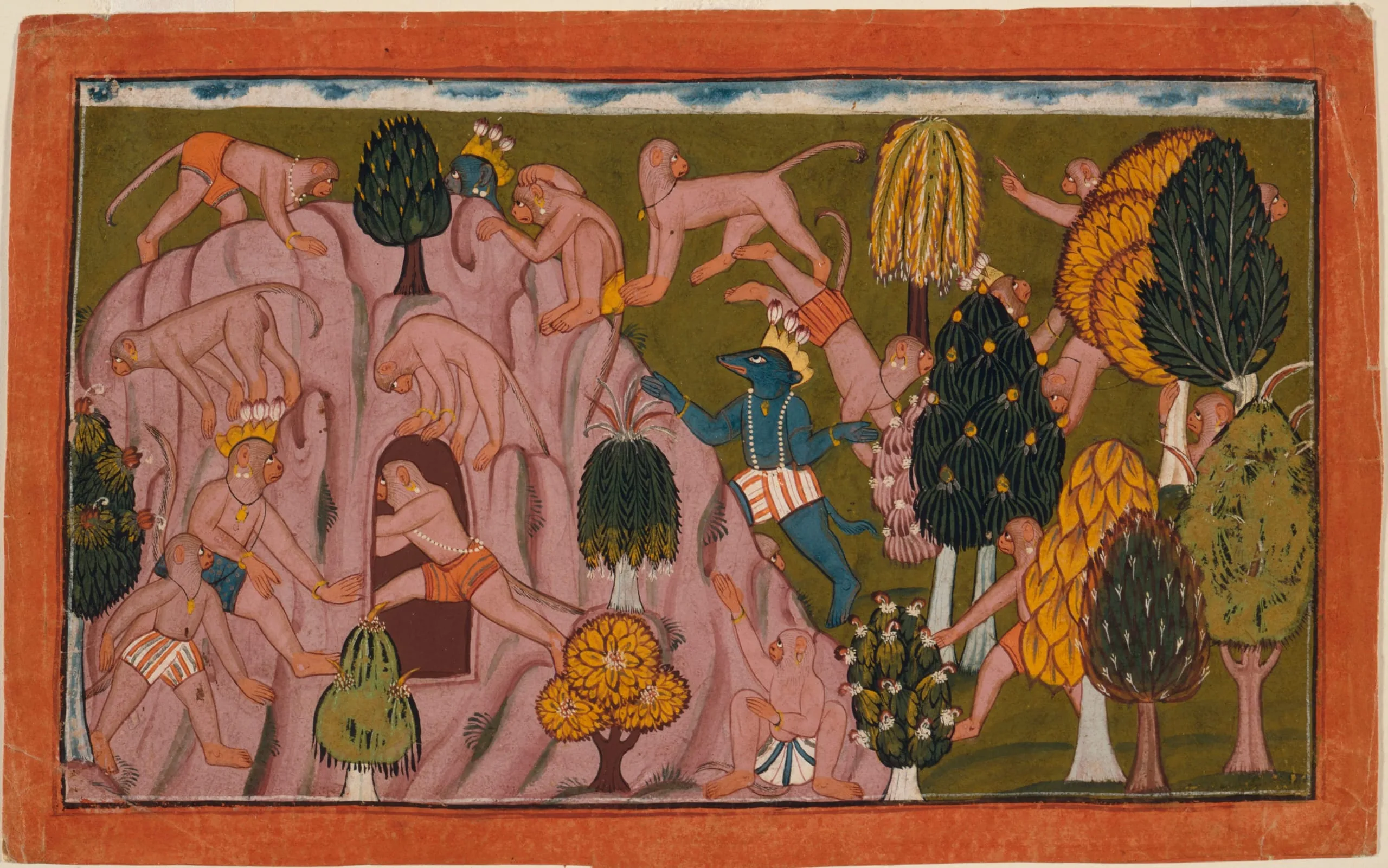
The Ramayana narrates the epic saga of the valiant Prince Rama and his dutiful wife, Princess Sita, who was abducted by Ravana, the arrogant ten-headed King of Lanka (probably modern Sri Lanka), during Rama's unjust fourteen-year forest exile from his capital of Ayodhya, Uttar Pradesh. To rescue Sita, Rama and his faithful brother Lakshmana assembled a great army of monkeys and bears led by the Monkey-King Sugriva and his Monkey-General Hanuman. After several magical battles, the princess was freed, and the happy couple triumphantly returned home to rule their kingdom. Rama and Sita epitomize the ideal ruler and the paragon of fidelity in Hindu culture.
This scene is from Book 4 (Kishkindha kanda) when the band of monkeys led by the Monkey-General Hanuman and the bears led by the Bear-King Jambavan search for Sita in the Vindhya mountains (Ramayana 4:49:1-4). Hanuman and Jambavan are shown multiple times throughout their search in a type of visual narrative called continuous narration.
This painting, and its series mates M.77.19.22, M.83.105.9, M.87.278.2, and M.91.348.2, are from a widely dispersed large series known as the “Shangri” Ramayana, so called because it was formerly in the ancestral collection of the Shangri branch of the royal family of Kulu, Himachal Pradesh. The series was dispersed in 1961. The National Museum, New Delhi has 168 folios.