- Title
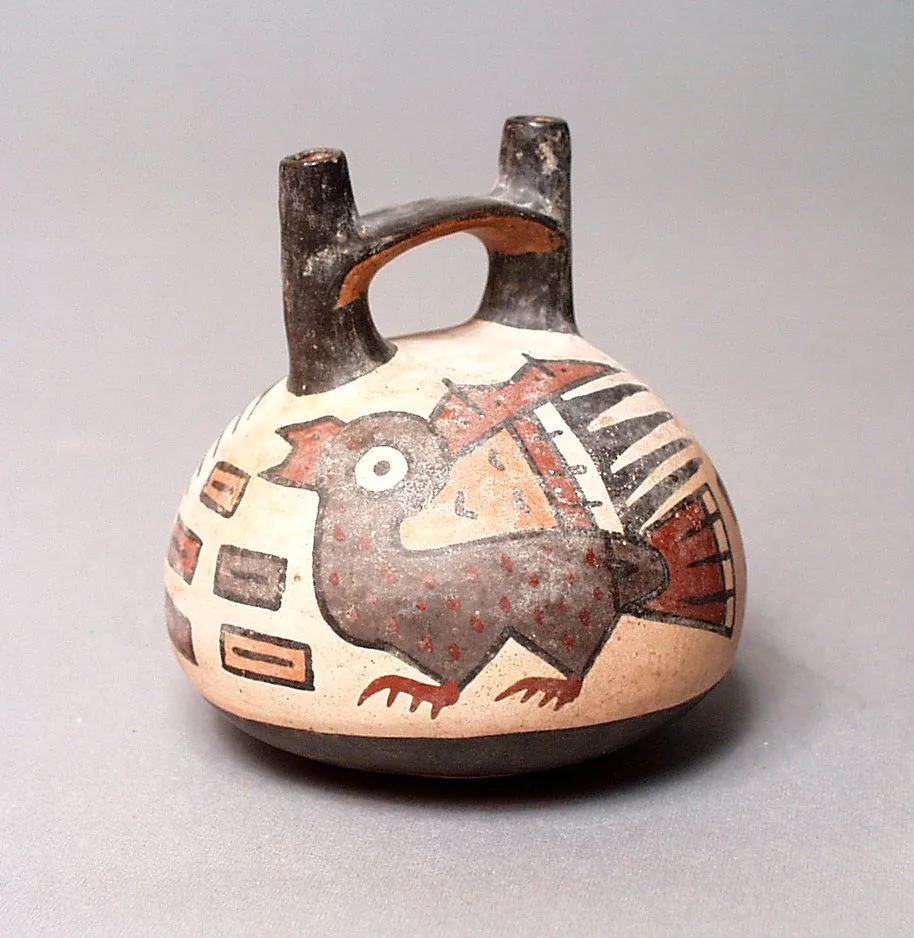
- Double Spouted Vessel with Vultures
- Date Made
- 100 BCE–200 CE
- Medium
- Ceramic, hand built, slip decorated, burnished fired.
- Dimensions
- 3 3/8 x 3 3/8 in. (8.57 x 8.57 cm)
- Accession Number
- M.73.48.22
- Curatorial Notes
These birds, with their long, curved necks and distinctive protrusion on the top of the beak, likely represent condors or vultures, carrion birds that can be observed soaring in wide circles in the sky or picking clean the carcasses of deceased animals on the ground. Their significance in Andean mythology as associated with both death and the sky realm is well attested in many cultures past and present (see also M.2010.115.309 and M.73.48.41). In fact, using just three small curved lines, the artist here has rendered a human face with closed eyes on the wing of each bird, likely representing a trophy head. Trophy-head hunting was a sacred Nasca practice, related to death and sacrifice in the service of fertility, regeneration, and rebirth. As is common on Nasca vessels, the design is repeated on both sides, with small rectangles in different colors floating between them.
This is a relatively small example of a Nasca double-spout-and-bridge vessel, a common form of bottle developed during the final centuries BCE on the coast of southern Peru. The exact function or meaning of this particular handle is not known; however, having two narrow spouts allows for airflow and hence the smooth pouring of liquid while still minimizing evaporation.
2025